Methods of Development: Narration, Cause-Effect & Comparison (College Board AP® English Language & Composition): Revision Note

This study guide introduces you to methods of development in AP Lang. It explains how writers use narration, cause-effect, comparison-contrast, definition and description to organize and develop arguments. It also shows how these methods help readers follow a writer’s line of reasoning, especially when evidence from sources is being integrated into a synthesis argument.
What are methods of development in AP Lang?
Methods of development are the organizational patterns writers use to develop ideas and guide readers through reasoning.
For example, a writer may:
Tell a brief story to illustrate a problem
Explain the causes and effects of a policy
Compare two possible solutions
Define a key term
Describe a situation so the audience understands the problem or issue
In a synthesis essay, methods of development help the writer decide how source material should be presented. One source may provide a narrative example, another may help explain cause and effect, and another may support a comparison between possible solutions. The writer’s reasoning should control the organization, while the sources support and develop that reasoning.
Common methods and related organizational patterns
Writers may develop ideas in many ways. Common methods of development include:
Exemplification
Narration
Description
Cause-effect
Classification and division
Comparison-contrast
Process
Definition
In AP Lang, however, instruction often focuses on the following methods: narration, cause-effect, comparison-contrast, definition and description. These five methods are especially useful because they help readers trace a writer’s reasoning in an argument.
Writers may also organize ideas through related patterns such as:
Chronological order
Spatial order
Problem-solution
Before-and-after
Old belief to new idea
These patterns often work inside the larger methods of development above.
Why methods of development matter for arguments
Methods of development matter because they help readers follow a writer’s line of reasoning. Also, each method develops an argument differently.
A writer who argues that a city should add shaded bus shelters at busy stops might use several methods:
Narration: describe a rider waiting for a bus in extreme heat
Cause-effect: explain how an exposed bus stop can discourage transit use
Comparison-contrast: compare shaded shelters with cheaper but less useful signs
Definition: define public transportation access as more than simply having a bus route
Description: describe what an unsafe or uncomfortable bus stop looks like
Without a clear method of development, a paragraph may feel like a list of disconnected ideas. With a clear method, the evidence becomes part of an organized, reasoned pattern.
The five typical methods of development
Method | What it does | Example use |
|---|---|---|
Narration | Tells a brief story or sequence of events | Describes one rider’s experience waiting at an uncovered stop |
Cause-effect | Explains why something happens or what results from it | Shows how lack of shade may affect transit use |
Comparison-contrast | Examines similarities and differences using the same categories | Compares shaded shelters with basic benches or signs |
Definition | Clarifies what a term or concept means | Defines “accessible transit” as more than route availability |
Description | Provides details, features or sensory information | Describes the conditions at a bus stop without seating or shade |
Narration as a method of development
Narration develops an idea through a story or sequence of events. In argument writing, narration is not storytelling for its own sake: the story should reveal something significant about the claim.
For example:
"A student leaves an after-school activity and walks to a bus stop with no shelter, no seating and no nearby shade. As the bus runs late, the student stands beside a busy road with a backpack and no place to escape the heat."
The narrative helps the audience to understand the experience behind a policy issue.
When narration works best
Narration works best when a writer wants to:
Make an abstract issue concrete
Introduce a consequence
Show how a problem unfolds over time
Help readers understand an experience
Create a context for later reasoning
Narration is especially useful when a source includes testimony, an interview, a personal account or a specific example.
How to write a narrative argument
To use narration effectively:
Select a story that clearly connects to the claim
Include only details that matter to the argument
Show the sequence of events clearly
Explain the significance of the story
Connect the narrative to the thesis
For example:
"A student leaves an after-school activity and walks to a bus stop with no shelter, no seating and no nearby shade. As the bus runs late, the student stands beside a busy road with a backpack and no place to escape the heat. Too often a student waits at an uncovered stop after practice, standing beside traffic for twenty minutes with no shade or seating. This example shows that transit access involves more than whether a bus route exists; it involves safe and usable conditions while waiting."
Note: the example above and the examples that follow provide a brief example rather than a fully developed paragraph. In a complete paragraph, the writer would use evidence and commentary to explain the connection more fully.
Cause-effect as a method of development
Cause-effect explains how one condition produces a result or how several causes lead to a consequence. A writer may focus on:
One cause and several effects
Several causes and one effect
A chain of causes and effects
Short-term and long-term consequences
For example:
"When a bus stop lacks shade, riders may experience discomfort and avoid using public transit during hotter parts of the day, or depend more heavily on cars and rides from others."
The reasoning links a physical condition to possible consequences.
When cause-effect works best
Cause-effect works best when a writer wants to:
Explain why a problem occurred
Show the consequences of a policy
Connect a decision to likely outcomes
Justify the urgency of a solution
Present a line of reasoning
Cause-effect is especially useful in synthesis when several sources address related causes or consequences.
How to write a cause-effect argument
To use cause-effect effectively:
Identify the cause
Identify the effect or effects
Explain the connection between them
Acknowledge other possible causes when necessary
For example:
"Although bus shelters alone will not determine whether people use public transportation, exposed stops make transit less practical for riders who must wait in heat, rain or heavy traffic. Uncomfortable waiting conditions may cause some riders to avoid the bus or depend more heavily on cars and rides from others. Over time, reduced ridership may weaken public support for expanded transit service. Improving waiting conditions may therefore remove one barrier to regular ridership."
Comparison-contrast as a method of development
Comparison-contrast develops reasoning by examining similarities and differences between two or more subjects. A comparison must use like-for-like categories, meaning that the writer should compare the same features across both subjects. For example, two solutions might be compared by their cost, effectiveness, safety, accessibility, long-term maintenance and impact on different groups. Using consistent categories creates a fair comparison and helps readers clearly understand the similarities and differences.
When comparison-contrast works best
Comparison-contrast works best when a writer wants to:
Evaluate two possible solutions
Show why one option is more effective
Clarify a difficult choice
Distinguish between two similar ideas
Qualify a claim by showing trade-offs
How to write a comparison-contrast argument
To use comparison-contrast effectively:
Identify the objects/subjects/ideas being compared
Establish categories of comparison
Apply the same categories to each option
Explain why the comparison matters
Connect the comparison to the claim
For example:
"Signs and shelters can both improve bus stops, but they address different needs. In terms of cost, signs are less expensive to install and maintain. In terms of function, however, signs primarily provide route and schedule information, while shelters offer shade, seating and protection from rain. Therefore, if the city’s main goal is to improve riders’ comfort and make regular transit use more practical, shelters are the more effective option despite their higher cost."
Definition and description as methods of development
Definition and description can both clarify an argument, but they serve different purposes. Definition explains what a term or concept means, while description explains what a person, place, object or condition is like.
Definition develops an argument by establishing the meaning of an important term or concept. A writer may clarify what the term includes, what it excludes and how it should be understood within the argument.
Description develops an idea by presenting specific details about a person, place, object or condition. In argument writing, these details should help readers understand an issue.
When definition works best
Definition works best when a writer wants to:
Clarify an unfamiliar or disputed term
Establish criteria for evaluating an issue
Distinguish between related concepts
Shape how readers understand the claim
When description works best
Description works best when a writer wants to:
Help readers visualize a condition
Make an unfamiliar issue easier to understand
Emphasize details that support a claim
Provide context for later analysis
How to choose the right method of development
Choose the method that best matches the purpose of the paragraph. The method should serve the line of reasoning.
Purpose | Best method |
|---|---|
Show what a problem feels like in real life | Narration |
Explain why a problem happens or what it causes | Cause-effect |
Evaluate two solutions | Comparison-contrast |
Clarify the meaning of a key idea | Definition |
Help readers visualize a situation | Description |
Worked example: annotated methods of development analysis
Prompt:
Develop a position on whether a city should prioritize adding shaded shelters at high-use bus stops
Sources:
Source | Main idea |
|---|---|
Source A | A transit survey reports that riders at several high-use stops identify heat, rain and lack of seating as common problems |
Source B | A city budget memo explains that shaded shelters cost more than signs or benches but last longer and provide more protection from exposure |
Source C | A photograph shows riders standing beside a busy road at an uncovered stop with no bench or nearby shade |
Source D | A community health article explains that heat exposure can be especially difficult for children, older adults and people with certain medical conditions |
Writer's position:
The city should prioritize shaded shelters at its busiest bus stops because a transit system is not fully accessible when riders have routes available but unsafe or uncomfortable places to wait
Paragraph using methods of development:
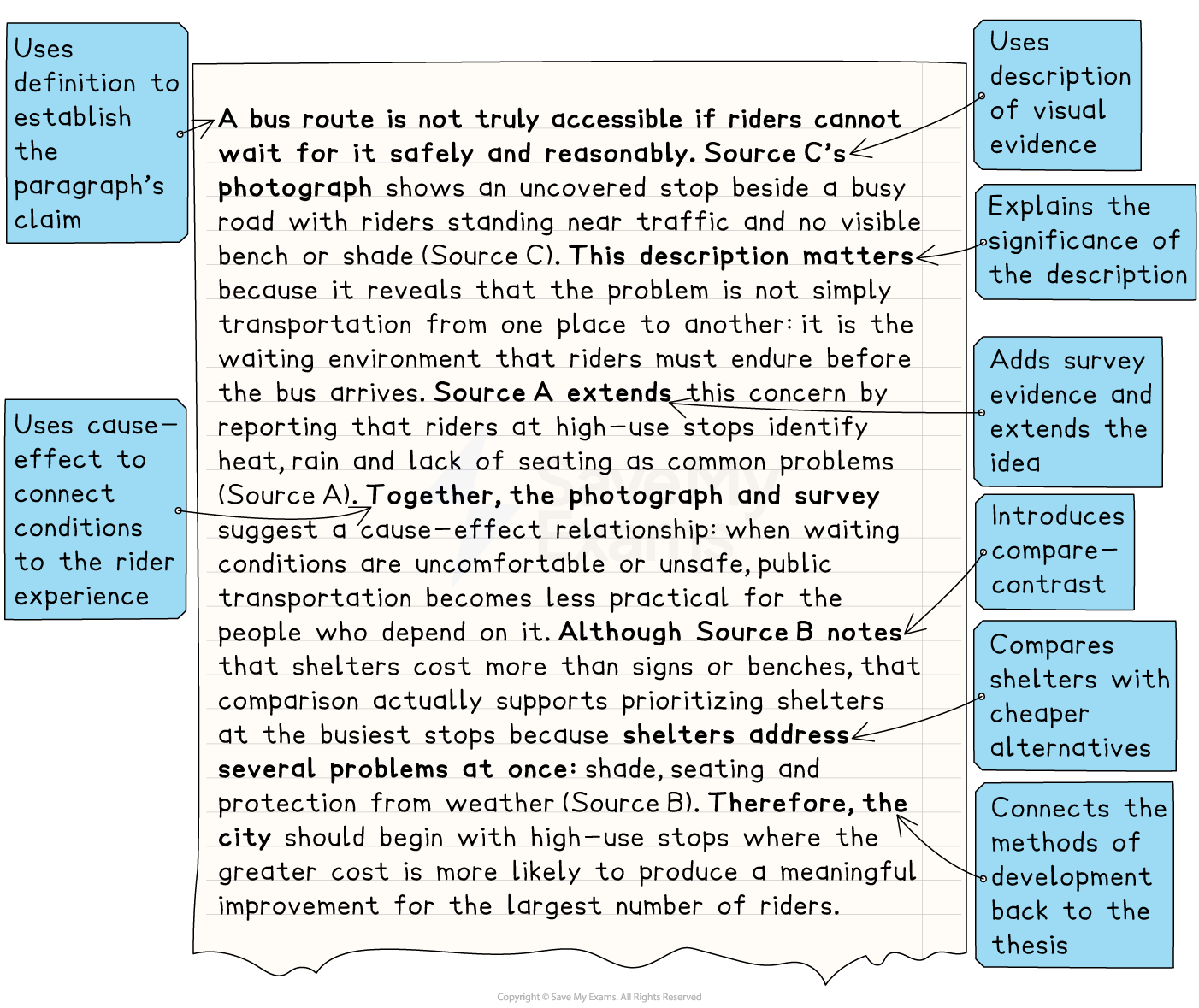
Why the paragraph is effective:
The paragraph:
Begins with the writer’s claim
Uses source evidence
Combines several methods of development purposefully
Explains how each method advances the reasoning
Compares options using clear categories
Connects the methods of development to the thesis
Tips on using methods of development
When analyzing a text, explain the function and how it develops the argument:
By using cause and effect to connect uncovered bus stops to discomfort and reduced transit use, the writer shows why shelter affects whether public transportation is practical
When writing an argument, match the method to the purpose:
Choose a method that advances your reasoning. The method should support a claim and strengthen the line of reasoning
Common mistakes when analyzing or using methods of development
The mistakes below apply both to analyzing how writers develop arguments in passages and sources, and to using methods of development in your own writing. In either case, the goal is not simply to name the method, but to explain how it advances the argument:
Naming the method without explaining its purpose
Using a method without connecting it to a claim
Choosing a method because it is familiar rather than useful
Treating organization patterns as separate arguments
Frequently asked questions
Can I combine multiple methods of development in one essay?
Yes. Most strong arguments combine methods. A writer may define a key term in the introduction, use cause-effect in one body paragraph, and compare possible solutions in another. The methods should work together to support the same line of reasoning.
Which method works best for the AP Lang argument essay (FRQ 3)?
No single method is always best. The best method depends on the prompt, the thesis and the evidence. Cause-effect is useful when explaining consequences. Comparison-contrast is useful when evaluating options. Narration is useful when a specific experience reveals a larger issue.
What's the difference between methods of development and rhetorical modes?
The two terms overlap. Rhetorical modes are broad patterns of writing, such as narration, description, definition, comparison and cause-effect. Methods of development are those same patterns viewed in terms of how they develop and organize an argument.
In AP Lang, the focus is less on memorizing the label and more on explaining how the method helps the writer advance a claim, connect evidence or guide the reader through the line of reasoning.
How are methods of development different from organization patterns?
Methods of development are ways writers build and explain ideas. Organizational patterns are ways writers arrange those ideas. The categories overlap, but the goal is the same in that both help the reader to follow the writer’s reasoning.
For example:
Narrative may use chronological order
Description may use spatial order
Cause-effect may support a problem-solution structure
Comparison-contrast may show a shift from old belief to new belief
How are methods of development tested in MCQs?
In multiple-choice passages, you may be asked how a paragraph or section develops an idea. A question might ask why a writer includes an anecdote, what effect a comparison has or how a cause-effect relationship supports an argument.
Key terms and glossary
Analogy: a comparison used to explain or clarify an idea by relating it to something more familiar
Before-and-after organization: an arrangement that compares conditions before and after a change
Cause-effect: a method of development that explains why something happens or what consequences result
Chronological order: an arrangement of events or ideas in time order
Classification and division: a method of development that organizes a subject into categories or parts
Comparison-contrast: a method of development that examines similarities and differences between subjects using like categories
Definition: a method of development that clarifies the meaning or boundaries of a term or idea
Description: a method of development that uses details, features or sensory information to help readers understand a subject
Exemplification: a method of development that uses examples to illustrate or prove a point
Method of development: an approach used to develop and organize the reasoning in an argument
Narration: a method of development that uses a story or sequence of events to illustrate a point
Old belief to new belief: an arrangement that shows how understanding changes because of new evidence or reasoning
Organizational pattern: the order or structure used to arrange ideas in a paragraph, passage or essay
Problem-solution: an arrangement that identifies a problem and then presents a response or solution
Process: a method of development that explains steps in a procedure or sequence
Rhetorical mode: a broad pattern of writing, such as narration, description, definition, comparison or cause-effect
Sequence: the order in which ideas, events or reasons are presented
Spatial order: an arrangement that describes a place, object or scene according to physical location
Synthesis argument: an argument that integrates ideas and evidence from multiple sources into the writer's own reasoning

Unlock more, it's free!
Join the 100,000+ Students that ❤️ Save My Exams
the (exam) results speak for themselves:

Was this revision note helpful?