Qualitative Analysis (OCR AS Chemistry A): Revision Note
Exam code: H032

Halide Ions
Halide ions can be identified in an unknown solution by dissolving the solution in nitric acid and then adding silver nitrate solution dropwise
The nitric acid is to prevent any false positive results from carbonate ions precipitating out with silver ions
The halide ions will react with the silver nitrate solution as follows:
Ag+ (aq) + X- (aq) → AgX (s)
(ionic equation)
Where X- is the halide ion
The state symbols are key in this equation
If the unknown solution contains halide ions, a precipitate of the silver halide will be formed (AgX)

A silver halide precipitate is formed upon addition of silver nitrate solution to halide ion solution
Silver chloride (AgCl) is a white precipitate
Silver bromide (AgBr) is a cream precipitate
Silver iodide (AgI) is a yellow precipitate

The silver halide precipitates are dense and characteristically coloured
Adding ammonia
Because the white, cream and yellow precipitates could look very similar in colour, ammonia is often used as a follow up test to determine which halide ion is present
Dilute followed by concentrated ammonia is added to the silver halide solution to identify the halide ion
If the precipitate dissolves in dilute ammonia the unknown halide is chloride
If the precipitate does not dissolve in dilute, but does dissolve in concentrated ammonia the unknown halide is bromide
If the precipitate does not dissolve in dilute or concentrated ammonia, then the unknown halide is iodide

Silver chloride and silver bromide precipitates dissolve on addition of ammonia solution whereas silver iodide is insoluble in ammonia
Reaction of Halide Ions with Silver Nitrate & Ammonia Solutions
Halide ion | Colour of silver halide precipitate | Effect of adding dilute ammonia solution to the precipitate | Effect of adding concentrated ammonia solution to the precipitate |
|---|---|---|---|
Cl- (aq) | white | dissolves | dissolves |
Br- (aq) | cream | remains insoluble | dissolves |
I- (aq) | yellow | remains insoluble | remains insoluble |
Qualitative Analysis of Ions
When identifying an unknown solution containing multiple ions, tests must be carried out in the correct order:
Carbonate: tested first, as both BaCO3 and Ag2CO3 are insoluble and would interfere with later tests
Sulfate: tested second, as Ag2SO4 is insoluble and would give a false positive in the halide test
Halide: tested last, once carbonates and sulfates have been eliminated
Examiner Tips and Tricks
The hydrochloric acid used in the sulfate test also removes any remaining carbonate ions, and nitric acid in the halide test removes any remaining carbonate ions, but nitric acid does not remove sulfate ions.
If sulfate is present, add excess barium nitrate solution and filter off the BaSO4 before the halide test, because Ag2SO4 is also insoluble.
When testing a mixture for halides, use nitric acid and barium nitrate rather than hydrochloric acid and barium chloride, so that no chloride ions are added.
Test for Carbonates
A small amount (around 1 cm3) of dilute hydrochloric acid should be added to a test tube using a pipette
An equal amount of sodium carbonate solution should then be added to the test tube using a clean pipette
As soon as the sodium carbonate solution is added, a bung with a delivery tube should be attached to the test tube
The delivery tube should transfer the gas which is formed into a different test tube that contains a small amount of limewater (calcium hydroxide solution)
If a carbonate compound is present then effervescence should be seen and the gas produced is CO2 which forms a white precipitate of calcium carbonate when bubbled through limewater:
CO32- (aq) + 2H+ (aq) → CO2 (g) + H2O (l)
CO2 (g) + Ca(OH)2 (aq) → CaCO3 (s) + H2O (l)

Limewater turns milky in the presence of CO2 caused by formation of insoluble calcium carbonate
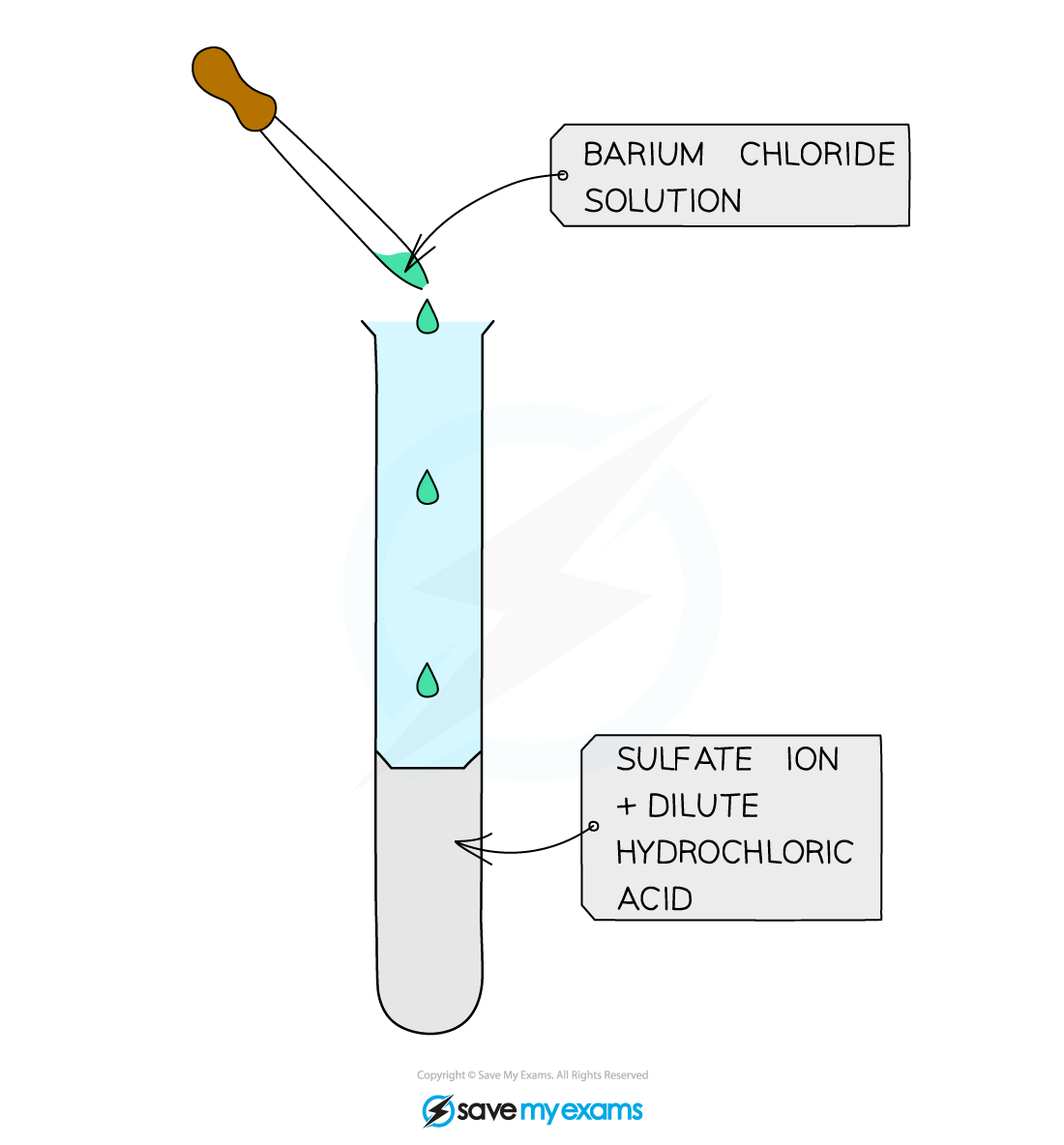
Test for Sulfates
Acidify the sample with dilute hydrochloric acid and then add a few drops of aqueous barium chloride
If a sulfate is present then a white precipitate of barium sulfate is formed:
Ba2+ (aq) + SO42- (aq) → BaSO4 (s)
The test can also be carried out with barium nitrate solution
Testing for ammonium ions
We can test for the presence of ammonium ions, NH4+, by reacting with warm aqueous sodium hydroxide forming ammonia gas
NH4+ (aq) + OH- (aq) → NH3 (g) + H2O (l)
Ammonia gas is produced. You are unlikely to see gas bubbles as ammonia is very soluble in water
Ammonia gas can be identified by its pungent smell or by turning red litmus paper blue

Unlock more, it's free!
Join the 100,000+ Students that ❤️ Save My Exams
the (exam) results speak for themselves:

Was this revision note helpful?
Build on this topic