Forces & Momentum (Edexcel International A Level (IAL) Physics): Exam Questions

Exam code: YPH11

1 hour17 questions
1a
2 marks

An aluminium sphere collides head-on with a stationary steel sphere. The two spheres move off separately after the collision.

State the principle of conservation of momentum.

1b
3 marks

The aluminium sphere has an initial velocity of 10.0 m s–1. Immediately after the collision the velocity of the steel sphere is 5.0 m s–1.

q12b-wph11-01-oct-2021-edexcel-int-as-and-a-level-phy

Calculate the velocity v of the aluminium sphere immediately after the collision.

mass of aluminium sphere = 2.7 kg

mass of steel sphere = 7.9 kg

v = .............................................

2a
2 marks

A slow moving asteroid A was hit by a faster asteroid B. Asteroid B was absorbed by asteroid A as shown.

q11-wph11-01-jan-2022-edexcel-int-as-a-level-phy

State the principle of conservation of linear momentum.

2b
5 marks

Before the collision, asteroid A had a velocity of 2.19 × 10³ m s−1 and a momentum of 1.80 × 10¹⁷ kg m s−1.

i) Show that the mass of asteroid A was about 8.2 × 10¹³ kg.                      (2)

  ii) Calculate the velocity of the asteroids after the collision.

mass of asteroid B = 5.90 × 10¹² kg

velocity of asteroid B before the collision = 15.0 × 10³ m s−1               

Velocity of asteroids = .................................(3)

3a
2 marks

A railway carriage of mass 7.15 × 10⁴ kg moving at 4.50 m s−1 collides with a second railway carriage of mass 5.35 × 10⁴ kg moving in the same direction.

The carriages join together. Immediately after the collision they move at a speed of 3.62 m s−1 .

Show that the total momentum of the carriages immediately after the collision was approximately 4.5 × 10⁵ kg m s−1 .

3b
2 marks

Calculate the velocity of the second carriage before the collision.

Velocity of second carriage = ..........................

3c
2 marks

Calculate the change in total kinetic energy during the collision.

Change in total kinetic energy = ............................

4
6 marks

A large spacecraft is made up of several ‘stages’. Each stage consists of a rocket motor and a fuel tank. Once a stage has used all its fuel, the rocket motor in that stage shuts down. The stage then disconnects from the spacecraft and falls back to Earth.

Two diagrams of a two-stage rocket. Before shut-down, the second stage, with the astronauts in its nose, sits on top of the first stage, whose motors are firing. After shut-down, the first stage has separated and is below the second stage

As the rocket is rising due to the upward force of the first stage, an astronaut feels himself pushed further and further back, compressing the back of his seat.

When the first stage shuts down, the astronaut is suddenly projected forwards by the seat. The astronaut is held in place by a safety strap.

Explain the effects experienced by the astronaut. You may assume that the force provided by the first stage rocket motor is constant until the moment it shuts down.

5
4 marks

A helicopter can hover in a fixed position as shown.

q112-wph14-04-jan-2022-edexcel-int-as-a-level-phy

The helicopter blades move air vertically downwards.

Explain how this enables the helicopter to maintain a constant height above the ground.

6a
3 marks

A student determines the acceleration of free fall g using a trolley on a ramp.

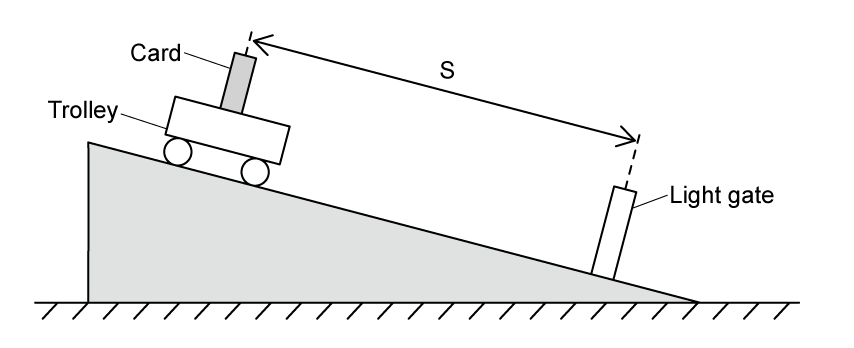
The trolley is released from rest and moves down the ramp. A card attached to the trolley interrupts a light gate near the bottom of the ramp, as shown.

A trolley with a vertical card mounted on top rests near the top of a ramp that slopes down to the right. A light gate stands across the ramp surface near the bottom of the slope. A double-headed arrow labelled s spans the distance along the ramp between the centre of the card and the light gate.

The student varies the distance s between the release position and the light gate. For each value of s, the student determines the velocity v of the trolley as it passes through the light gate.

Describe the measurements that need to be made using this apparatus and how they are used to determine v and s.

6b
2 marks

Explain why a graph of v2 against s gives a straight line through the origin.

6c
2 marks

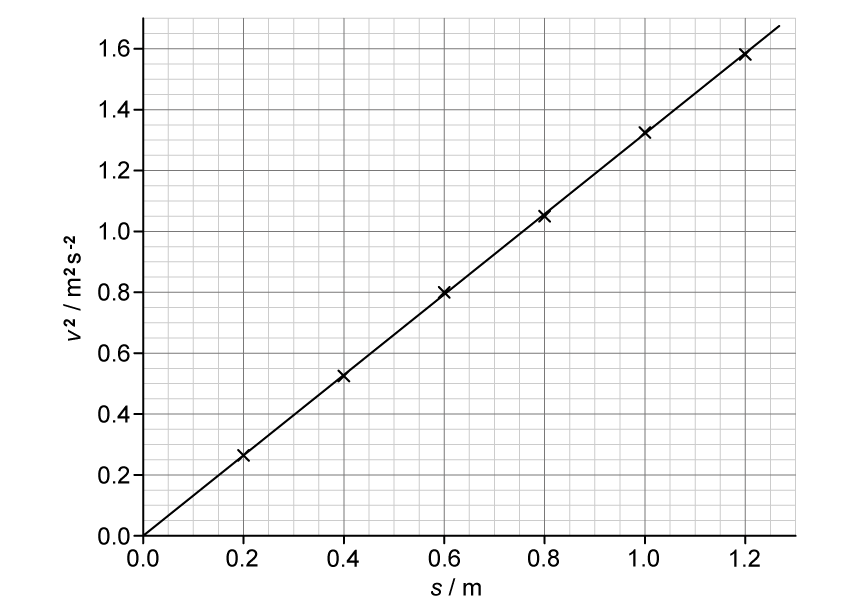
The student plotted a graph of v2 against s, as shown.

Graph of v squared against s, with a straight best-fit line through the origin. s runs from 0 to 1.3 metres and v squared from 0 to 1.7 metres squared per second squared; plotted points include (0.2, 0.26) and (1.2, 1.58).

The ramp is inclined at an angle of 4.0° to the horizontal.

Determine a value for g using the graph.

6d
1 mark

The student's value for g is less than 9.81 m s-2.

Give a reason for this difference.

7a
2 marks

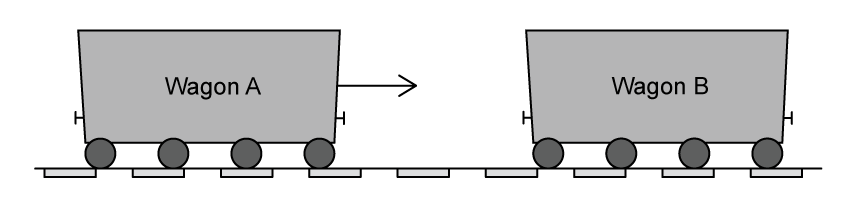
The diagram shows two freight wagons, A and B, on a straight, horizontal railway track.

Wagon A moves towards wagon B. Wagon B is stationary. Wagon A collides with wagon B, and the wagons join together.

Two wagons on a horizontal railway track. Wagon A moves to the right towards stationary wagon B.

State the principle of conservation of momentum.

7b
2 marks

Explain how Newton's second and third laws show that the momentum of the wagons is conserved during the collision.

7c
3 marks

Before the collision, wagon A moved with a velocity of 3.0 m s−1.

An operator claims that, after the collision, the wagons move at more than half the original speed of wagon A.

Assess whether this claim is correct.

mass of wagon A =8000 kg

mass of wagon B =16000 kg

1
6 marks

A student of weight 600 N is standing on weighing scales in a lift. The scales are calibrated to give readings in newtons.

A student standing on weighing scales on the floor of a lift, which hangs from a single cable

The lift moves upwards at constant velocity, then decelerates to rest. As the lift moves, the student looks at the readings on the scales.

Explain the readings on the scales.

2a
6 marks

A delivery drone rises vertically from rest. It then hovers above a garden before descending at constant velocity.

Explain how the forces acting on the drone change during the flight, with reference to Newton's laws of motion.

2b
2 marks

The mass of the drone is 0.90 kg. At take-off, the upward lift force on the drone is 12.2 N.

Show that the initial acceleration of the drone is about 4 m s−2.

2c
2 marks

The drone descends at constant velocity.

Explain the energy transfers taking place during the descent.