Thermal Energy Transfer (Edexcel International A Level (IAL) Physics): Exam Questions

Exam code: YPH11

41 mins7 questions
1
Sme Calculator
5 marks

Cocoa powder, milk and hot water are mixed together to produce a ‘hot chocolate’ drink. The mass of the drink is 275 g, and its initial temperature is 71.5 °C.

Ice at 0.0 °C is added to the drink to reduce its temperature. Research indicates that the maximum serving temperature of any hot drink should be 58.0 °C.

Deduce whether 4.0 g of ice would be enough to bring the temperature below 58.0 °C.

specific latent heat of ice = 3.34 × 10⁵ J kg–1

specific heat capacity of ‘hot chocolate’ = 3750 J kg–1 °C–1 \

specific heat capacity of water = 4190 J kg–1 °C–1

2
Sme Calculator
4 marks

A kettle was used to heat 855 g of water to boiling point. The initial temperature of the water was 21.5 °C and it took 115 s to heat the water to 100 °C.

The kettle is left switched on for 175 s after the water has reached 100 °C.

Calculate the mass of water that was boiled away.

specific heat capacity of water = 4190 J kg−1 K−1

specific latent heat of vaporisation of water = 2.26 × 10⁶ J kg−1

Mass of water that was boiled away = .........................................

3
Sme Calculator
6 marks

In the book Charlie and the Chocolate Factory, a palace is made entirely from chocolate.

Soon after it was made the palace melted, due to energy transfer from the Sun.

q13-wph15-05-june-2021-edexcel-int-as-and-a-level-phy

The total volume of chocolate used for the palace was 1250 m3. The initial temperature of the chocolate palace was 28.5°C. Chocolate melts at a temperature of 36.0°C.

The book states that the palace melted completely in less than a day.

Deduce whether this statement could be correct.

rate of energy transfer to the palace = 7.5 × 10⁵ W

density of chocolate = 1325 kg m−3

specific latent heat of chocolate = 4.5 × 10⁴ J kg−1

specific heat capacity of chocolate is 1.30 × 10³ J kg−1 K−1

4a
2 marks

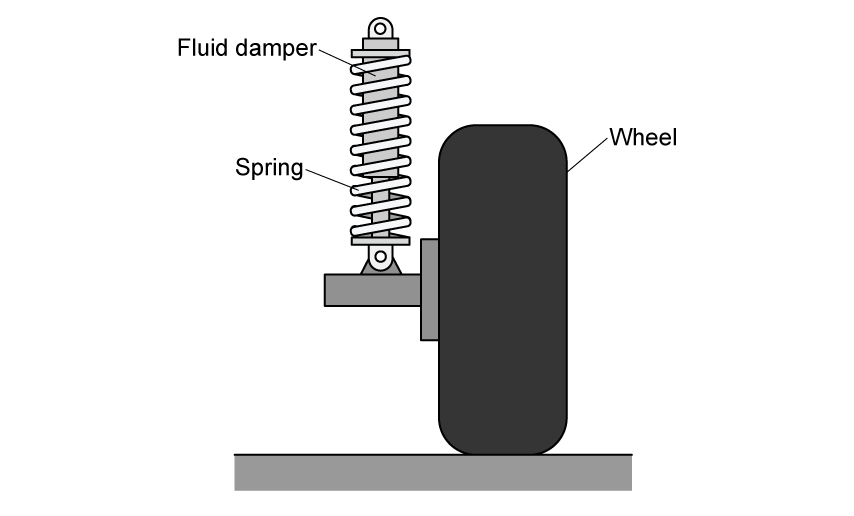
A car suspension system includes a spring and a fluid damper attached to each wheel, as shown.

A car suspension showing a vertical spring and fluid damper assembly mounted beside a single wheel resting on the road surface

When the car is driven over a bump in the road, it oscillates vertically with simple harmonic motion. On a long stretch of road with equally spaced bumps, the amplitude of the oscillations increases at a particular speed.

Explain why the amplitude of vertical oscillations becomes very large at a particular speed.

4b
Sme Calculator
4 marks

When a person of mass 65 kg steps into the car, the vertical height of the car above the road decreases by 0.8 cm.

The greatest amplitude of oscillation occurs when the bumps are spaced 12.0 m apart.

Calculate the speed at which the car is driven along the road. You should consider the car as a mass‑spring system.

mass of empty car = 1100 kg

4c
2 marks

The oscillations are heavily damped by the fluid dampers on each wheel.

The graph shows how the vertical displacement of the car varies with time for an undamped suspension system after it passes over a bump in the road.

Graph with axes of displacement against time, with a trace of the original sinusoidal wave

Sketch, on the axes below, a graph to show how the vertical displacement of the car varies with time for the damped system over the same time interval.

Graph of displacement against time showing a smooth sinusoidal wave oscillating above and below a horizontal zero line, representing simple harmonic motion
4d
3 marks

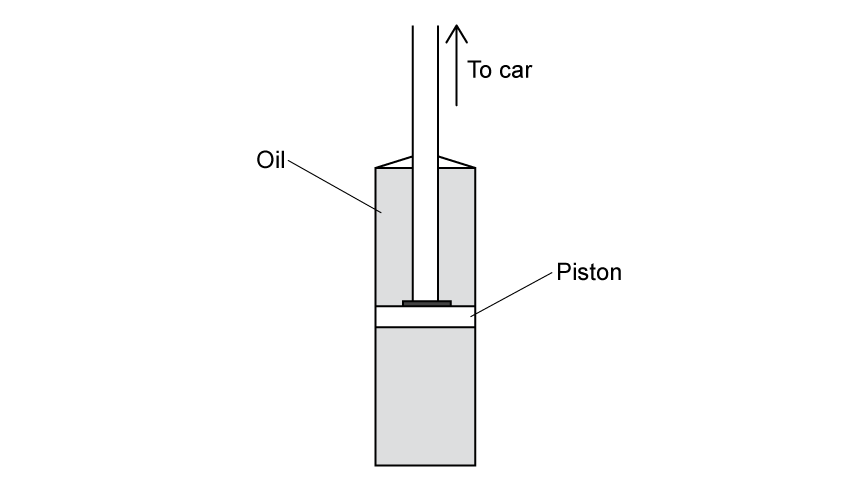
The fluid damper consists of a piston moving within a cylinder filled with oil. The oil has a high viscosity.

A vertical hydraulic cylinder filled with oil and containing a piston, with an upward arrow marked “to car”.

Explain how the fluid dampers produce heavy damping.

4e
Sme Calculator
5 marks

Each fluid damper contains 0.25 kg of oil. Every time the car passes over a bump, 90 J of mechanical energy is transferred to the oil in each damper.

The car is driven along the bumpy road for 15 minutes. Heat is lost from the damper to the surrounding air at a steady rate of 80 W during operation.

The damper oil has a safe operating limit of 130 °C.

Assess whether the damper oil exceeds its safe operating limit during the drive.

specific heat capacity of damper oil = 1800 J kg1 K1

temperature of surroundings = 20 °C

5a
6 marks

A student carried out an experiment to determine the latent heat of vaporisation of an unknown alcohol.

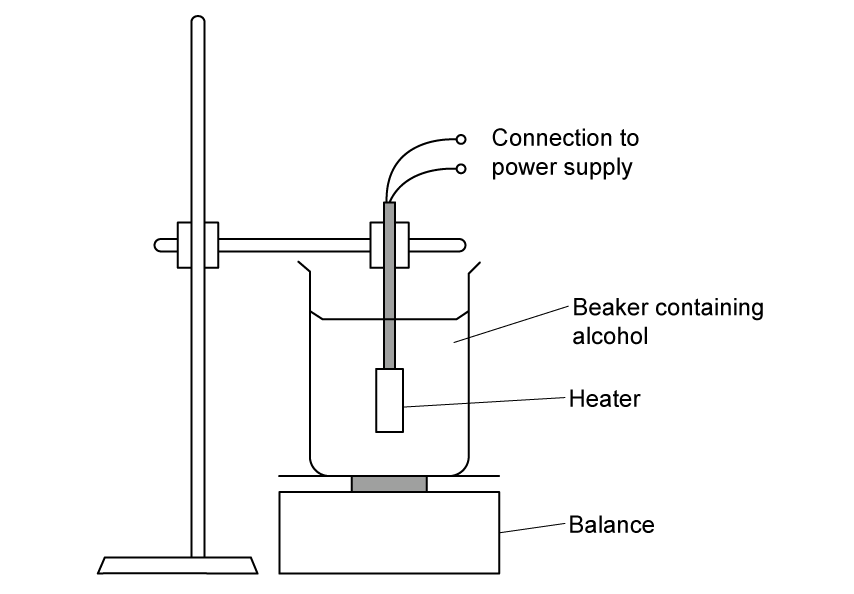
The student used an electrical heater to boil the alcohol in a beaker. She connected the heater to a circuit and adjusted the power P supplied to the heater by varying the potential difference and current in the circuit.

A beaker on a digital balance containing alcohol with a submerged electrical heater connected to an external power supply.

When the alcohol was at its boiling point, the student monitored the change in mass m of alcohol in the beaker over a period of 75 s. She repeated the experiment for different values of power P supplied to the heater and plotted her results on the graph.

Scatter plot with mass in grams on the x-axis and power P in watts on the y-axis showing five data points and a line of best fit.

The student used her graph to determine a value for the latent heat of the alcohol in the beaker. She concluded that the alcohol was propanol.

Liquid

Latent heat of vaporisation / MJ kg1

methanol

1.10

ethanol

0.85

propanol

0.79

butanol

0.58

Comment on the validity of the student’s conclusion.

5b
2 marks

Explain one modification to this method which would improve the accuracy of the student's conclusion.