Interference & Stationary Waves (Edexcel International A Level (IAL) Physics): Exam Questions

Exam code: YPH11

46 mins11 questions
1a
Sme Calculator
2 marks

In an experiment to determine the speed of sound in air, a student held a vibrating tuning fork above a glass tube. The air column in the tube could be adjusted by raising or lowering the tube into a cylinder containing water. When the length of the air column was l, a stationary wave with one node and one antinode was produced as shown.

This caused a sound to be heard.

q12-wph12-02-oct-2021-edexcel-int-as-and-a-level-phy

Explain how the stationary wave was formed in this experiment.

1b
Sme Calculator
5 marks

i) A sound was heard when l was 19.3 cm.

Determine a value for the speed of sound in air.

frequency of tuning fork = 440 Hz

Speed of sound in air = .......................................(3)

ii) The antinode is slightly further from the water than the end of the glass tube.

Explain how this would affect the accuracy of your calculated value for the speed of sound.

(2)

1a
Sme Calculator
1 mark

A student investigated stationary waves on a string, using the apparatus shown.

q15-wph12-02-jan-2022-edexcel-int-as-a-level-phy

The frequency f of the vibrator was adjusted until a stationary wave was formed with a node at each end. This was repeated for various stationary waves on the string. A metre rule was used to measure the distance d between adjacent nodes on the string.

The resolution of the metre rule was 1 mm, but the measurements were recorded to the nearest 0.5 cm.

Suggest why.

1b
Sme Calculator
7 marks

The student plotted a graph of d against 1/f as shown.

q15b-wph12-02-jan-2022-edexcel-int-as-a-level-phy

i) Determine the total mass of the hanging masses used in the investigation. Mass per unit length of string = 4.5 × 10⁻⁴ kg m–1

Total mass of hanging masses = ............................(5)

ii) The string was replaced with one that had twice the mass per unit length.

The length of the string and the mass of the hanging masses did not change.

Add a line to the graph to show how d varied with 1/f for the new string.

(2)

2a
1 mark

The interference of microwaves can be investigated in the laboratory using a microwave transmitter and receiver. A coherent beam of microwaves is directed at two slits, S1 and S2, formed between metal plates, as shown.

A microwave transmitter, two slits in metal plates, and a receiver moving vertically along screen AB at points O, P and Q to detect transmitted waves

Describe what is meant by a coherent beam.

2b
3 marks

As the receiver is moved along line AB, alternate points of maximum and minimum readings are detected.

Explain why maximum and minimum readings are detected.

2c
Sme Calculator
3 marks

The receiver detects a maximum reading at point O, which is equidistant from the two slits.

The next two maximum readings are detected at P and Q.

Point Q is 85 cm from S1 and 75 cm from S2.

Three common microwave bands and their corresponding frequencies are given in the table.

Band

Frequency / GHz

S

2–4

C

4–8

X

8–12

Deduce the band of the microwaves used in this experiment.

1a
Sme Calculator
3 marks

A student investigated the reflection of microwaves from a metal plate and a glass plate.

The metal plate reflects microwaves and the glass plate partially reflects microwaves.

A plan view of the apparatus is shown.

q2-wph13-03-oct-2021-edexcel-int-as-and-a-level-phy

The metal plate, the transmitter and the receiver were kept in fixed positions.

The value of d was varied by moving the glass plate.

As d varied, the intensity of the microwaves detected by the receiver varied.

Explain why.

1b
Sme Calculator
5 marks

The student recorded values of d when the receiver showed a maximum value of intensity.

He recorded d for a sequence of five maxima.

Maxima

1

2

3

4

5

d / cm

9.9

11.1

12.7

13.9

15.4

i) Determine the wavelength of the microwaves being transmitted.

Wavelength = .......................................... (3)

ii) Calculate the frequency of the microwaves being transmitted.

Frequency = ...........................................(2)

2a
6 marks

A student uses a microwave oven to investigate standing waves. They remove the rotating turntable from the oven and place a bar of chocolate inside, so it lies flat and remains stationary, as shown.

A microwave oven showing the oven wall, a bar of chocolate on the base, and a microwave source on the right side.

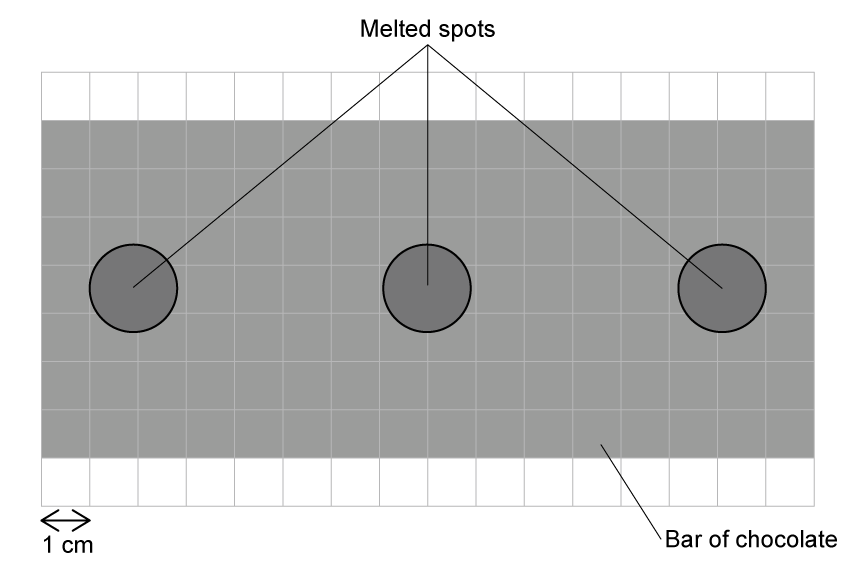
The microwaves are switched on until a pattern of melted spots forms on the chocolate, as shown.

A rectangular chocolate bar grid with three dark circular melted spots in a row, each separated by 6 small grid squares. Each square has a length of 1 cm.

Explain how the standing wave pattern of melted spots forms.

2b
Sme Calculator
3 marks

Determine the frequency of the microwaves used by the oven.

2c
1 mark

Explain why it was necessary for the student to remove the rotating turntable before switching on the microwave oven.