Waves, Electrons & Photons (Edexcel International A Level (IAL) Physics): Exam Questions

Exam code: YPH11

1 hour13 questions
1a
Sme Calculator
4 marks

Rolled steel joists (RSJs) are used in the construction of buildings, as shown.

q12-1-wph12-02-jan-2022-edexcel-int-as-a-level-phy

The strength of an RSJ is greatly reduced if there are air gaps within the steel.

Ultrasound is used to detect any air gaps in the RSJ.

Pulses of ultrasound are sent by a transducer into an RSJ as shown. Any returning ultrasound is detected by the transducer.

q12-2-wph12-02-jan-2022-edexcel-int-as-a-level-phy

Explain how this arrangement can be used to show whether the RSJ contains an air gap.

1b
Sme Calculator
3 marks

Ultrasound is a sound wave with a frequency greater than 20 kHz. The frequency of ultrasound used by the transducer in this method is 5 MHz.

Explain why a much higher frequency than 20 kHz is needed in this method.

2a
Sme Calculator
4 marks

A laser, a diffraction grating and a screen are set up as shown. The laser emits monochromatic light.

q14-wph12-02-jan-2022-edexcel-int-as-a-level-phy

When the laser is switched on, a series of bright dots is seen on the screen.

The diagram below shows the position of the central dot at O. The next bright dot appears at position X.

The diffraction grating has 450 lines per mm.

q14a-wph12-02-jan-2022-edexcel-int-as-a-level-phy

Determine the wavelength of the light from the laser.

Wavelength = ..................................

2b
Sme Calculator
3 marks

Explain why a series of bright dots is seen on the screen.

2c
Sme Calculator
2 marks

The laser is replaced by a source producing a parallel beam of bright white light.

Suggest what would now be observed on the screen.

3a
Sme Calculator
4 marks

Sirius A is the brightest star in the night sky and is mostly composed of hydrogen.

When light from Sirius A passes through the hydrogen in the outer layers of the star, some light is absorbed. This causes electrons in the hydrogen to be excited.

The diagram shows an electron being excited from the –3.40 eV level to the –1.50 eV level.

q18a-wph12-02-jan-2022-edexcel-int-as-a-level-phy

The wavelengths of the different colours of visible light are shown in the table below.

violet

blue

green

yellow

orange

red

380–450 nm

450–495 nm

495–570 nm

570–590 nm

590–620 nm

620–750 nm

Deduce the colour of the visible light that caused the electron transition shown in the diagram.

3b
Sme Calculator
4 marks

A light year is the distance travelled by light in one year.

Sirius A is 8.60 light years from Earth. The intensity of radiation from Sirius A received on Earth is 1.17 × 10⁻⁷ W m–2.

Calculate the power of Sirius A.

Power of Sirius A = ...........................

3c
Sme Calculator
2 marks

When hydrogen gas is excited in the laboratory, only certain wavelengths of light are emitted.

Explain why.

4a
Sme Calculator
3 marks

ICESat-2 is a satellite launched into space by NASA in 2018. One purpose of the satellite is to measure the thickness of ice on the Earth’s surface. The satellite is powered using solar panels. A laser in the satellite produces a beam of photons, which travel to the Earth and back.

Calculate the intensity of solar radiation as it reaches ICESat-2.

distance from the Sun to ICESat-2 = 1.50 × 10¹¹ m    

power of the Sun = 3.83 × 1026 W

Intensity of solar radiation = ........................................

4b
Sme Calculator
3 marks

The laser emits light with a wavelength of 532 nm. Calculate the energy, in J, of each photon.

Energy of photon = ...................................... J

4c
Sme Calculator
3 marks

The photons released by the laser are directed towards the Earth. The mean time for these photons to return to the satellite is 3.20 ms.

i) Calculate the height that ICESat-2 orbits above the surface of the Earth.

Height above Earth = .......................................(2)

ii) When photons arriving at the satellite are detected, only those with a wavelength of exactly 532 nm are used in the analysis of the results.

Suggest why.

(1)

4d
Sme Calculator
2 marks

At one point, ICESat-2 passes over a flat ice sheet. The ice sheet is 1000 m above sea level.

Explain how the measurements taken by ICESat-2 can be used to show that the ice sheet has a flat surface and is higher than sea level.

5a
6 marks

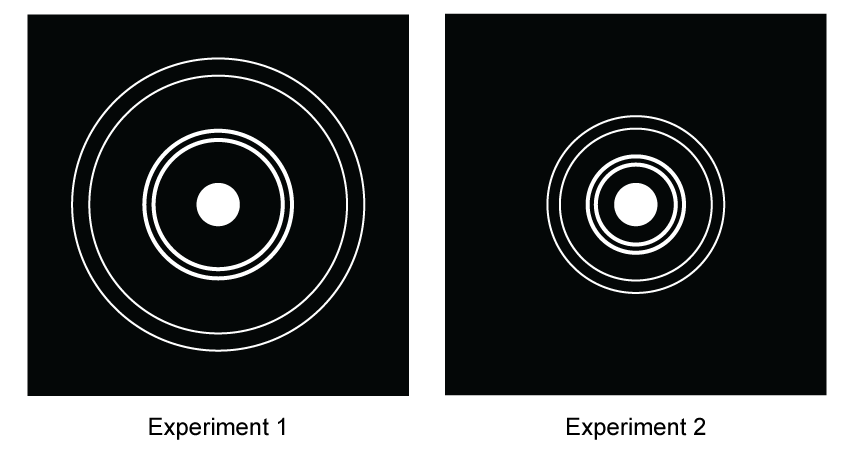
A student used an electron beam tube to accelerate electrons towards a thin polycrystalline gold film. A pattern consisting of concentric bright rings is observed on a fluorescent screen.

In Experiment 1, the electrons are accelerated from rest through a potential difference of 5.00 kV.

In Experiment 2, the potential difference across the tube is increased.

Two black squares with a series of concentric white circles. Experiment 1 shows larger circles, Experiment 2 shows smaller circles.

Discuss the conclusions that can be made from these experiments about the nature of electrons and the structure of gold.

5b
Sme Calculator
3 marks

Calculate the de Broglie wavelength of the electrons in Experiment 1.

5c
3 marks

The student suggested that alpha particles accelerated through a potential difference of 5.00 kV would also be suitable for investigating the structure of the gold film.

Comment on the student's suggestion.

6a
2 marks

Ultrasound can be used to investigate the structure of organs of the human body using the pulse-echo technique. A transducer emits ultrasound waves through body tissue and detects the reflected waves.

Describe how an ultrasound wave travels through body tissue.

6b
Sme Calculator
3 marks

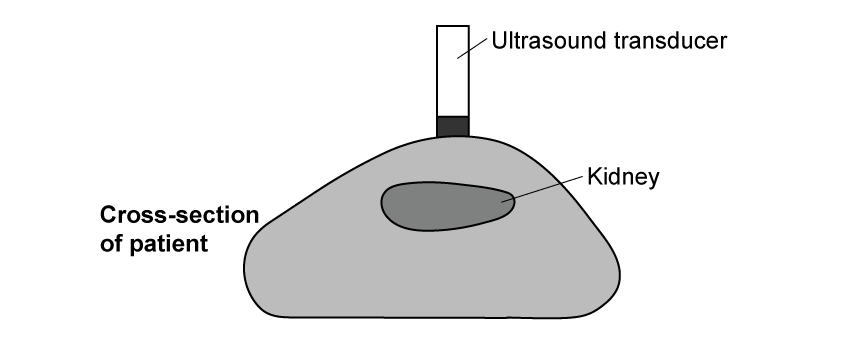
The diagram shows the transducer emitting a short pulse of ultrasound into a patient's body.

A cross-section of a patient, showing an ultrasound transducer on the skin above a kidney inside the body.

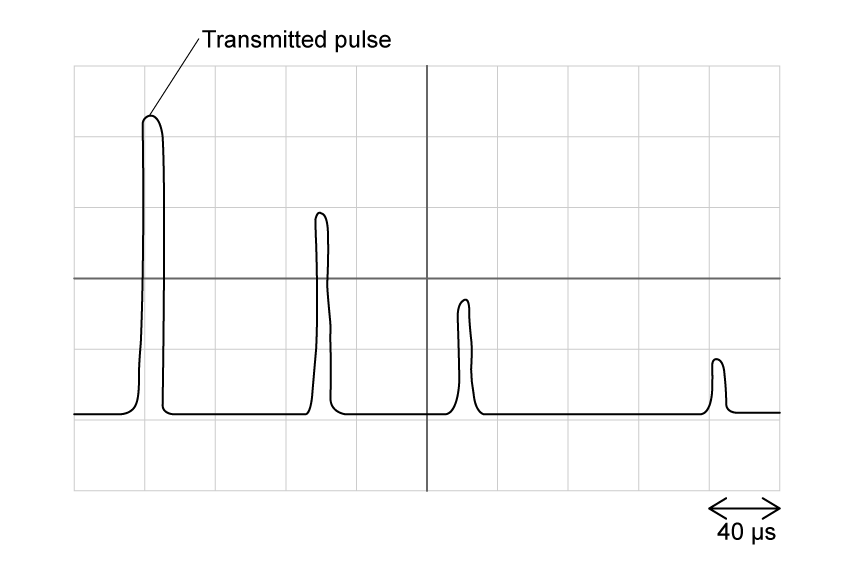
The oscilloscope trace below shows the transmitted and detected pulses. Each division on the oscilloscope trace represents 40 μs.

Oscilloscope trace showing four pulses: the transmitted pulse and three echo pulses of decreasing intensity. There are 2.5 squares between the transmitted pulse and the first reflected pulse, then 2 squares to the next pulse, and 3.5 squares to the final pulse. A square on the horizontal axis is marked 40 microseconds.

Calculate the diameter of the kidney.

speed of ultrasound in soft body tissue = 1540 m s1

6c
1 mark

Give a reason why the ultrasound must be emitted in short pulses rather than as a continuous wave.

6d
2 marks

The transducer emits ultrasound at a frequency of 2.5 MHz.

Explain why ultrasound waves of much lower frequency are unsuitable for medical imaging.

7a
Sme Calculator
4 marks

A student used a diffraction grating to check the wavelength of the light emitted by a laser labelled 630±10 nm. Light from the laser was directed through the diffraction grating and onto a screen a distance D away.

The diffraction pattern consisted of the central maximum and the first and second order maxima, as shown.

A laser directed at a diffraction grating, with the diffracted beams reaching a screen showing the central maximum and first- and second-order maxima on either side. The distance between the grating and the screen is labelled "D".

The student measured the distance between the two first-order maxima as 1640 mm. The diffraction grating had 600 lines mm1.

D=2.00 m

Deduce whether the light from the laser was within the range 630±10 nm.

7b
2 marks

Explain one modification to this method that would produce a smaller percentage uncertainty in the value of wavelength.

7c
3 marks

A polarising filter is placed between the laser and the grating.

The polarising filter is rotated slowly through 360° in the plane perpendicular to the laser beam. The student makes the following observations.

  • As the polarising filter is rotated, the intensity of the diffraction pattern on the screen varies.

  • At two positions during the rotation, the diffraction pattern is not visible on the screen.

Explain what these observations show about the light emitted by the laser.