Exploring the Structure of Matter (Edexcel International A Level (IAL) Physics): Exam Questions

Exam code: YPH11

2 hours20 questions
1
1 mark

Which of the following statements does not help to explain why electrons can be used to probe the nuclei of atoms?

  • Electrons can be accelerated to high energies.

  • Electrons can be part of an atom.

  • Electrons can exhibit diffraction effects.

  • Electrons can have wavelengths similar in size to nuclear diameters.

2
1 mark

Which of the following describes why electrons are released from a metal filament during thermionic emission?

  • Electrons in the metal filament are accelerated by a strong electric field.

  • Electrons in the metal filament are bombarded by high-energy particles.

  • Electrons gain energy when photons are incident on the metal surface.

  • Electrons gain energy when the metal filament is heated by an electric current.

3
1 mark

O817 is an isotope of oxygen.

Which row of the table gives the number of nucleons and the number of neutrons in an atom of O817?


Number of nucleons

Number of neutrons

A

8

8

B

8

9

C

17

8

D

17

9

    4
    1 mark

    A nuclide of bismuth contains 214 nucleons and 83 protons.

    How many neutrons are in the nuclide?

    • 83

    • 131

    • 214

    • 297

    5
    1 mark

    The diagram shows some of the components in a cathode ray tube.

    q5-6-wph14-04-jan-2022-edexcel-int-as-a-level-phy

    Electrons are released from the heated metal filament.

    Which of the following is the name of this process?

    • ionisation

    • photoelectric emission

    • relativistic effect

    • thermionic emission

    6
    1 mark

    The diagram shows some of the components in a cathode ray tube.

    q5-6-wph14-04-jan-2022-edexcel-int-as-a-level-phy

    When a potential difference is applied across the parallel metal plates, the electrons are deflected.

    Which of the following changes would decrease the deflection of the electrons?

    • increasing the current in the metal filament

    • increasing the distance between the plates

    • increasing the length of the plates

    • increasing the potential difference across the plates

    7
    1 mark

    In the early 20th century experiments were carried out to measure the scattering of alpha particles after striking thin gold foil.

    Which of the following could not be concluded from the results of these experiments?

    • The nucleus is charged.

    • The nucleus contains most of the mass of the atom.

    • The nucleus contains neutrons and protons.

    • The nucleus is very small compared to the atom.

    8
    1 mark

    A charged particle is accelerated in a spiral path in a cyclotron.

    q9-wph14-04-jan-2022-edexcel-int-as-a-level-phy

    Which of the following changes would increase the amount of energy transferred to the particle as it travels through 360°?

    • increasing the distance between the dees

    • increasing the frequency of the potential difference across the dees

    • increasing the strength of the magnetic field within the dees

    • increasing the maximum potential difference across the dees

    9
    1 mark

    The structure of nucleons can be investigated using electrons with high energies.

    Which of the following is the reason why high energies are required?

    • to allow for the creation of new particles

    • to overcome the repulsive electrostatic forces

    • to produce a relativistic increase in particle lifetime

    • to produce short de Broglie wavelengths

    10
    1 mark

    The diagram shows particle tracks in a bubble chamber. A photon enters the chamber and collides with a stationary neutral hydrogen atom. An electron is ejected from the atom, and an electron–positron pair is produced.

    Bubble chamber tracks showing two tightly wound spiral tracks curling in opposite directions and a nearly straight track exiting to the right.

    Which of the following is a valid conclusion from these tracks?

    • The photon enters the chamber from the right

    • The momentum of the ejected electron is greater than the momentum of the electron–positron pair

    • The magnetic field is directed out of the page

    • Charge is not conserved in this interaction

    11
    1 mark

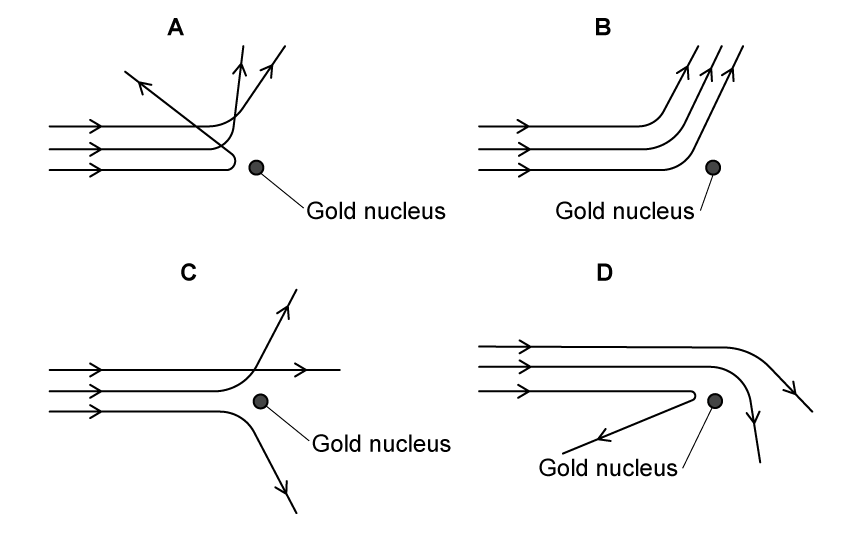
    In an alpha scattering experiment, three alpha particles with equal energies are directed towards the nucleus of a gold atom.

    Which of the following diagrams shows the possible paths of the alpha particles?

    Four diagrams, A to D, each showing three parallel alpha particle paths approaching a gold nucleus and being deflected in different ways.
A: The bottom path (closest to the nucleus) curves upwards by more than 90 degrees. The middle path curves upwards by around 90 degrees. The top path (furthest from the nucleus) curves upwards by less than 90 degrees.
B: All three paths curve upwards through the same angle.
C: The bottom and middle paths curve by the same angle but in opposite directions. The top path passes the nucleus and does not curve.
D: The bottom path curves downwards by more than 90 degrees. The middle path passes the nucleus and then curves downwards by around 90 degrees. The top path passes the nucleus and then curves downwards by less than 90 degrees.
      12
      1 mark

      Muons created in the upper atmosphere travel towards the ground at speeds close to the speed of light. More muons reach the ground than expected from their lifetime measured at rest.

      Which statement explains this observation?

      • The mass of the muons increases at high speed, so they take longer to decay

      • The lifetime of the muons is extended by time dilation, so they travel further before decaying

      • Time dilation means the muons decay in a shorter time as observed from the ground

      • The muons travel faster than light relative to the ground, so they reach it before decaying