Isomerism: Optical (Cambridge (CIE) A Level Chemistry): Exam Questions

Exam code: 9701

1 hour6 questions
1a
3 marks

Hydroxypropanoic acid has two position isomers.

i) Draw the structural formulae of the two position isomers of hydroxypropanoic acid and state the systematic name of each.

[2]

ii) State which of these isomers exhibits optical isomerism.

[1]

1b
1 mark

Fig. 1.1 shows the structures of three amino acids.

Structural formulae of glycine, cysteine and aspartate

Fig. 1.1

Identify the amino acid in Fig. 1.1 that does not exhibit optical isomerism.

1c
2 marks

Serine, shown in Fig. 1.2, exhibits optical isomerism.

Structural formula of serine showing the chiral centre

Fig. 1.2

Draw three-dimensional diagrams to show the two optical isomers of serine.

1a
1 mark

Leucine is an optically active amino acid with the molecular formula (CH3)2CHCH2CH(NH2)COOH.

Draw the displayed formula of leucine.

1b
4 marks

Leucine exists as stereoisomers.

i) Explain what is meant by the term stereoisomerism.

[2]

ii) Describe how the two optical isomers of leucine can be distinguished.

[2]

1c
2 marks

Draw three-dimensional diagrams to show the two optical isomers of leucine.

1d
1 mark

State the systematic (IUPAC) name of leucine.

2a
2 marks

Propranolol is an optically active drug. Its structure is shown in Fig. 2.1.

Skeletal formula of propranolol

Fig. 2.1

i) Deduce the molecular formula of propranolol.

[1]

ii) On Fig. 2.1, indicate the chiral centre with an asterisk (*).

[1]

2b
2 marks

Explain why a racemic mixture of propranolol has no effect on plane-polarised light.

2c
2 marks

Explain why it is often important that chiral drugs, such as propranolol, are administered as a single pure enantiomer rather than as a racemic mixture.

2d
3 marks

Chiral catalysts are often used in the manufacturing process of drugs.

i) State the purpose of using a chiral catalyst in drug synthesis.

[1]

ii) State one advantage and one disadvantage of using a chiral catalyst.

[2]

3a
8 marks

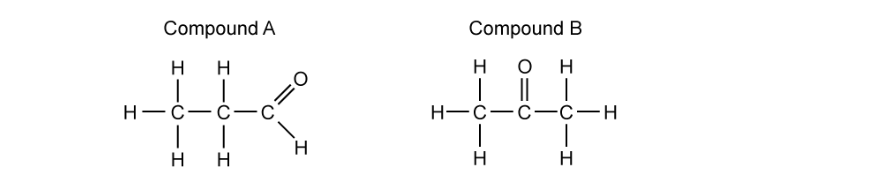
Two isomers of C3H6O are shown below in Fig. 3.1.

Structural formulae of propanal (compound A, an aldehyde) and propanone (compound B, a ketone)

Fig. 3.1

i) State the systematic (IUPAC) name of compound A and of compound B.

[2]

ii) State the name of the mechanism for the reaction between compound A and HCN.

[1]

iii) Describe the mechanism for the reaction between compound A and HCN. Include all relevant curly arrows, lone pairs, and partial charges in your diagram.

[4]

iv) State the systematic name of the organic product formed in this reaction.

[1]

3b
3 marks

Compound B also reacts with HCN.

i) State the systematic name of the organic product formed.

[1]

ii) Explain why the organic product in b(i) does not exhibit optical isomerism.

[2]

3c
3 marks

Explain why the reaction between compound A and HCN produces a racemic mixture.

3d
2 marks

Explain why the racemic mixture formed in this reaction has no effect on plane-polarised light.

1a
2 marks

This question is about the chemistry of limonene.

Skeletal structural formula of limonene showing a cyclohexene ring with a methyl substituent and an isopropenyl group

Limonene is a naturally occurring hydrocarbon found in citrus fruits, with the molecular formula C10H16.

Limonene exists as a pair of enantiomers:

  • One enantiomer is responsible for a strong orange smell

  • The other enantiomer is responsible for a lemon smell

Draw three-dimensional diagrams to show the two optical isomers of limonene.

optical isomer 1

optical isomer 2

1b
3 marks

Suggest why receptors in the human nose can distinguish between the orange and lemon enantiomers of limonene.

1c
Sme Calculator
4 marks

Limonene can undergo full hydrogenation to form menthane as shown.

Equation showing limonene reacting with two molecules of hydrogen gas to form menthane by complete hydrogenation

For the complete hydrogenation of an impure sample of 3.00 g of limonene at room temperature and pressure, 870 cm3 of hydrogen was required.

Calculate, showing your working, the percentage purity of limonene.

percentage purity = ........................ %

1d
2 marks

The final step of the multi-step synthetic conversion of limonene to menthol is shown.

Structural formulae showing a menthone ketone intermediate converting to menthol, representing the final step in the synthesis of menthol from limonene

State the reagent and the type of reaction for this step.

Reagent: ..............................................................

Type of reaction: ..............................................................

2a
4 marks

Explain why all aldehydes, other than methanal, react with HCN to form a product that exhibits optical isomerism, whereas only some ketones do. Use the general formulae RCHO and R'COR'' in your answer. Include equations where appropriate.

2b
2 marks

The β-hydroxyaldehyde shown in Fig. 2.1 is heated under reflux with acidified aqueous potassium dichromate(VI).

Beta-hydroxyaldehyde structure showing an aldehyde group and a tertiary hydroxyl group on the adjacent carbon

Fig. 2.1

State whether the organic product of this reaction exhibits optical isomerism. Explain your answer.

2c
2 marks

Pent-1-en-3-ol is reacted with hydrogen gas in the presence of a nickel catalyst.

State whether the organic product formed in this reaction exhibits optical isomerism. Explain your answer.

2d
3 marks

An isomer of pent-1-en-3-ol, C5H10O, is a secondary alcohol that exhibits both optical isomerism and geometrical (E/Z) isomerism.

i) Draw the skeletal formula of this isomer and indicate the chiral centre with an asterisk (*).

[2]

ii) State the systematic name of this isomer.

[1]