Arenes (Cambridge (CIE) A Level Chemistry): Exam Questions

Exam code: 9701

2 hours12 questions
1a
1 mark

Benzene can react with aluminium bromide, AlBr3, and bromoethane, CH3CH2Br, to form ethylbenzene.

Construct an equation for the formation of the CH3CH2+ species.

1b
1 mark

State the name of the mechanism for the formation of ethylbenzene from benzene and aluminium bromide.

1c
3 marks

Describe the mechanism for the conversion of benzene into ethylbenzene using the CH3CH2+ electrophile. Include all relevant curly arrows and charges.

1d
1 mark

State why anhydrous conditions are required for this reaction.

2a
2 marks

Construct an equation for the reaction of benzene with concentrated nitric acid to form nitrobenzene and water.

2b
2 marks

The structure of methylbenzene is shown below in Fig. 2.1.

Skeletal formula of methylbenzene showing a hexagonal benzene ring with a methyl (CH~3~) group attached

Fig. 2.1

Draw the skeletal formulae of the two isomers of chloromethylbenzene formed from the reaction of methylbenzene and Cl2 in the presence of AlCl3.

2c
1 mark

State the type of reaction that benzene will typically undergo.

3a
1 mark

State the name of the mechanism that benzene will undergo if reacted with bromine in the presence of a halogen carrier to form bromobenzene, C6H5Br.

3b
2 marks

Construct an equation to show how the halogen carrier generates the Br+ ion in order to allow the reaction in part (a) to occur.

3c
3 marks

Complete the mechanism in Fig. 3.1 for the formation of bromobenzene. Include all relevant curly arrows and charges.

Partially drawn mechanism for the bromination of benzene, with blank spaces for curly arrows, the intermediate structure, and the product

Fig. 3.1

4a
1 mark

Draw the skeletal formula of compound A in Fig. 4.1.

Reaction scheme showing methylbenzene reacting with Br~2~ under ultraviolet light to form compound A, a free radical substitution in the side chain

Fig. 4.1

4b
1 mark

Compound A is heated with aqueous sodium hydroxide, NaOH(aq), to form compound B.

Draw the skeletal formula of compound B.

4c
3 marks

State the reagents and conditions required for reaction 1 in Fig. 4.3 for the formation of benzoic acid from methylbenzene.

Reaction scheme showing methylbenzene converted to benzoic acid by reaction 1, with a box labelled 'reagents and conditions'

Fig. 4.3

1a
5 marks

4-nitromethylbenzene can be prepared via an electrophilic substitution reaction as shown in Fig. 1.1.

Reaction scheme showing nitration of methylbenzene to give 4-nitromethylbenzene as the major product, via intermediate T

Fig. 1.1

i) This reaction also forms an isomer of 4-nitromethylbenzene as a by-product. Draw the structure of this by-product.

[1]

ii) Construct an equation for the reaction between HNO3 and H2SO4 that forms the electrophile for this reaction.

[1]

iii) Describe how the structure and bonding of the six-membered ring in intermediate T differ from those in methylbenzene. In your answer refer to the hybridisation, the π bonding and the bond angles in the ring system.

[3]

1b
6 marks

Benzocaine is used as a local anaesthetic. It can be synthesised from 4-nitromethylbenzene by the route shown in Fig. 1.2.

Reaction scheme showing four-step synthesis of benzocaine from 4-nitromethylbenzene, with intermediate compounds W and others

Fig. 1.2

i) State the systematic name of compound W.

[1]

ii) State the reagents and conditions for step 1.

[2]

iii) State the reagent for step 2.

[1]

iv) State the reagents and conditions for step 3 and step 4.

[2]

1c
5 marks

A sample of benzocaine was analysed by carbon-13 NMR and proton NMR spectroscopy.

i) Deduce the number of peaks in the carbon-13 NMR spectrum of benzocaine.

[1]

Benzocaine was dissolved in CDCl3 and the proton NMR spectrum of this solution was recorded as shown in Fig. 1.3.

Proton NMR spectrum of benzocaine in CDCl3 showing peaks at approximately 1.2, 3.5, 5.5, and 7.1-7.4 ppm

Fig. 1.3

ii) The data in Table 1.2 should be used in answering this question. Complete Table 1.1 for the chemical shifts δ 1.2 ppm, 3.5 ppm and 5.5 ppm.

Table 1.1

δ / ppm

environment of proton

number of 1H atoms responsible for the peak

splitting pattern

1.2

3.5

5.5

7.1–7.4

attached to aromatic ring

4

two doublets

[3]

iii) Explain the splitting pattern for the absorption at δ 1.2 ppm.

[1]

Table 1.2

Environment of proton

Example

chemical shift range, δ / ppm

alkane

–CH3, –CH2–, >CH

0.9–1.7

alkyl next to C=O

CH3–C=O, –CH2–C=O, >CH–C=O

2.2–3.0

alkyl next to aromatic ring

CH3–Ar, –CH2–Ar, >CH–Ar

2.3–3.0

alkyl next to electronegative atom

CH3–O, –CH2–O, –CH2–Cl

3.2–4.0

attached to alkene

=CHR

4.5–6.0

attached to aromatic ring

H–Ar

6.0–9.0

aldehyde

HCOR

9.3–10.5

alcohol

ROH

0.5–6.0

phenol

Ar–OH

4.5–7.0

carboxylic acid

RCOOH

9.0–13.0

alkyl amine

R–NH

1.0–5.0

aryl amine

Ar–NH2

3.0–6.0

amide

RCONHR

5.0–12.0

1d
3 marks

Benzocaine can also be used to synthesise the azo compound S by the following route.

Reaction scheme showing two-step synthesis of azo dye S from benzocaine: step 1 forms diazonium salt R, step 2 couples R with phenol to give azo dye S

Fig. 1.4

i) State the reagent(s) used for step 1.

[1]

ii) Draw the structures of compounds R and S in the boxes in Fig. 1.4.

[2]

2a
4 marks

Benzene can undergo electrophilic substitution with ethanoyl chloride in the presence of aluminium chloride.

i) Construct an equation to show the formation of the electrophile.

[1]

ii) Describe the mechanism for the reaction. Include all relevant curly arrows and charges.

[3]

2b
2 marks

The organic product from part (a) can be reduced to form an alcohol.

Name a suitable reducing agent. Construct an equation for this reduction, using [H] to represent the reducing agent.

2c
2 marks

Explain why Friedel-Crafts acylation gives a mono-substituted product, while Friedel-Crafts alkylation may give a mixture of poly-substituted products.

2d
2 marks

Explain how the aluminium chloride catalyst reforms at the end of the electrophilic substitution reaction.

3a
4 marks

Compound A can be formed from ethylbenzene by the following route in Fig. 3.1.

Synthesis route showing ethylbenzene converted in three steps to compound A via nitration, reduction and diazotisation

Fig. 3.1

State the reagents and conditions for the following steps.

Step 1 ......................................................................................................

Step 2 ......................................................................................................

Step 3 .......................................................................................................

3b
2 marks

Name the organic products of the reactions between each of the compound A and the following reagents. If no reaction occurs write ‘no reaction’.

Reagent

Product with compound A

Na

H+ / KMnO4

3c
1 mark

Explain why ethyl-2-nitrobenzene is formed rather than ethyl-3-nitrobenzene.

3d
1 mark

Using your answer to (a), construct an equation for the formation of the electrophile in step 1.

4a
2 marks

Methylbenzene can undergo different reactions to form the products shown in Fig. 4.1.

Reaction scheme showing methylbenzene undergoing two different bromination reactions: side-chain free radical substitution (reaction 1) and ring electrophilic substitution (reaction 2) (Fig. 4.1)

Fig. 4.1

State the reagents and conditions for these two reactions.

reaction 1 ........................................................................................

reaction 2 ........................................................................................

4b
2 marks

i) Name the mechanism of reaction 1 in part (a)

[1]

ii) Draw the structure of the product obtained if reaction 1 is carried out using an excess of bromine.

[1]

4c
3 marks

Describe the mechanism for reaction 2. Include all relevant curly arrows and charges.

4d
2 marks

Nitrobenzene reacts in the same conditions as reaction 2 in part (a). Draw and name the product of this reaction.

5a
4 marks

Benzene reacts with concentrated nitric acid in the presence of concentrated sulfuric acid.

Describe the structure and bonding of a benzene molecule, C6H6. In your answer, refer to:

  • the hybridisation of the carbon atoms

  • the bond angles within the ring

  • how the σ and π bonds are formed.

5b
5 marks

i) Construct an equation to show the generation of the electrophile.

[1]

ii) Name and draw the fully labelled mechanism for the formation of nitrobenzene.

[4]

5c
3 marks

i) State the relative order of increasing acidity for ethanol, phenol, and ethanoic acid.

[1]

ii) Identify the electronic effect of the alkyl group that makes the ethoxide ion less stable than the phenoxide ion.

[1]

iii) Describe the distribution of the negative charge in the ethanoate ion that makes it the most stable of these three conjugate bases.

[1]

5d
1 mark

Predict the major product formed when phenol reacts with dilute nitric acid.

5e
5 marks

Benzene can be converted into 3-chlorobenzoic acid in a multi-step synthesis.

Suggest a three-step synthetic route for this conversion. In your answer, identify the reagents and conditions for each step and draw the structures of the intermediate compounds formed.

1a
3 marks

The nitration of benzene forms the basis for the synthesis of dyes and explosives.

i) Construct an equation for the generation of the electrophile.

[1]

ii) State which reactant is acting as a Brønsted-Lowry base and justify your answer.

[1]

iii) Identify the conjugate acid in the reaction.

[1]

1b
5 marks

Compound B is produced in two steps as outlined in Fig. 1.1.

Reaction scheme showing benzene undergoing Friedel-Crafts acylation in step 1 to form compound A (phenyl propan-1-one), then reduction in step 2 to form compound B

Fig. 1.1

i) State the reagents and conditions required for the production of compound A shown in Fig. 1.1.

[2]

ii) Describe the mechanism for step 1. Include all relevant curly arrows and charges.

[3]

1c
2 marks

Draw the dot-and-cross diagram for the structure of the catalyst once the electrophile has been generated in part (b).

1d
4 marks

Explain why benzene can generally only undergo substitution reactions.

2a
2 marks

Fig. 2.1 shows the formation of a ketone followed by an alcohol.

Reaction scheme showing benzene converted to a ketone via Friedel-Crafts acylation (step 1), then to a secondary alcohol via reduction (step 2) (Fig. 2.1)

Fig. 2.1

Describe the mechanism to show the formation of the catalyst responsible for step 1. Include all relevant curly arrows and charges.

2b
5 marks

Describe the mechanism for the formation of the ketone, including the regeneration of the catalyst. Include all relevant curly arrows and charges.

2c
2 marks

State the reagents required for step 2.

3a
4 marks

Benzene can be converted into cyclohexane as shown in Fig. 3.1.

Reaction scheme showing benzene being converted to cyclohexane

Fig. 3.1

i) For this reaction, name the type of reaction and state the reagent and conditions needed.

[2]

ii) State the bond angles in benzene and cyclohexane. Explain your answers.

[2]

3b
4 marks

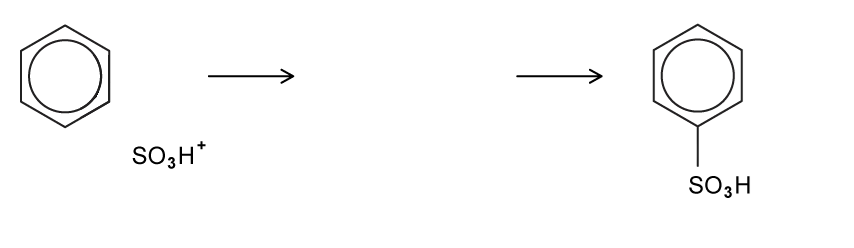
When benzene reacts with SO3, as shown in Fig. 3.2, benzenesulfonic acid is produced.

Reaction scheme showing benzene reacting with SO~3~ in the presence of concentrated H~2~SO~4~ to form benzenesulfonic acid

Fig. 3.2

The mechanism of this reaction is similar to that of the nitration of benzene. Concentrated H2SO4 is used in an initial step to generate the SO3H+ electrophile as shown.

SO3 + H2SO4 → SO3H+ + HSO4

i) Describe the mechanism for the reaction of benzene with SO3H+ ions in Fig. 3.3. Include all relevant curly arrows and charges.

Partially drawn electrophilic substitution mechanism for the reaction of benzene with SO3H+ showing blank spaces for curly arrows, the intermediate, and the product

Fig. 3.3

[3]

ii) Construct an equation to show how the H2SO4 catalyst is reformed.

[1]

3c
5 marks

3-aminobenzoic acid can be synthesised from methylbenzene in three steps as shown in Fig. 3.4.

Flowchart showing three-step synthesis of 3-aminobenzoic acid from methylbenzene, with boxes for intermediates M and N and arrows labelled step 1, 2, and 3

Fig. 3.4

i) Draw the skeletal formulae of M and N in the boxes.

[2]

ii) State reagents and conditions for each step of the synthesis.

step 1 ................................................................................

step 2 ................................................................................

step 3 ................................................................................

[3]