11 mark
What makes the alveoli suitable as a gas exchange surface in mammals?
| a dense capillary network | large total surface area |
A | X | X |
B | ✔ | X |
C | X | ✔ |
D | ✔ | ✔ |
Was this exam question helpful?
Exam code: 0610 & 0970
What makes the alveoli suitable as a gas exchange surface in mammals?
| a dense capillary network | large total surface area |
A | X | X |
B | ✔ | X |
C | X | ✔ |
D | ✔ | ✔ |
Was this exam question helpful?
Which of the following sequences show the correct path of oxygen as it enters the lungs?
trachea → bronchiole → bronchus → alveolus
trachea → bronchus → bronchiole → alveolus
alveolus → bronchus → bronchiole → trachea
alveolus → bronchiole → bronchus → trachea
Was this exam question helpful?
What is the approximate percentage of carbon dioxide in expired air?
16 %
0.04 %
4 %
21 %
Was this exam question helpful?
The image below shows some cells found in the trachea.

What is the function of the part labelled K?
Increasing surface area
Gas exchange
Moving mucus
Trapping bacteria
Was this exam question helpful?
Name the structures shown in the diagram.

| W | X | Y | Z |
A | larynx | trachea | bronchi | bronchioles |
B | trachea | larynx | bronchioles | bronchi |
C | bronchi | trachea | bronchioles | larynx |
D | larynx | bronchi | larynx | bronchioles |
Was this exam question helpful?
The diagram below shows a cross-section through an alveolus and a capillary.

Why does oxygen move from P to Q?
The concentration of carbon dioxide is lower in the alveolus than in the blood.
The concentration of oxygen in the blood is lower than in the air in the capillary.
Oxygen must replace carbon dioxide.
The concentration of oxygen in the blood is lower than the air in the alveolus.
Was this exam question helpful?
Some amphibians, such as frogs, can use their skin as a gas exchange surface.
What are the most likely characteristics of the surface of the skin in these amphibians?
| surface area | type of skin |
A | small | thick |
B | large | thick |
C | small | thin |
D | large | thin |
Was this exam question helpful?
When the diaphragm relaxes and internal intercostal muscles contract, how does the volume and pressure inside the thorax change?
| pressure | volume |
A | decreases | decreases |
B | decreases | increases |
C | increases | decreases |
D | increases | increases |
Was this exam question helpful?
Compared to the composition of atmospheric air, the air exhaled by a man contains:
more water vapour, more carbon dioxide.
more water vapour, less carbon dioxide.
less water vapour, more carbon dioxide.
less water vapour, less carbon dioxide.
Was this exam question helpful?
The diagram shows the composition of four samples of air (O2 = oxygen, CO2 = carbon dioxide, N2 = nitrogen).

Which sample is inspired air and which sample is expired air?
| inspired air | expired air |
A | R | S |
B | P | R |
C | Q | P |
D | S | R |
Was this exam question helpful?
What are the approximate percentages of oxygen and carbon dioxide in inspired air?
percentage of oxygen | percentage of carbon dioxide | |
|---|---|---|
A | 16 | 4.00 |
B | 16 | 8.00 |
C | 21 | 0.04 |
D | 21 | 4.00 |
Was this exam question helpful?
The diagrams show the depth and rate of breathing in a person at 12:00 and 13:00.
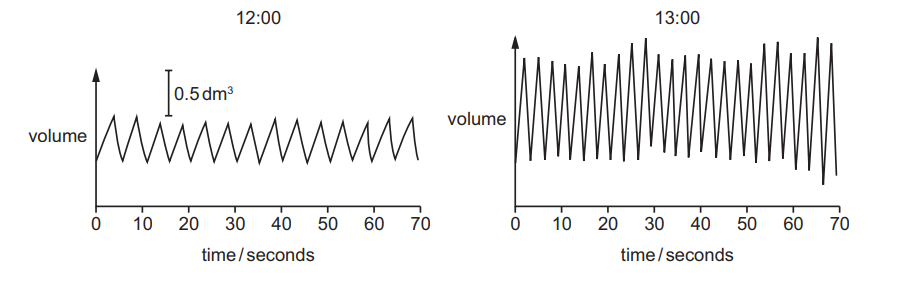
What happens to the person’s breathing between 12:00 and 13:00?
depth of breathing | rate of breathing | |
A | decreases | decreases |
B | decreases | increases |
C | increases | decreases |
D | increases | increases |
Was this exam question helpful?
A person lives in a climate where the air is very dry.
Which row correctly compares inspired air with expired air for this person?
inspired air | expired air | |
|---|---|---|
A | higher carbon dioxide concentration | higher oxygen concentration |
B | lower water vapour concentration | higher carbon dioxide concentration |
C | lower oxygen concentration | higher water vapour concentration |
D | lower carbon dioxide concentration | lower water vapour concentration |
Was this exam question helpful?
Which row shows a change that occurs during ventilation?
process | thorax pressure | thorax volume | air movement | |
|---|---|---|---|---|
A | expiration | decreases | increases | in |
B | expiration | increases | decreases | out |
C | inspiration | decreases | increases | out |
D | inspiration | increases | decreases | in |
Was this exam question helpful?
Which sequence of changes takes place when we breathe in?
diaphragm contracts → volume of thorax increases → pressure in lungs decreases
diaphragm contracts → volume of thorax increases → pressure in lungs increases
diaphragm relaxes → volume of thorax increases → pressure in lungs decreases
diaphragm relaxes → volume of thorax increases → pressure in lungs
increases
Was this exam question helpful?
What do the external intercostal muscles do during inhalation?
pull ribs downwards
pull ribs upwards and outwards
push air into lungs
produce mucus
Was this exam question helpful?
Why does breathing rate increase during exercise?
oxygen concentration in blood increases
oxygen concentration in blood decreases
carbon dioxide concentration in blood increases
carbon dioxide concentration in blood decreases
Was this exam question helpful?
The diagram shows a representation of the human gas exchange system.
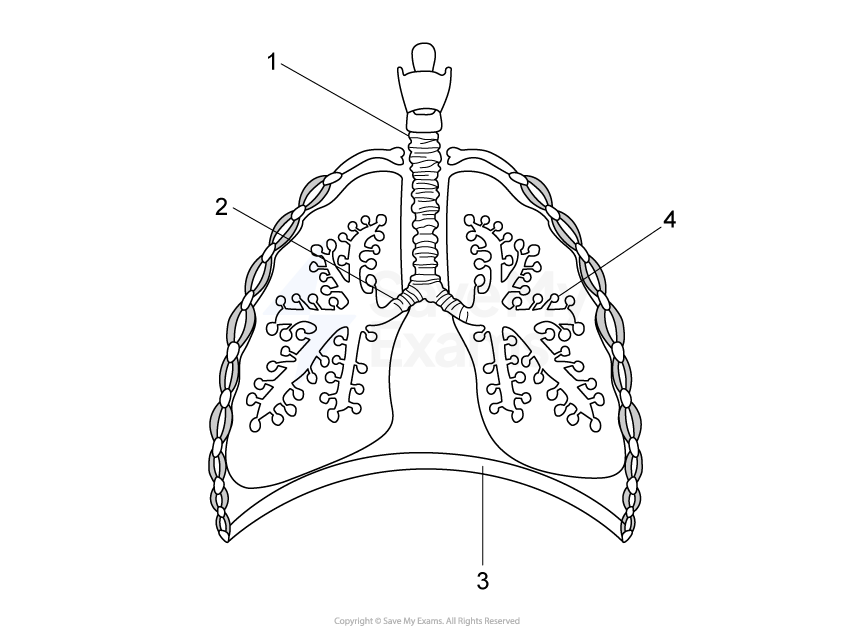
Which row correctly identifies the labelled structures?
Structure 1 | Structure 2 | Structure 3 | Structure 4 | |
A | Oesophagus | Bronchus | Diaphragm | Alveolus |
B | Trachea | Bronchiole | Intercostal muscle | Blood vessel |
C | Trachea | Bronchus | Diaphragm | Alveolus |
D | Bronchus | Bronchiole | Abdominal muscle | Capillary |
Was this exam question helpful?
Which of the following correctly describes the actions of the intercostal muscles and the diaphragm when we breathe in?
| external intercostal muscles | internal intercostal muscles | diaphragm |
A | contract | relax | domed |
B | contract | relax | flat |
C | relax | contract | domed |
D | relax | contract | flat |
Was this exam question helpful?
The diagram shows part of the structure of a human lung.
Where would the concentration of carbon dioxide be highest?

Was this exam question helpful?
The diagram below illustrates the changes in air pressure taking place inside the lungs during a complete cycle of breathing. Atmospheric pressure is 101 kPa.

At which point on the diagram does the process of inhalation start?
Was this exam question helpful?
A person exhales, and the air from their lungs is collected and placed in a gas jar. A second gas jar contains normal atmospheric air. A candle is set alight and is placed inside each gas jar as shown. The time taken for each flame to go out is measured with a stopwatch.

The table shows the results of this experiment.
gas jar | time for candle flame to go out /s |
1 | 7 |
2 | 12 |
Which of the following is a correct explanation for the difference between the results in jars 1 and 2?
Jar 1 contains atmospheric air which has less oxygen than exhaled air.
Jar 1 contains exhaled air which has less oxygen compared to atmospheric air.
Jar 2 contains atmospheric air which has more carbon dioxide than exhaled air.
Jar 2 contains exhaled air which has more carbon dioxide than oxygen in it.
Was this exam question helpful?
Which of the following helps carbon dioxide to be excreted rapidly into the alveoli from the blood in the lungs?
Inhaled air has a lower concentration of carbon dioxide than the blood constantly pumping through the lungs.
Alveoli have thick walls and a large surface area.
Alveoli have thin walls and a large surface area.
The concentration of carbon dioxide in the blood is lower than in the alveoli.
1, 2 & 4 only
3 only
1 & 3 only
3 & 4 only
Was this exam question helpful?
Below are statements about the features of gas exchange surfaces in humans.
Gas exchange surfaces have a large surface area to maximise the rate of diffusion
Gas exchange surfaces have a thick surface to prevent damage from the constant movement of air
Gas exchange surfaces have a good blood supply to remove gases that have diffused across the surface
Gas exchange surfaces are well ventilated to increase the concentration of carbon dioxide in the alveoli
Which statements are correct?
1 only
1, 2 and 3 only
1 and 3 only
1, 3 and 4 only
Was this exam question helpful?
The graph shows changes in the volume of air in the lungs of a person at rest, over a period of 30 seconds.

Which graph below shows the changes in the volume of air in the lungs for the same person immediately after they have done a few minutes of vigorous exercise?

Was this exam question helpful?
Which row correctly describes the composition of expired air compared to inspired air?
Oxygen | Carbon dioxide | Water vapour | |
A | higher | higher | higher |
B | lower | higher | higher |
C | lower | lower | higher |
D | higher | lower | lower |
Was this exam question helpful?