Cell Structures (Edexcel IGCSE Biology): Revision Note

Exam code: 4BI1

Cell Structures

  • Cells are surrounded by a cell membrane, which separates them from their external environment

  • Inside the cell membrane is the cytoplasm, a jelly-like substance of water with dissolved substances

  • Eukaryotic cells have organelles within the cytoplasm

    • Organelles are sub-cellular structures that carry out specific functions within the cell

  • Within the cytoplasm of eukaryotic cells the following organelles are present:

    • Nucleus

    • Ribosomes

    • Mitochondria

      • Watch out for the difference between the terms 'mitochondria' and 'mitochondrion'

      • Mitochondrion is used to refer to one organelle

      • Mitochondria is used to refer to more than one organelle eg. muscle cells contain many mitochondria

  • Plant cells contain the following additional structures: 

    • Cell wall

    • Chloroplasts

    • Permanent vacuole

  • When viewed under a microscope, the structures inside a plant cell are visible

  • Some cellular structures, like ribosomes and mitochondria, are too small to be viewed under a light microscope but are visible under an electron microscope
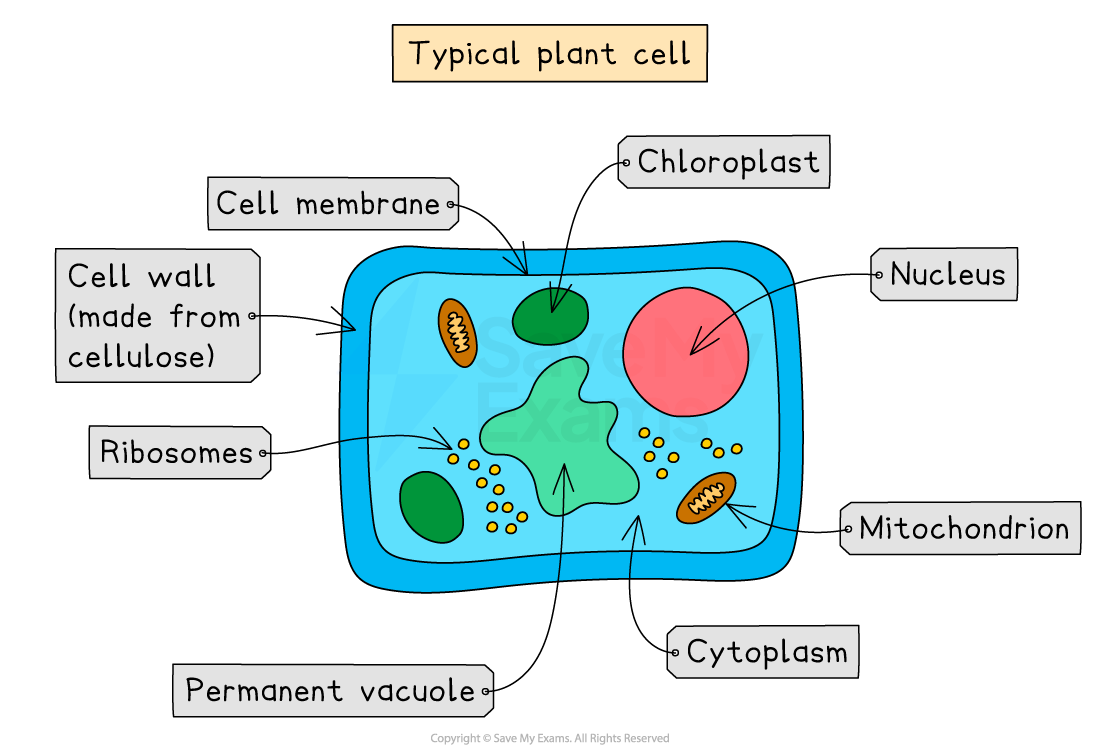
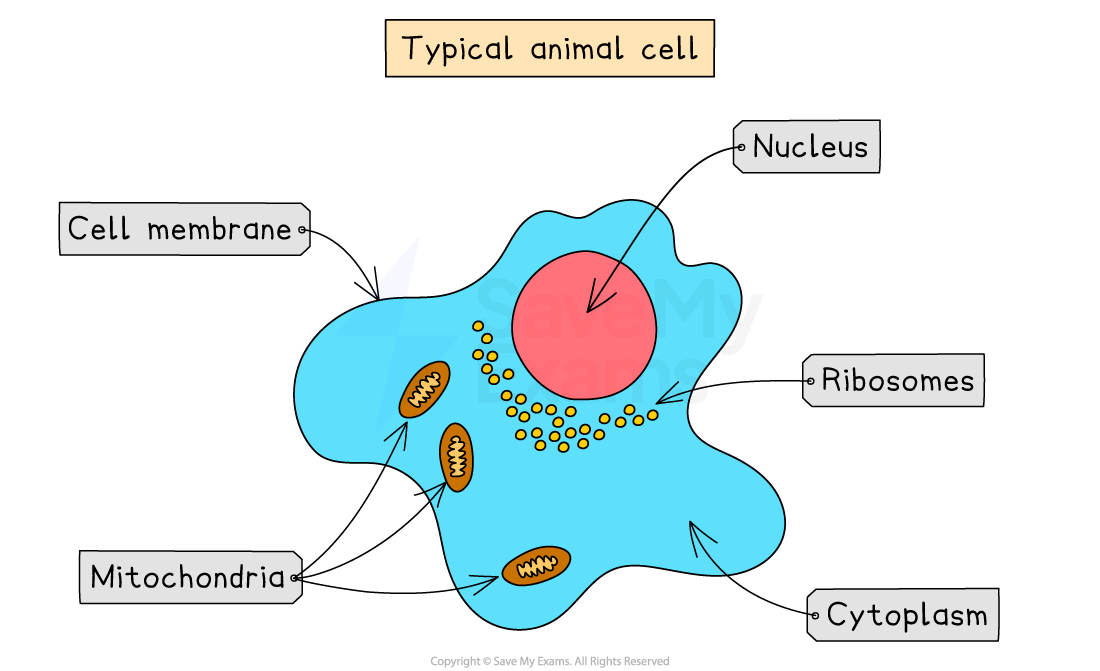
Diagram of a typical plant cell, labelled with parts including chloroplast, nucleus, mitochondrion, ribosomes, cell wall, membrane, cytoplasm, vacuole.
Diagram of a typical animal cell with labels for cell membrane, nucleus, ribosomes, mitochondria, and cytoplasm.

Cell Structures & Functions

Cellular Structures & Functions Table

Structure

Function

Nucleus

  • Contains genetic material (chromosomes)

Cytoplasm

  • Site of many chemical reactions

  • Contains water and many solutes

Cell membrane

  • Controls substances entering and leaving the cell

Cell wall

  • Gives the cell extra support and defines its shape, prevents bursting

Mitochondria

  • Site of aerobic respiration

Chloroplasts

  • Site of photosynthesis

  • Contains chlorophyll to absorb light for photosynthesis

Ribosomes

  • Site of protein synthesis

Vacuole

  • Contains cell sap (water with dissolved solutes)

  • Provides support to plant cells, helping them to stay firm

Unlock more, it's free!

Join the 100,000+ Students that ❤️ Save My Exams

the (exam) results speak for themselves:

Build on this topic

Lára Marie McIvor

Author: Lára Marie McIvor

Expertise: Content Creator

Lára graduated from Oxford University in Biological Sciences and has now been a science tutor working in the UK for several years. Lára has a particular interest in the area of infectious disease and epidemiology, and enjoys creating original educational materials that develop confidence and facilitate learning.

Lucy Kirkham

Reviewer: Lucy Kirkham

Expertise: Content Creator

Lucy has been a passionate Maths teacher for over 12 years, teaching maths across the UK and abroad helping to engage, interest and develop confidence in the subject at all levels.Working as a Head of Department and then Director of Maths, Lucy has advised schools and academy trusts in both Scotland and the East Midlands, where her role was to support and coach teachers to improve Maths teaching for all.