Investigations (Cambridge (CIE) IGCSE International Maths: Extended): Exam Questions

Exam code: 0607

1 hour18 questions
1a
Sme Calculator
2 marks

This investigation looks at the geometry and properties of an ellipse, including its area and its circumference.

An ellipse can be thought of as a squashed or stretched circle.

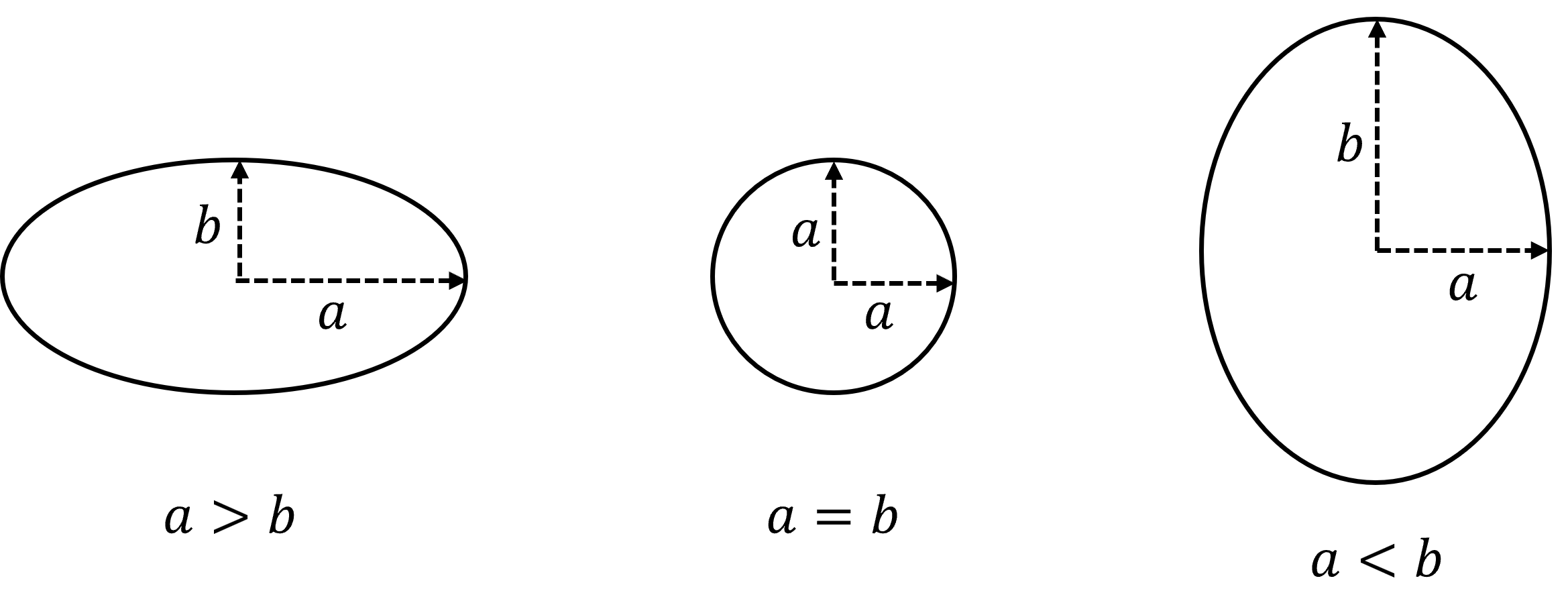
It can be described by a horizontal length, a, and a vertical length, b, measured from its centre, as shown below.

When a equals b, the ellipse is a circle with radius a.

Three shapes: a horizontal ellipse with a greater width than height labelled 'a > b,' a circle labeled 'a = b,' and a vertical ellipse labelled 'a < b.'

This investigation will only consider ellipses in the form a greater or equal than b.

Sketch an ellipse with a equals 5 and b equals 2.

Label the two lengths on your diagram.

1b
Sme Calculator
1 mark

The formula for the area of an ellipse, A, is given by

A equals pi a b

Complete the table below, leaving all answers in terms of pi.

The first example has been done for you:

A equals pi cross times 5 cross times 2 equals 10 pi

a

b

A

5

2

10 pi

8

3

3

36 pi

10

50 pi

2
Sme Calculator
3 marks

An ellipse is a shape that can be thought of as a squashed or stretched circle.

It can be described by a horizontal length, a, and a vertical length, b, measured from its centre, as shown below.

A horizontal ellipse with width from centre a and height from centre b, with a > b.

The formula for the area of an ellipse, A, is given by

A equals pi a b

A minor circle refers to the biggest circle that fits inside an ellipse, with the same centre, as shown.

Diagram of an ellipse with a dashed inner circle, labelled "minor circle."

A major circle refers to smallest circle that fits outside an ellipse, with the same centre, as shown.

Diagram showing an ellipse inside a dashed major circle, labelled "major circle."

The following notation will be used for the different areas:

  • A subscript E is the area of an ellipse

  • A subscript C is the area of its minor circle

  • A subscript D is the area of its major circle

Complete the table below, leaving answers fully simplified and in terms of pi (where necessary).

Parts of the table have been done for you.

a

b

a over b

A subscript E

A subscript C

A subscript E over A subscript C

A subscript D

A subscript E over A subscript D

8

2

4

16 pi

4 pi

4

64 pi

1 fourth

10

5

2

50 pi

25 pi

2

12

4

3
Sme Calculator
3 marks

An ellipse is a shape that can be thought of as a squashed or stretched circle.

It can be described by a horizontal length, a, and a vertical length, b, measured from its centre, as shown below.

A horizontal ellipse with width from centre a and height from centre b, with a > b.

The formula for the area of an ellipse, A, is given by

A equals pi a b

A minor circle refers to the biggest circle that fits inside an ellipse, with the same centre, as shown.

Diagram of an ellipse with a dashed inner circle, labelled "minor circle."

A major circle refers to smallest circle that fits outside an ellipse, with the same centre, as shown.

Diagram showing an ellipse inside a dashed major circle, labelled "major circle."

The following notation is used for the different areas:

  • A subscript E is the area of an ellipse

  • A subscript C is the area of its minor circle

  • A subscript D is the area of its major circle

Use the area formulas for A subscript E, A subscript C and A subscript D to prove algebraically that

A subscript E over A subscript C

is the reciprocal of

A subscript E over A subscript D

4a
Sme Calculator
2 marks

An ellipse is a shape that can be thought of as a squashed or stretched circle.

It can be described by a horizontal length, a, and a vertical length, b, measured from its centre, as shown below.

A horizontal ellipse with width from centre a and height from centre b, with a > b.

The formula for the area of an ellipse, A, is given by

A equals pi a b

In the diagram below, the area of the circle, radius R, is equal to the area of the ellipse, pi a b.

A circle, radius R, with the same area as the ellipse.
A circle, radius R, with the same area as the ellipse

Use algebra to show that

R equals square root of a b end root

4b
Sme Calculator
2 marks

There is no algebraic formula for the circumference of an ellipse, C.

However, there are many formulas that give approximations to the circumference of an ellipse in the form

2 pi r

One approximate formula uses r equals square root of a b end root from part (a), giving:

C subscript 1 equals 2 pi square root of a b end root

A second approximate formula uses r as the mean of a and b, giving:

C subscript 2 equals 2 pi open parentheses fraction numerator a plus b over denominator 2 end fraction close parentheses

The table below compares the approximations C subscript 1 and C subscript 2 to the true circumferences, C.

Complete the table, giving answers correct to 1 decimal place.

The first two rows have been done for you.

a

b

C

C subscript 1

C subscript 2

10

9

59.7

59.6

59.7

10

1

40.6

19.9

34.6

15

13

88.1

15

2

61.6

4c
Sme Calculator
2 marks

Explain, with evidence from the table in part (b), which approximation out of C subscript 1 and C subscript 2 you would not recommend for ellipses that are very flat.

5a
Sme Calculator
1 mark

An ellipse is a shape that can be thought of as a squashed or stretched circle.

It can be described by a horizontal length, a, and a vertical length, b, measured from its centre, as shown below.

A horizontal ellipse with width from centre a and height from centre b, with a > b.

The point F on the diagram below is called the focus of an ellipse.

The focus is:

  • a point on the line O A

  • that is a distance c away from O

  • and that forms a right-angled triangle, B O F

  • with a hypotenuse of length a, as shown.

The length O A equals a is not shown.

Diagram of an ellipse with centre O and the points A and B on the ellipse. F is the focus of the ellipse.

The eccentricity of an ellipse, e, is the ratio of the length c to the length a, given by

e equals c over a

By finding c in terms of a and b from the diagram, show that the eccentricity can be written in the form

e equals fraction numerator square root of a squared minus b squared end root over denominator a end fraction

5b
Sme Calculator
3 marks

Two formulas for approximating the circumference of an ellipse are space C subscript 1 equals 2 pi square root of a b end root space and space C subscript 2 equals 2 pi open parentheses fraction numerator a plus b over denominator 2 end fraction close parentheses.

A third formula to approximate the circumference of an ellipse is

C subscript 3 equals 2 pi a open parentheses 1 minus 1 fourth e squared minus 3 over 64 e to the power of 4 close parentheses

where e is the eccentricity of the ellipse, as given in part (a).

Use this formula for C subscript 3 to work out an estimate for the circumference of an ellipse with a equals 26 and b equals 24.

You must show your working clearly.

Give your answer correct to 2 decimal places.

5c
Sme Calculator
1 mark

The true circumference of an ellipse with a equals 26 and b equals 24 is 157.14, rounded to 2 decimal places.

Explain whether the estimate in part (b) is an overestimate or an underestimate.

6
Sme Calculator
5 marks

An ellipse is a shape that can be thought of as a squashed or stretched circle.

It can be described by a horizontal length, a, and a vertical length, b, measured from its centre, as shown below.

A horizontal ellipse with width from centre a and height from centre b, with a > b.

An ellipse can be rotated 360degree about the x-axis to form a 3D shape called a prolate spheroid, as shown, where a greater than b.

Diagram of a prolate spheroid with horizontal axis labelled 'a' and cross-sectional axes labelled 'b'.

The total surface area of a prolate spheroid, A, is given by the formula

A equals 2 pi a squared open square brackets 1 minus e squared plus fraction numerator square root of 1 minus e squared end root over denominator e end fraction open parentheses fraction numerator theta pi over denominator 180 end fraction close parentheses close square brackets

where e equals fraction numerator square root of a squared minus b squared end root over denominator a end fraction is the eccentricity of the ellipse, and theta is the acute angle in degrees that satisfies the equation

sin theta equals e

Use the information above to find the total surface area of a prolate spheroid with a equals 2 and b equals square root of 3.

Leave your answer in the exact form

A equals p pi plus q square root of 3 pi squared

where p is an integer and q is a fraction, both of which you should find.