Investigations (Cambridge (CIE) IGCSE International Maths: Extended): Exam Questions

Exam code: 0607

1 hour18 questions
1
Sme Calculator
1 mark

This investigation introduces and explores the properties and patterns of the sequence of hexagonal numbers.

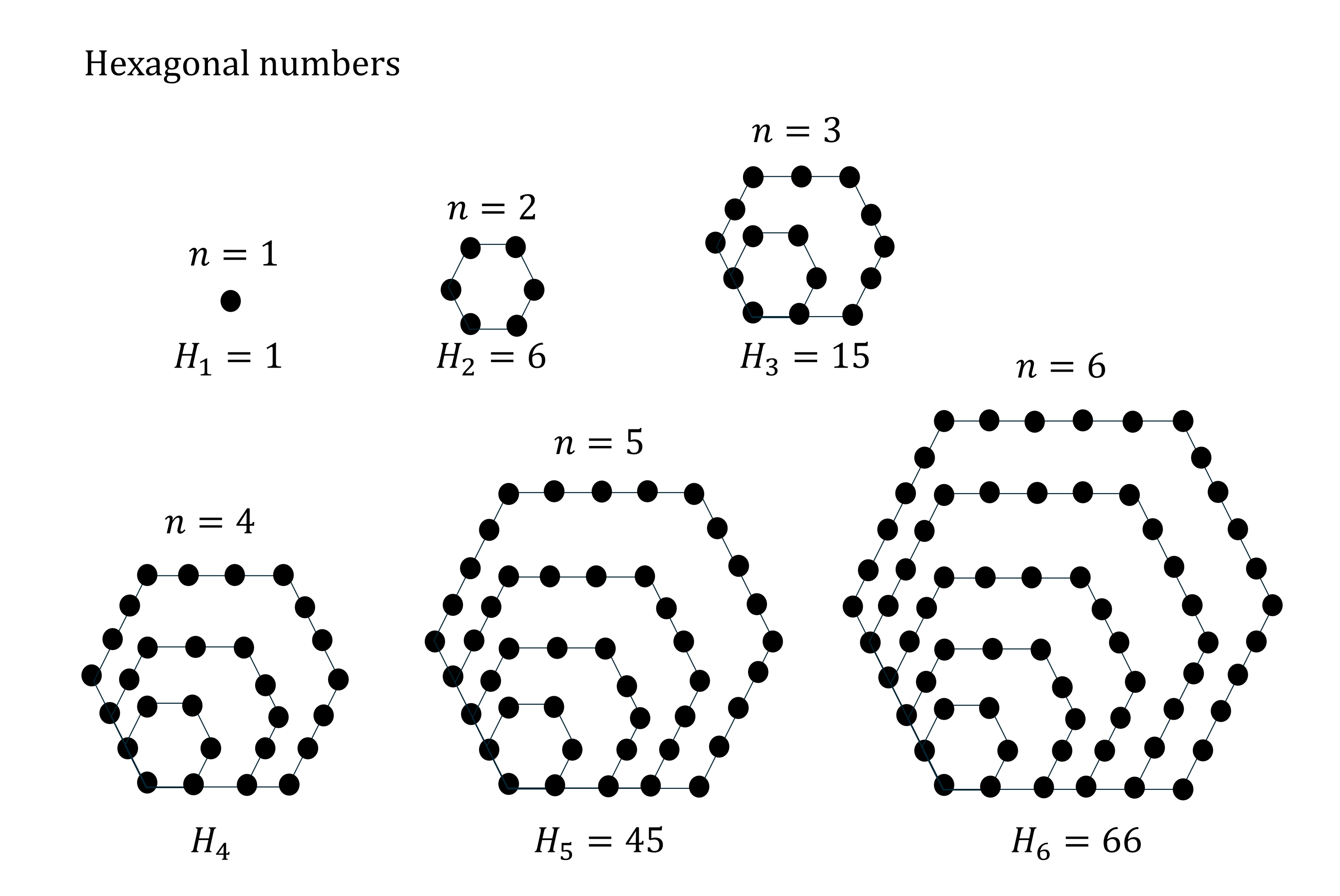
Hexagonal numbers are numbers formed by summing equally spaced dots around hexagons that sit inside of each other, as shown below.

If n is the position of the term in the sequence then Hn is the nth hexagonal number.

Diagram of hexagonal numbers from n=1 to n=6, showing black dots in hexagon patterns.

By counting the total number of dots in the diagram for n=4, work out the fourth hexagonal number, H4.

2a
Sme Calculator
2 marks

The hexagonal numbers are an increasing sequence of numbers, with each number greater than the one before.

The first six hexagonal numbers are

H1=1,  H2=6,  H3=15,  H4=28,  H5=45,  H6=66

Show that the first three hexagonal numbers are triangular numbers.

2b
Sme Calculator
1 mark

Is it true that all triangular numbers are hexagonal numbers?

Explain your answer.

3a
Sme Calculator
2 marks

The hexagonal numbers are an increasing sequence of numbers, with each number greater than the one before.

The first six hexagonal numbers are

H1=1,  H2=6,  H3=15,  H4=28,  H5=45,  H6=66

To test whether a number, x, is a hexagonal number or not, substitute it into the formula:

1+8x+14

If the output is a positive integer, then it is a hexagonal number.

For example, to test if 6 is a hexagonal number, substitute in x=6:

1+8×6+14=1+48+14=1+494=1+74=84=2

The output is 2, which is a positive integer, so 6 is a hexagonal number.

Use the test above to determine whether 120 is a hexagonal number.

You must show your working clearly.

3b
Sme Calculator
2 marks

Is it enough for the square root part of the formula, 8x+1, to be an integer in order for the output of the formula to be an integer?

Explain your answer.

3c
Sme Calculator
3 marks

A student believes that the number 1 is the only square number that is also a hexagonal number.

Use the number 1225 to show that the student is not correct.

You must show your working clearly.

4
Sme Calculator
4 marks

The hexagonal numbers are an increasing sequence of numbers, with each number greater than the one before.

To test whether a number, x, is a hexagonal number or not, you can substitute it into the formula:

1+8x+14

If the output is a positive integer, then it is a hexagonal number.

A hexagonal number, Hn, and its position value, n, satisfy this formula in the following way:

1+8Hn+14=n

By making Hn the subject, show that the formula for the nth term of a hexagonal number is given by

Hn=2n2n

5a
Sme Calculator
2 marks

The sequence of hexagonal numbers, Hn, is shown below.

n

1

2

3

4

5

6

Hn

1

6

15

28

45

66

A new sequence, Kn, is formed using the nth term formula:

Kn=n+Hn

The first three terms, K1, K2 and K3, are shown in the table below.

n

1

2

3

4

5

6

Hn

1

6

15

28

45

66

Kn

2

8

18

Find K4, K5 and K6.

5b
Sme Calculator
3 marks

A fraction is said to be a perfect square if it can be written in the form (ab)2 where a and b are non-zero integers.

Terms in the sequence of Kn can be made into fractions by dividing the previous term, Kn1, by the current term:

Kn1Kn=previous termcurrent term

Use the table below to show that fractions formed in this way are perfect squares.

The first example has been done for you, as follows:

K1K2=28=14=(12)2

n

1

2

3

4

5

6

Hn

1

6

15

28

45

66

Kn

2

8

18

Kn1Kn

No previous term

(12)2

5c
Sme Calculator
3 marks

By substituting the nth term formula

Hn=2n2n

into the formula

Kn=n+Hn

and simplifying, use algebra to prove that

Kn1Kn=(n1)2n2

6
Sme Calculator
2 marks

The hexagonal numbers are an increasing sequence of numbers, with each number greater than the one before.

The nth term formula for the hexagonal numbers is

Hn=2n2n

A new sequence is given by

Rn=22n11n

Use algebra to prove that Rn is the sequence of the reciprocals of hexagonal numbers.