The Competitive Environment (Edexcel A Level Business): Revision Note

Exam code: 9BS0

Lisa Eades

Written by: Lisa Eades

Reviewed by: Steve Vorster

Updated on

The competitive environment

  • The UK confectionery and biscuits market is highly competitive, with intense rivalry between large multinational businesses, supermarket own-label products and smaller independent firms

    • Competition takes place across price, branding, product range, promotion and distribution, and is shaped by the maturity of the market

  • As most UK consumers already buy confectionery and biscuits regularly, businesses are not aiming to attract large numbers of new customers

    • Instead, they are competing to win market share from rivals, which increases competitive pressure

The confectionery market

Competitive element

Explanation

Market concentration and rivalry

  • The UK confectionery market shows a high level of concentration

    • The top five multinational firms control around 47.96% of the UK confectionery market

    • Major players include Mondelēz, Mars, Nestlé, Ferrero and Lindt & Sprüngli

    • This means nearly half of all confectionery sales are made by just five businesses

  • This level of concentration gives large firms significant market power, but rivalry between them remains strong because growth is limited

Competition by segment

  • Chocolate accounts for around 70% of UK confectionery sales by value

  • Competition is especially intense in:

    • countlines

    • sharing bags

    • seasonal products (Easter and Christmas)

  • Brands such as Cadbury, Galaxy, Mars and Kinder compete heavily through promotions and shelf space

  • The sweets segment is smaller but highly competitive

  • Haribo holds around 22.6% of the UK sweets market, making it the clear market leader

    • Other brands, such as Skittles and Maoam, compete through flavour innovation and branding

Non-price competition

  • In confectionery, competition is often non-price based, because constant price cutting can damage margins

  • Businesses compete through:

    • strong branding and advertising

    • emotional marketing linked to treating and gifting

    • product innovation and limited editions

    • seasonal ranges and special packaging

  • For example, Cadbury and Mars invest heavily in Easter and Christmas ranges to protect sales during key periods

The biscuits market

Competitive element

Explanation

Market concentration and rivalry

  • The UK biscuits market is also highly competitive, but competition is spread across a larger number of brands and product types

    • The market is dominated by firms such as pladis (McVitie’s), Mondelēz (Oreo, belVita), Fox’s Burton’s Companies and Lotus Bakeries

    • Supermarket own-label biscuits are particularly strong competitors in everyday segments

  • Unlike confectionery, biscuits are often bought as part of routine shopping, which increases price competition

Value vs volume competition

  • Recent data shows that:

    • Sweet biscuit sales values have increased by around 2–3%

    • However, sales volumes have fallen by over 3% in some years

  • This means competition is increasingly about:

    • protecting sales volume while prices rise

    • using promotions carefully

    • encouraging consumers to trade up to premium biscuits

  • Brands such as Fox’s and LU have achieved growth by focusing on premium positioning and new flavours, rather than low prices

Competition from own-label

  • Supermarket own-label biscuits are a major competitive force

    • Own-label products often undercut branded biscuits on price

    • They appeal strongly to price-sensitive families

    • During the cost-of-living crisis, own-label gained market share in everyday biscuits

  • This increases pressure on branded producers to:

    • justify higher prices through quality or branding

    • rely more on premium and indulgent ranges

Competition between multinationals and independents

  • Competition between large firms and independents is unequal, due to differences in scale and resources

    • Independents rarely compete directly with multinationals, but instead avoid the most competitive mass-market segments
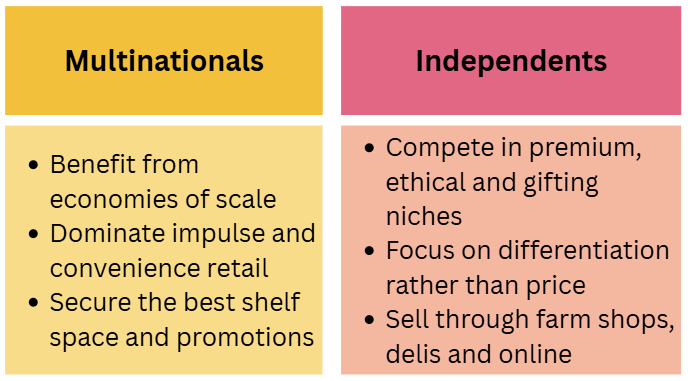
Comparison chart: Multinationals benefit from scale, dominate retail; Independents compete in niches, focus on differentiation, sell through specialty shops.

Barriers to entry

  • The competitive environment creates high barriers to entry, especially for small firms

    • Key barriers include:

      • strong brand loyalty to established names

      • high marketing and promotion costs

      • supermarket power over pricing and shelf space

      • economies of scale in production enjoyed by larger businesses

  • As a result, new entrants must usually:

    • target niche markets

    • offer ethical or premium differentiation

    • accept slower growth

Unlock more, it's free!

Join the 100,000+ Students that ❤️ Save My Exams

the (exam) results speak for themselves:

Lisa Eades

Author: Lisa Eades

Expertise: Business Content Creator

Lisa has taught A Level, GCSE, BTEC and IBDP Business for over 20 years and is a senior Examiner for Edexcel. Lisa has been a successful Head of Department in Kent and has offered private Business tuition to students across the UK. Lisa loves to create imaginative and accessible resources which engage learners and build their passion for the subject.

Steve Vorster

Reviewer: Steve Vorster

Expertise: Economics & Business Subject Lead

Steve has taught A Level, GCSE, IGCSE Business and Economics - as well as IBDP Economics and Business Management. He is an IBDP Examiner and IGCSE textbook author. His students regularly achieve 90-100% in their final exams. Steve has been the Assistant Head of Sixth Form for a school in Devon, and Head of Economics at the world's largest International school in Singapore. He loves to create resources which speed up student learning and are easily accessible by all.