Magnetic Flux Density (Cambridge (CIE) A Level Physics): Revision Note
Exam code: 9702

Force on a current-carrying conductor
A current-carrying conductor produces its own magnetic field
When interacting with an external magnetic field, it will experience a force
The force due to a magnetic field can be observed by
placing a copper rod in a uniform magnetic field
connecting the copper rod to a circuit
When current is passed through the copper rod, it experiences a force
This causes it to accelerate in the direction of the force
Observing the force on a current-carrying conductor
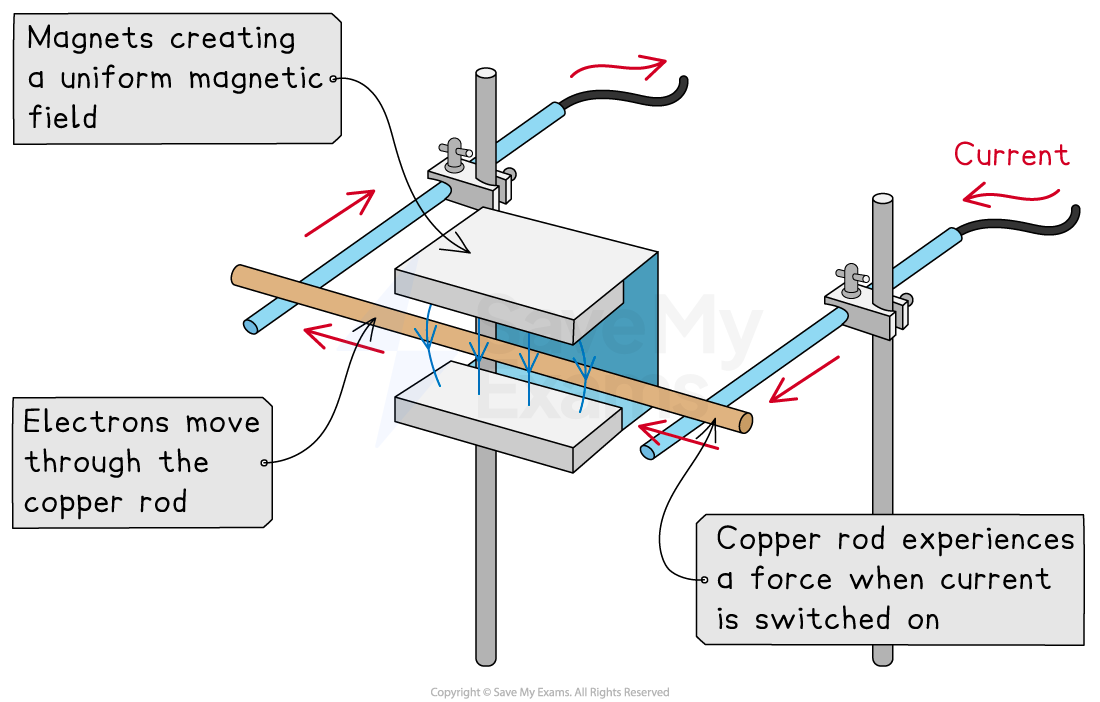
A copper rod moves within a magnetic field when current is passed through it
Magnetic flux density definition
The strength of a magnetic field can be described by the density of its field lines
The higher the flux density, the stronger the magnetic field i.e. regions where field lines are closer together
The lower the flux density, the weaker the magnetic field i.e. regions where field lines are further apart
This is described by the magnetic flux density B of a field, which is defined as:
The force exerted per unit current per unit length on a straight current-carrying conductor placed perpendicular to the magnetic field
Magnetic flux density is measured in teslas (T)
One tesla, 1 T, is defined as:
The flux density that causes a force of 1 N on a 1 m wire carrying a current of 1 A at right angles to the field
To put this into perspective, the Earth's magnetic flux density is around 0.032 mT and an ordinary fridge magnet is around 5 mT

Unlock more, it's free!
Join the 100,000+ Students that ❤️ Save My Exams
the (exam) results speak for themselves:

Was this revision note helpful?
Build on this topic
