Forces Between Current-Carrying Conductors (Cambridge (CIE) A Level Physics): Revision Note
Exam code: 9702

Origin of the forces between current-carrying conductors
A current-carrying conductor, such as a wire, produces a magnetic field around it
The direction of the field depends on the direction of the current through the wire
This is determined by the right-hand grip rule
Parallel current-carrying conductors will therefore either attract or repel each other
If the currents are in the same direction in both conductors, the magnetic field lines between the conductors cancel out – the conductors will attract each other
If the currents are in the opposite direction in both conductors, the magnetic field lines between the conductors push each other apart – the conductors will repel each other
Magnetic field lines around two current-carrying wires
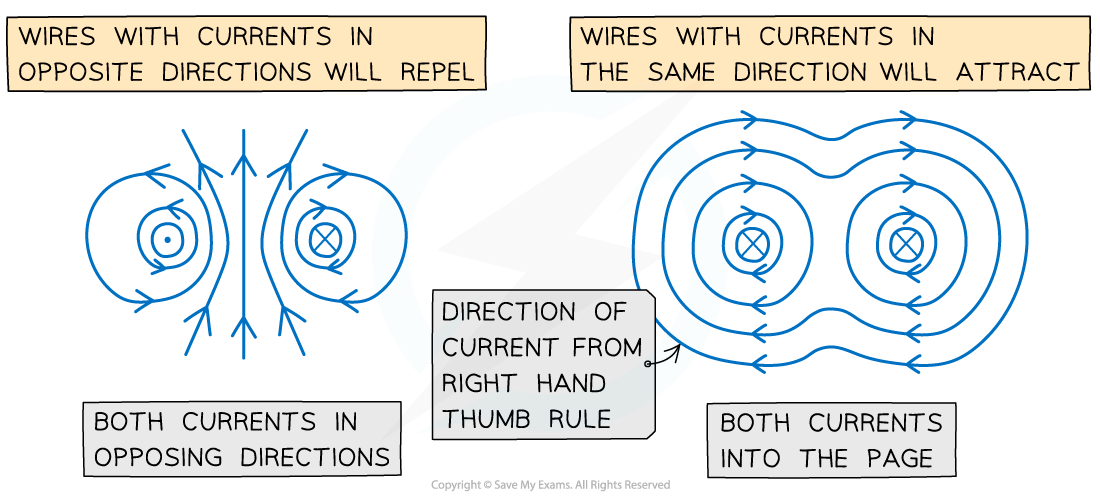
Both wires will attract if their currents are in the same direction and repel if in opposite directions
When the conductors attract, the direction of the magnetic forces will be towards each other
When the conductors repel, the direction of the magnetic forces will be away from each other
The magnitude of each force depend on the amount of current and length of the wire
Worked Example
Two long, straight, current-carrying conductors, WX and YZ, are held at a close distance, as shown in diagram 1.
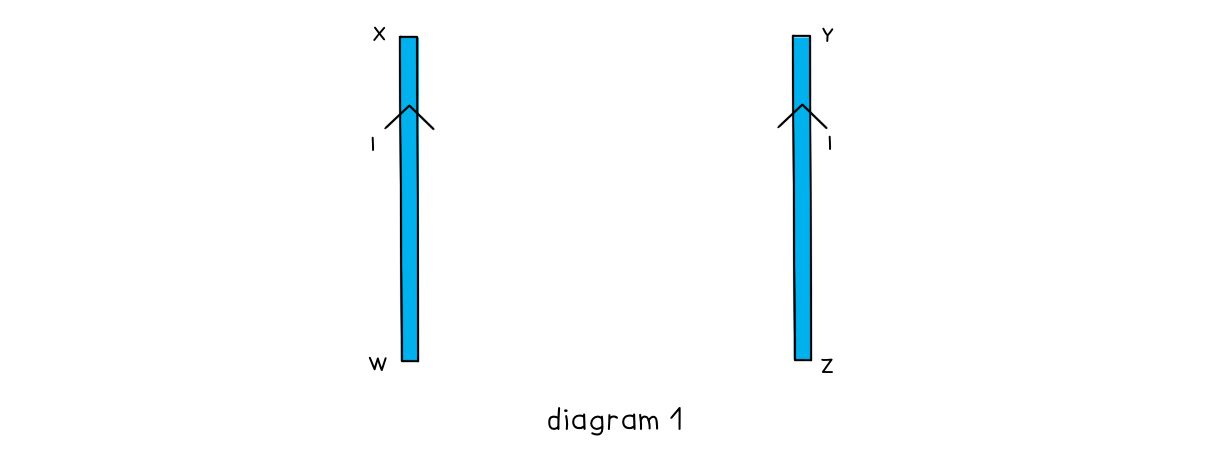
The conductors each carry the same magnitude current in the same direction. A plan view from above the conductors is shown in diagram 2.

On diagram 2, draw arrows, one in each case, to show the direction of:
The magnetic field at X due to the current in wire YZ (label this arrow BYZ)
The force at X as a result of the magnetic field due to the current in the wire YZ (label this arrow FYZ)
The magnetic field at Y due to the current in wire WX (label this arrow BWX)
The force at Y as a result of the magnetic field due to the current in the wire WX (label this arrow FWX)
Answer:
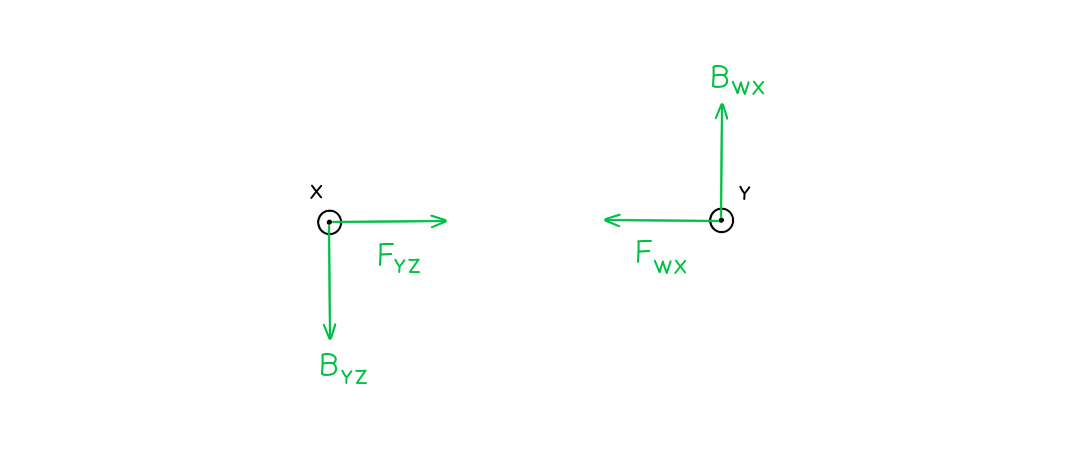
Newton’s third law states: When two bodies interact, the force on one body is equal but opposite in direction to the force on the other body
Therefore, the forces on the wires act in equal but opposite directions

Unlock more, it's free!
Join the 100,000+ Students that ❤️ Save My Exams
the (exam) results speak for themselves:

Was this revision note helpful?
Build on this topic