Equilibrium Points (DP IB Applications & Interpretation (AI): HL): Revision Note

Equilibrium points
What is an equilibrium point?
An equilibrium point for a system of coupled differential equations is a point at which both and
If a solution trajectory starts on an equilibrium point
it will never move from that point
For example, consider and
Solve and
is the equilibrium point
What are stable and unstable equilibrium points?
An equilibrium point can be stable or unstable
An equilibrium point is stable if
all solution trajectories which start close to the equilibrium point remain close to the equilibrium point
An equilibrium point is unstable if
there is any solution trajectory which starts close to the equilibrium point and moves away from the equilibrium point
A saddle point is an example of an unstable equilibrium point
Some solution trajectories which start close to the saddle point move towards the saddle point
Whereas other solution trajectories which start close to the saddle point move away from the saddle point
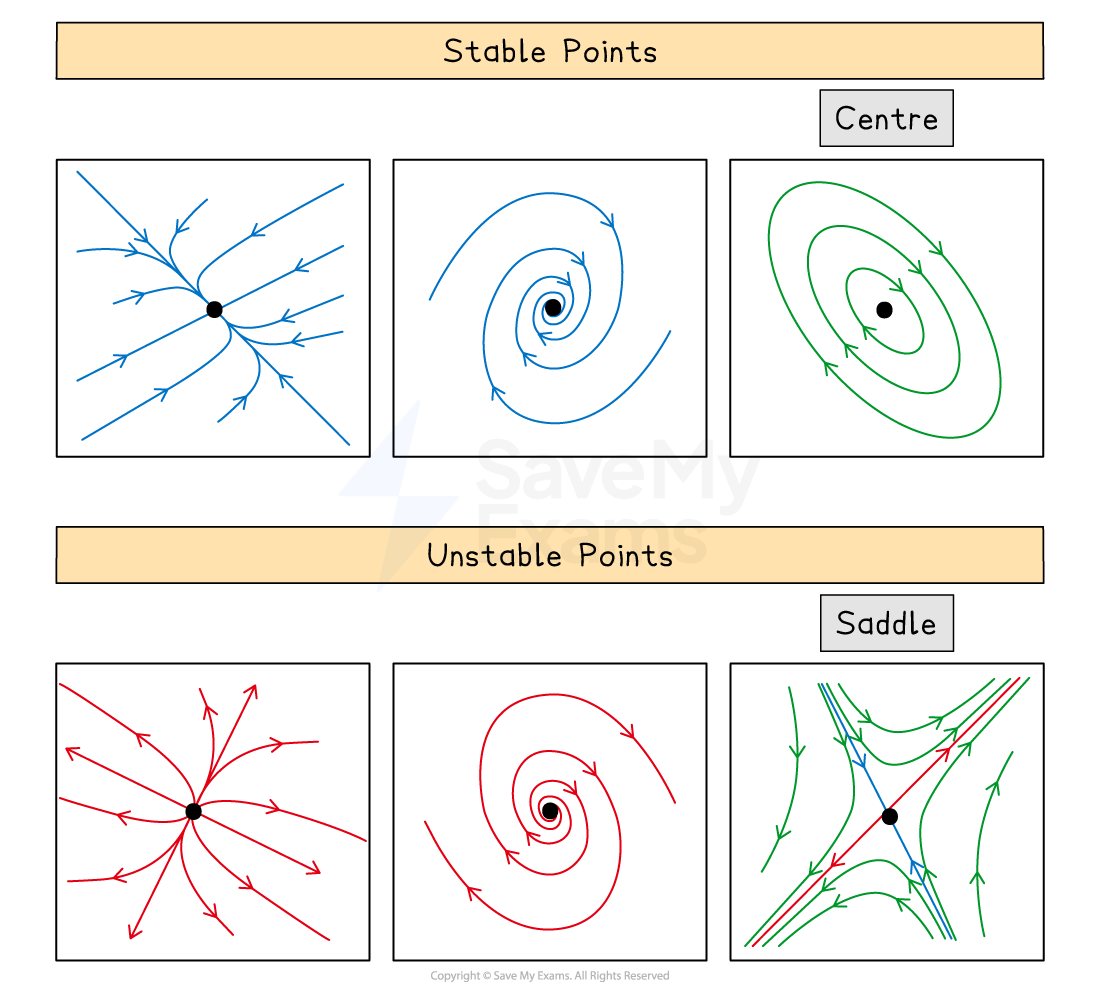
How can I determine the nature of an equilibrium point?
You can use a phase portrait to determine the nature of the equilibrium point
The origin is always an equilibrium point , where
Eigenvalues of | Nature of equilibrium point at |
|---|---|
Both positive and distinct | Unstable |
Both negative and distinct | Stable |
One positive and one negative | Unstable (a saddle point) |
Complex with positive real parts | Unstable |
Complex with negative real parts | Stable |
Complex with no real parts | Stable (a centre) |
Worked Example
a) Consider the system of coupled differential equations
Show that is an equilibrium point for the system.
Answer:

b) Consider the system of coupled differential equations
Given that and are the eigenvalues of the matrix , with corresponding eigenvectors and , determine the coordinates and nature of the equilibrium point for the system.
Answer:


Unlock more, it's free!
Join the 100,000+ Students that ❤️ Save My Exams
the (exam) results speak for themselves:

Was this revision note helpful?
Build on this topic