Introduction to Derivatives (DP IB Applications & Interpretation (AI): HL): Revision Note

Introduction to derivatives
What is a limit?
The limit of a function is the value a function (of ) approaches as approaches a particular value from either side
Limits are of interest when the function is undefined at a particular value
For example, the function will approach a limit (the value 4) as approaches 1 from both below and above
But the function is undefined at as this would involve dividing by zero
What might I be asked about limits?
You may be asked to predict or estimate limits from a table of function values or from the graph of
You may be asked to use your GDC to plot the graph and use values from it to estimate a limit
What is a derivative?
Calculus is about rates of change
the way a car’s position on a road changes is its speed (velocity)
the way the car’s speed changes is its acceleration
The gradient (rate of change) of a non-linear function varies with
The derivative of a function is a function that gives the gradient at each value of
The derivative is also called the gradient function
How are limits and derivatives linked?
Consider the point on the graph of as shown below
is a series of chords
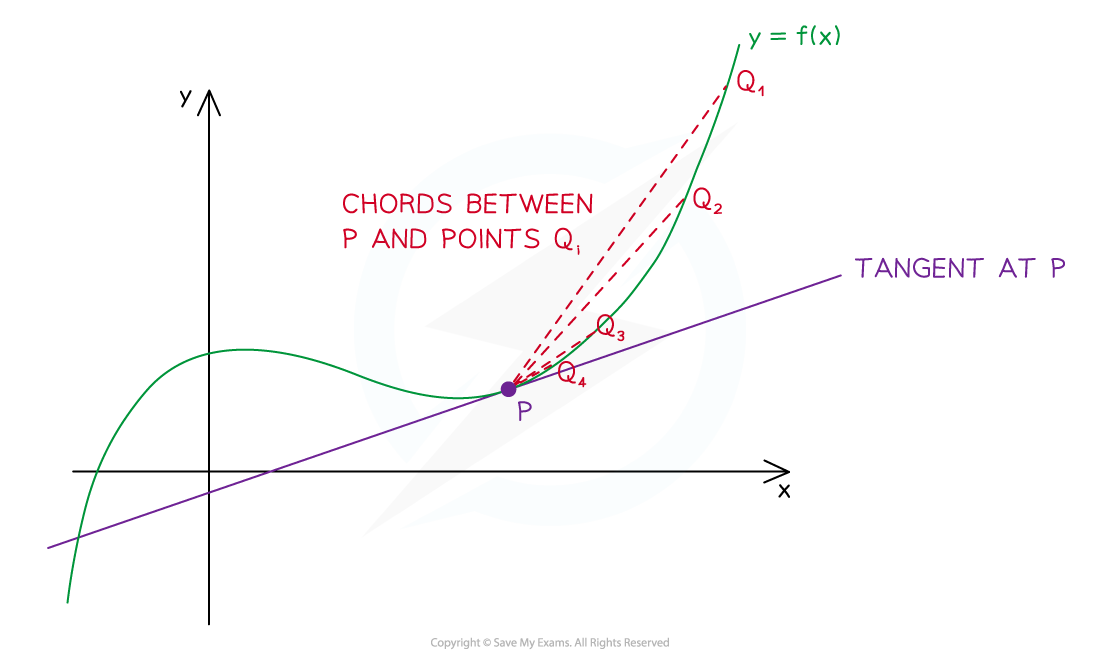
The gradient of the function at the point is equal to the gradient of the tangent at point
The gradient of the tangent at point is the limit of the gradient of the chords as point ‘slides’ down the curve and gets ever closer to point
The gradient of the function changes as changes
The derivative is the function that calculates the gradient as an output if you input a value of
What is the notation for derivatives?
For the function , the derivative, with respect to , is written as
Different variables may be used
e.g. If then
Worked Example
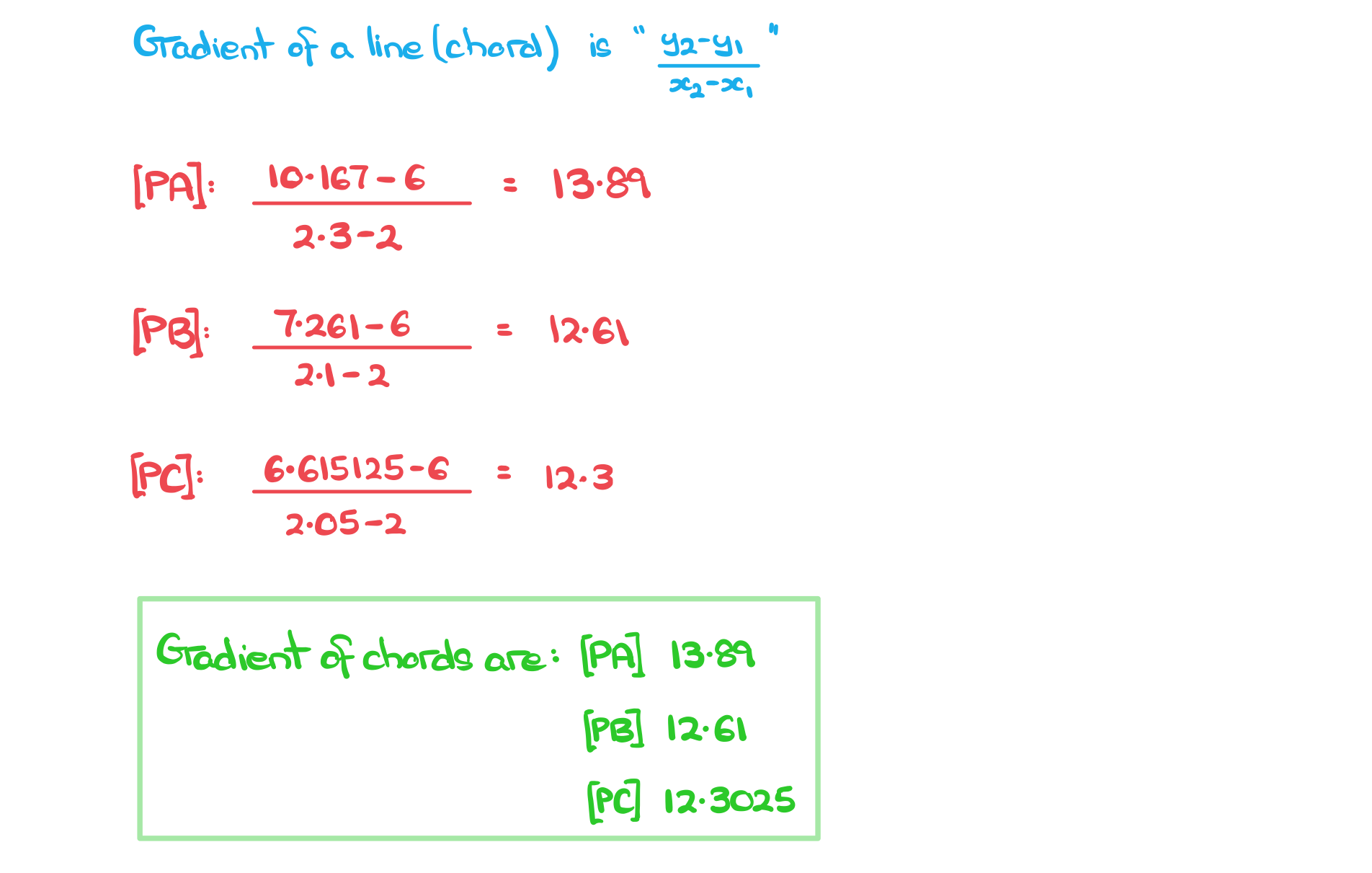
The graph of where passes through the points and .
a) Find the gradient of the chords and .
Answer:
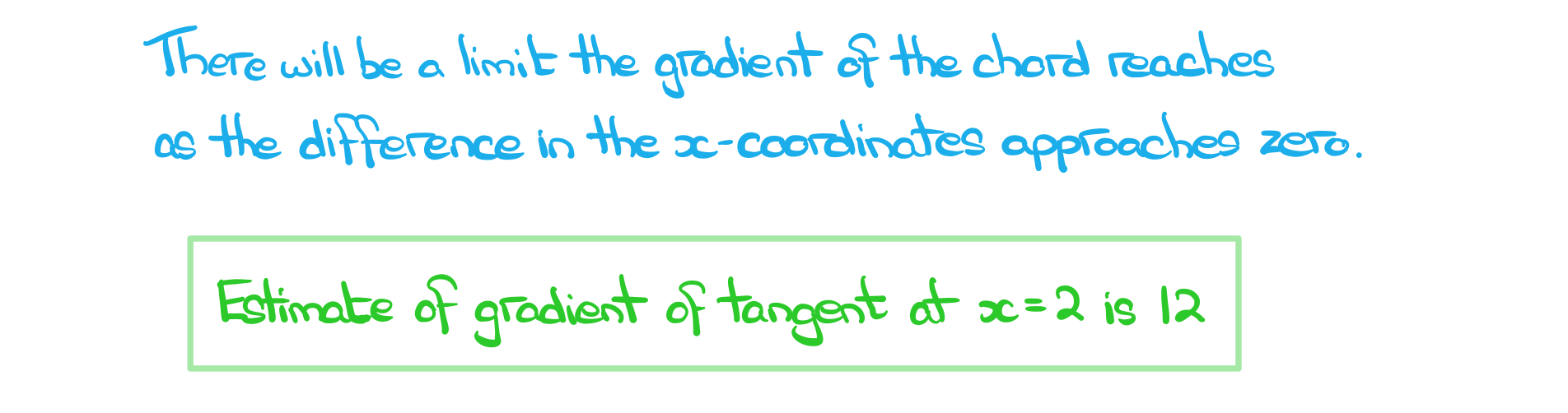
b) Estimate the gradient of the tangent to the curve at the point .
Answer:

Unlock more, it's free!
Join the 100,000+ Students that ❤️ Save My Exams
the (exam) results speak for themselves:

Was this revision note helpful?
Build on this topic
