Integrating Special Functions (DP IB Applications & Interpretation (AI): HL): Revision Note

Integrating trig functions
How do I integrate sin, cos and 1/cos2?
The antiderivatives for sine and cosine are
where is the constant of integration
Also, from the derivative of
Examiner Tips and Tricks
The three standard integrals above are all in the exam formula booklet.
For the linear function, where and are constants,
For calculus with trigonometric functions angles must be measured in radians
Ensure you know how to change the angle mode on your GDC
Examiner Tips and Tricks
Make sure you have a copy of the formula booklet during revision but don't try to memorise everything in the formula booklet.
Instead, make sure you are familiar with the layout of the formula booklet. That way you’ll be able to quickly locate whatever you are after.
For formulae you think you have remembered, use the booklet to double check.
Worked Example
a) Find, in the form, an expression for each integral
Answer:

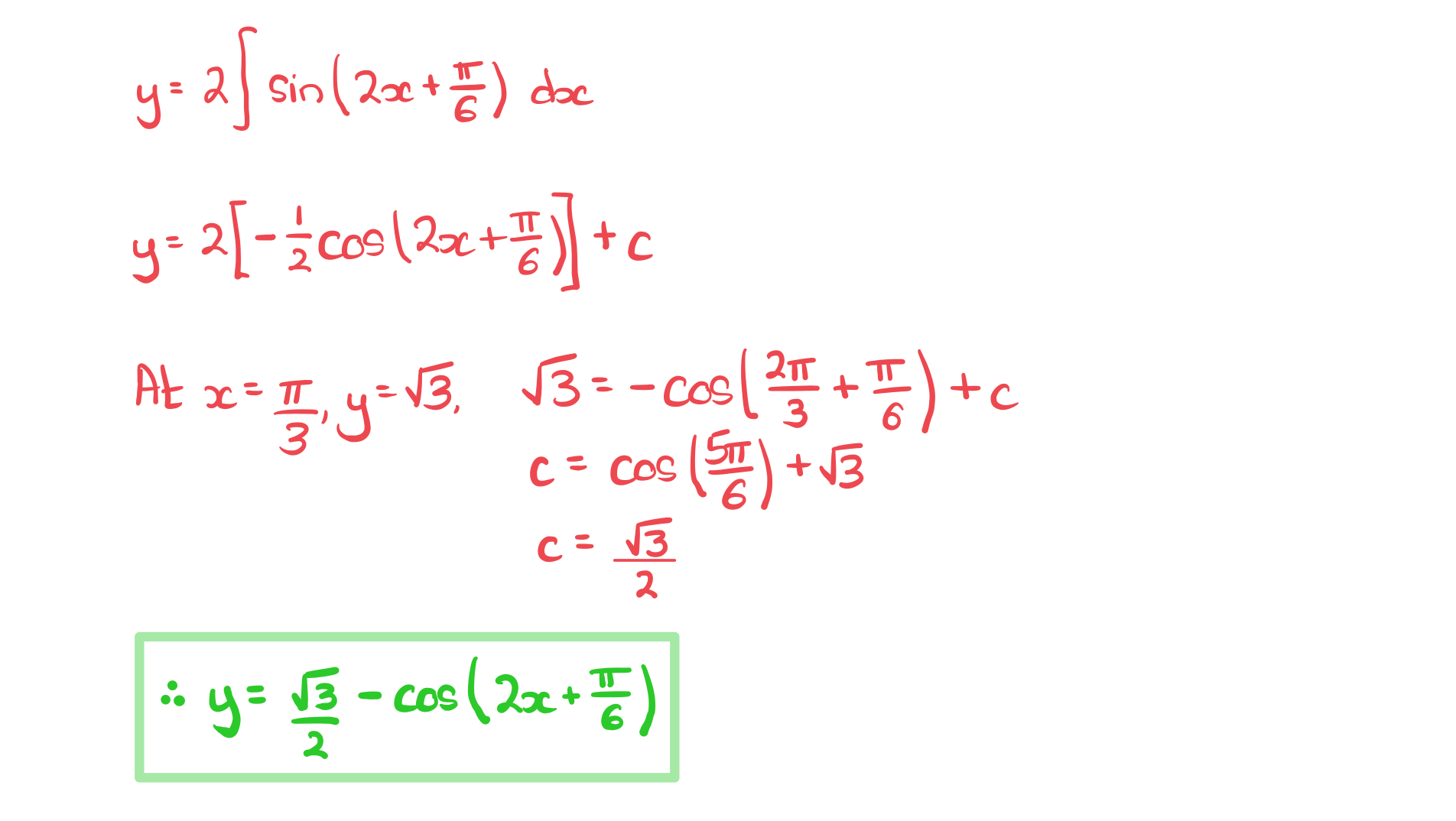
b) A curve has equation.
The curve passes through the point with coordinates.
Find an expression for.
Answer:
Integrating e^x & 1/x
How do I integrate exponentials and 1/x?
The antiderivatives involving and are
where is the constant of integration
Examiner Tips and Tricks
Both of the standard integrals above are in the exam formula booklet.
For the linear function, where and are constants,
It follows from the last result (by using the using the reverse chain rule) that
Examiner Tips and Tricks
With ln, it can sometimes be useful to write the constant of integration,, as a logarithm. I.e., by letting for some (positive) constant .
Using the laws of logarithms, the answer can then be written as a single term. For example:
Worked Example
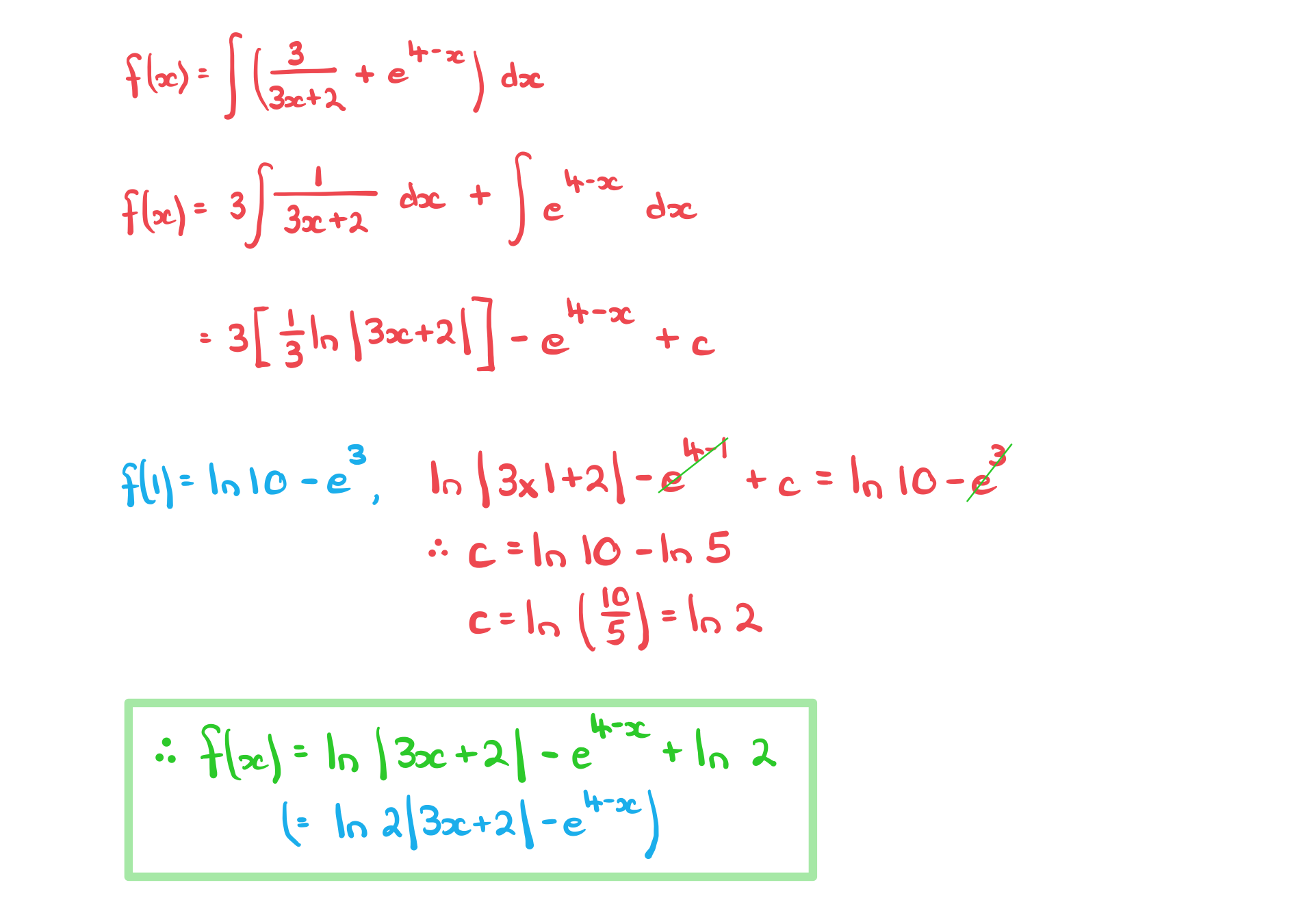
A curve has the gradient function.
Given that the exact value of is, find an expression for.
Answer:

Unlock more, it's free!
Join the 100,000+ Students that ❤️ Save My Exams
the (exam) results speak for themselves:

Was this revision note helpful?
Build on this topic