Phase Portraits (DP IB Applications & Interpretation (AI): HL): Revision Note

Phase portraits
What is a phase portrait for a system of coupled differential equations?
Consider the system of coupled equations that can be represented in the matrix form , where
A phase portrait is a diagram showing how the values of x and y change over time
On a phase portrait we will usually sketch several typical solution trajectories
The precise trajectory that the solution for a particular system will travel along is determined by the initial conditions for the system
Suppose for the matrix
and are the eigenvalues
and are the corresponding eigenvectors
The overall nature of the phase portrait depends in large part on the values of and
Examiner Tips and Tricks
You need to know how phase portraits looks when the eigenvalues or:
real, distinct and non-zero
complex conjugates
What does the phase portrait look like when the eigenvalues are real numbers?
The phase portraits when the eigenvalues are real always include two lines representing the eigenvectors
These go through the origin
They are parallel to the eigenvectors
The origin separates these two lines into four solution trajectories
For example, if and are eigenvectors
then these lines have the equations and respectively
The origin separates these two lines into four solution trajectories
Their directions depend on the signs of the corresponding eigenvalues
If an eigenvalue is positive then the corresponding lines are directed away from the origin
If an eigenvalue is negative then the corresponding lines are directed towards the origin
The solution trajectories have the properties:
As , the solution trajectory is parallel to the line corresponding to the smaller eigenvalue
As , the solution trajectory is parallel to the line corresponding to the larger eigenvalue
A solution trajectory never crosses a line corresponding to an eigenvector
Examiner Tips and Tricks
Remember that the exact solution is of the form when the eigenvalues are real, distinct and non-zero. You can use this to help you determine the trajectory.
For example, consider .
When , . Therefore, as .
When , . Therefore, as .
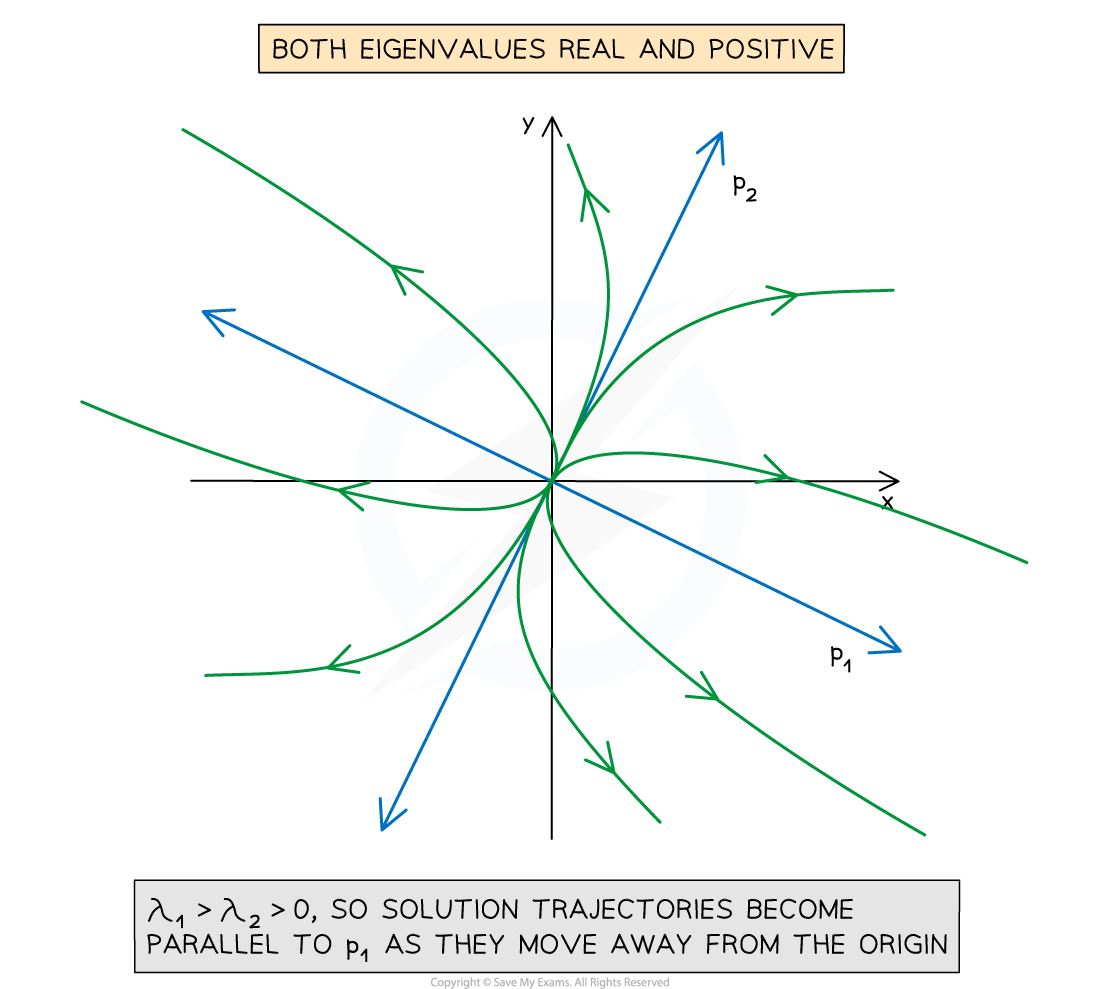
Both eigenvalues are positive
Suppose
All solution trajectories are directed away from the origin as t increases
To draw a solution trajectory
Start at the origin
Draw a line roughly parallel to
Move away from the origin and
Draw a line roughly parallel to
The line does not end
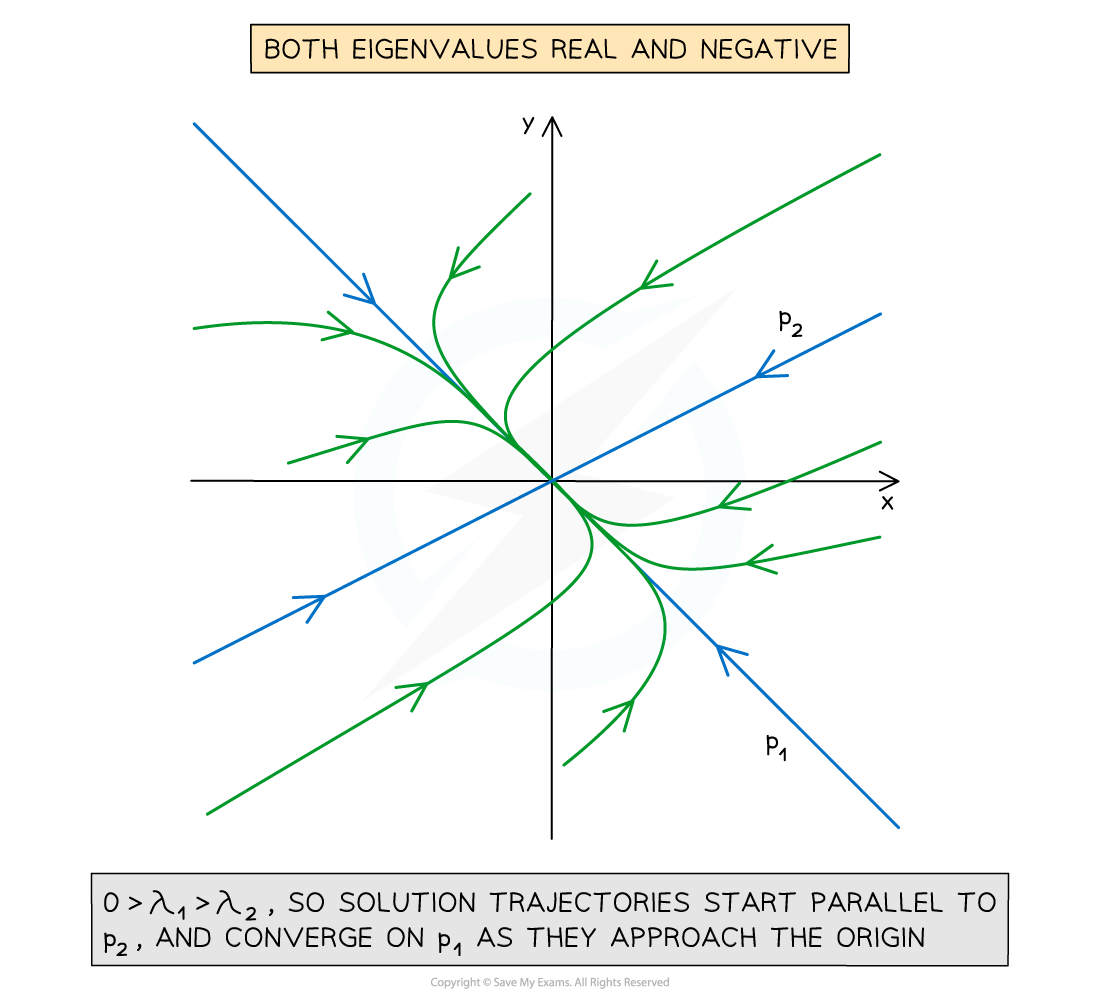
Both eigenvalues are negative
Suppose
All solution trajectories are directed towards the origin as t increases
To draw a solution trajectory
Start from somewhere at the edge of the graph
Draw a line roughly parallel to
Move toward the origin and away from
Draw a line roughly parallel to
End at the origin
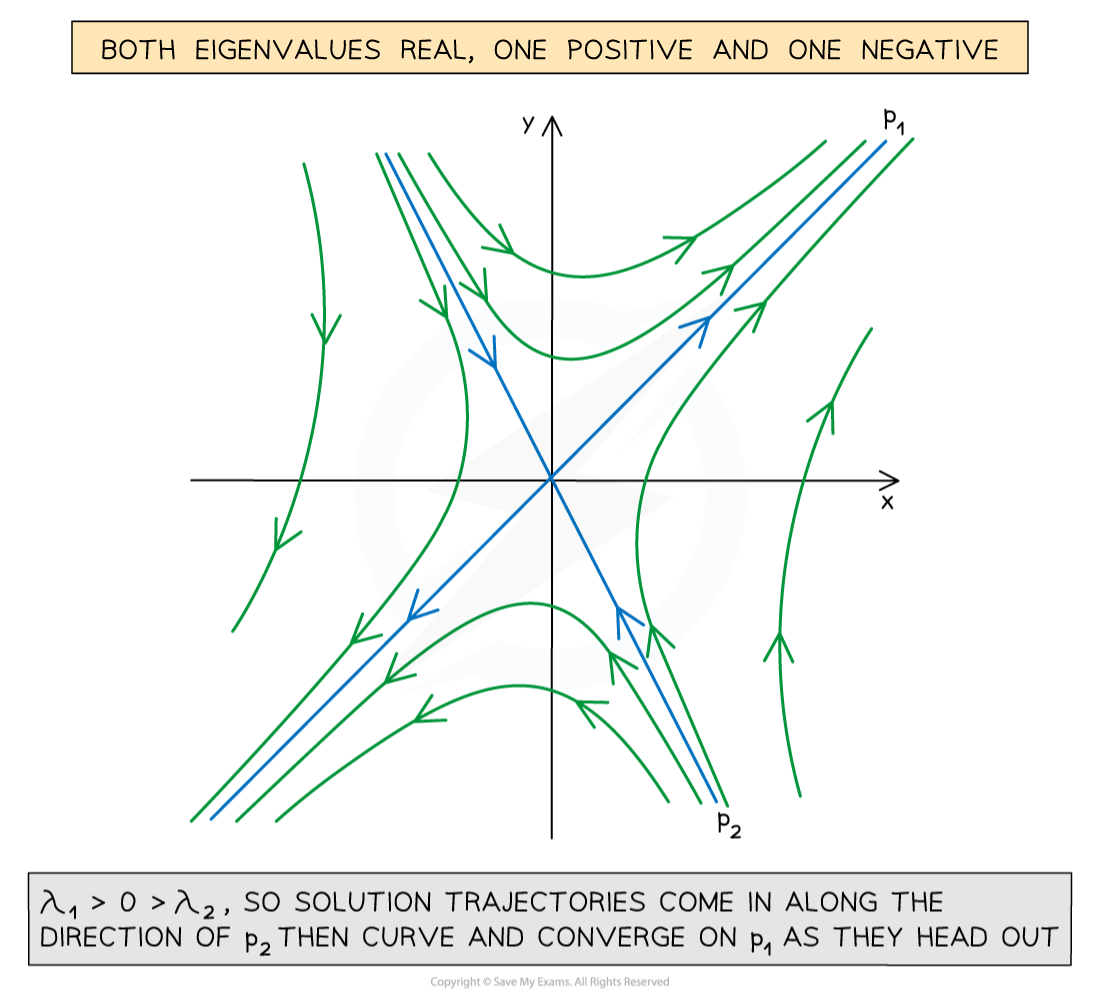
One positive and one negative eigenvalue
Suppose
To draw a solution trajectory
Start from somewhere at the edge of the graph
Draw a line roughly parallel to
Move toward the origin and away from
Move away from the origin and toward
Draw a line roughly parallel to
The line does not end
What does the phase portrait look like when the eigenvalues are complex numbers?
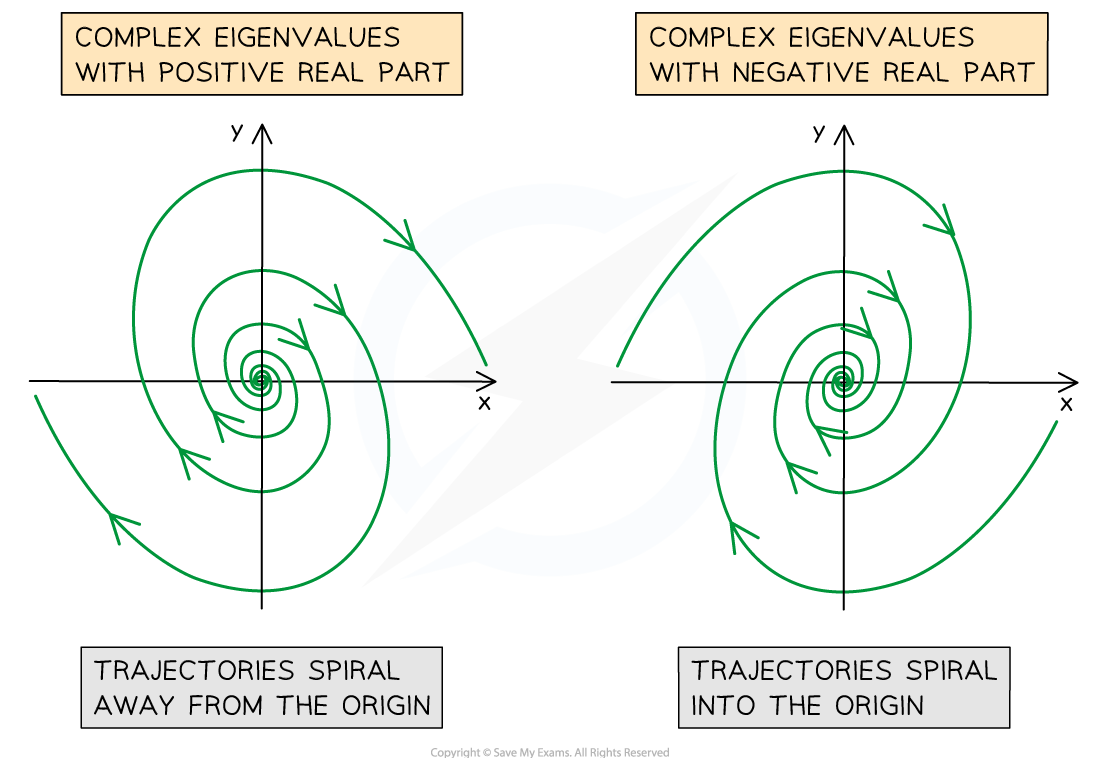
The phase portraits when the eigenvalues are complex always include curves orbiting the origin
They could be closed ellipses
They could be open spirals
The real part of the complex eigenvalues affect the shape
Positive real parts cause the trajectories to spiral away from the origin
Negative real parts cause the trajectories to spiral towards the origin
Zero real parts cause the trajectories to form ellipses centred at the origin
You can find the orientation of the trajectory by finding the value of at a specific point on one of the coordinate axes
For example, consider the system
Pick the point
From , the trajectory is moving to the right and up
Therefore, it is counter-clockwise around the origin
Examiner Tips and Tricks
To make it easiest, you should pick or .
The trajectory is clockwise if it is moving down from or right from .
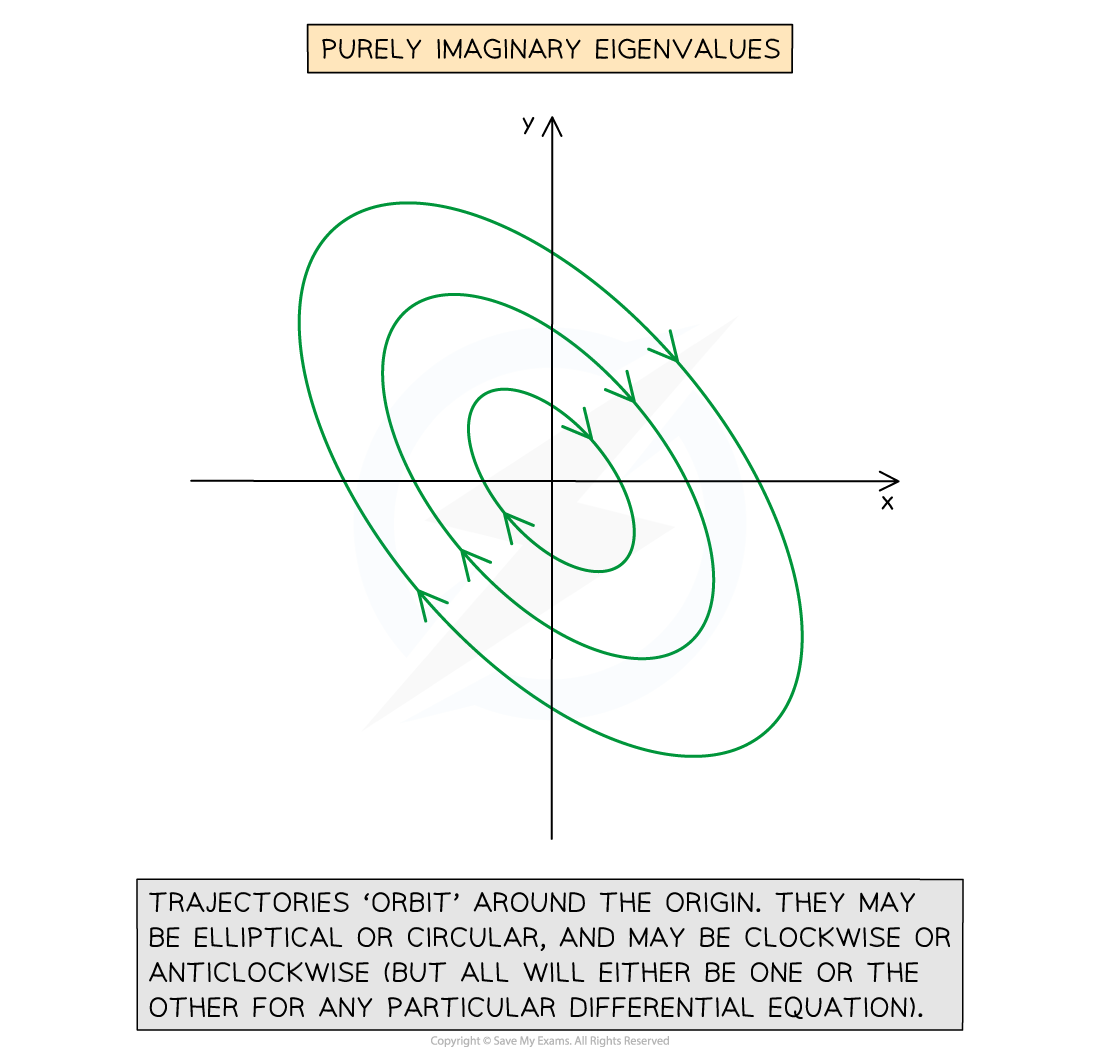
Real part is equal to zero
Suppose and
To draw a solution trajectory
Find the direction at or to determine if it is clockwise or counter-counter
Draw ellipses that are centred at the origin
Real part is not equal to zero
Suppose and
To draw a solution trajectory
Find the direction at or to determine if it is clockwise or counter-counter
Draw spirals from origin
Label the direction of the trajectories
If it spirals towards the origin
If it spirals away from the origin
Worked Example
Consider the system of coupled differential equations
Given that and are the eigenvalues of the matrix , with corresponding eigenvectors and , draw a phase portrait for the solutions of the system.
Answer:


Unlock more, it's free!
Join the 100,000+ Students that ❤️ Save My Exams
the (exam) results speak for themselves:

Was this revision note helpful?
Build on this topic
