Laws of Logarithms (DP IB Applications & Interpretation (AI): HL): Revision Note

Amber

Written by: Amber

Reviewed by: Mark Curtis

Updated on

Laws of logarithms

What are the laws of logarithms?

  • The laws of logarithms (log laws) you need to know are:

    • logaxy= logax+ logay

    • logaxy= logax  logay

    • logaxm= mlogax

  • These hold for a, x, y>0

Examiner Tips and Tricks

The laws of logarithms are given in the formula booklet.
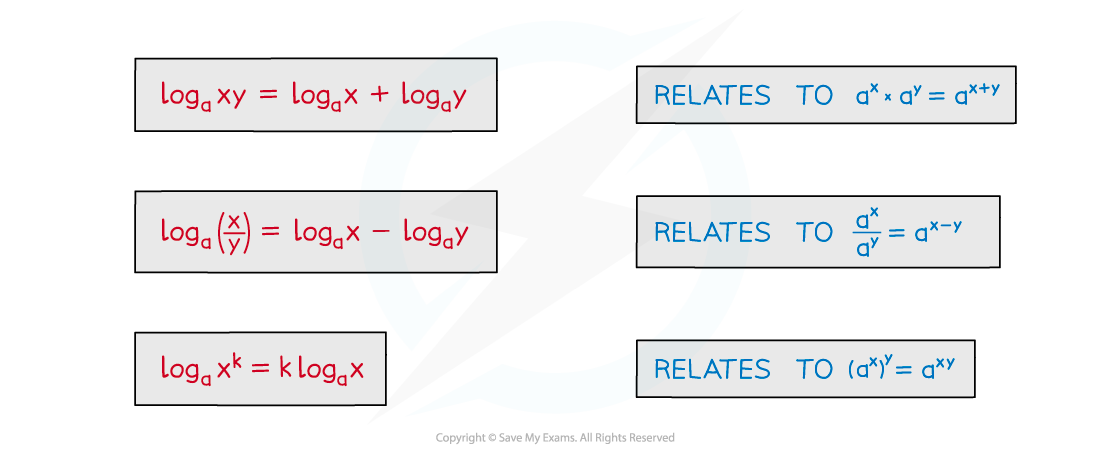
Logarithmic laws and their equivalent exponential forms, showing relationships between multiplication, division, and powers in logarithms and exponents.

Useful results from the laws of logarithms

  • loga1=0

    • This is equivalent to a0=1

  • logaa=1

    • This is equivalent to a1=a

  • logaak= k

    • because logaak= klogaa=k×1

  • alogax= x

    • because logarithms and powers are inverses

  • loga1x=logax

    • because loga1x=loga1logax=0logax

Examiner Tips and Tricks

These useful results are not in the formula booklet.
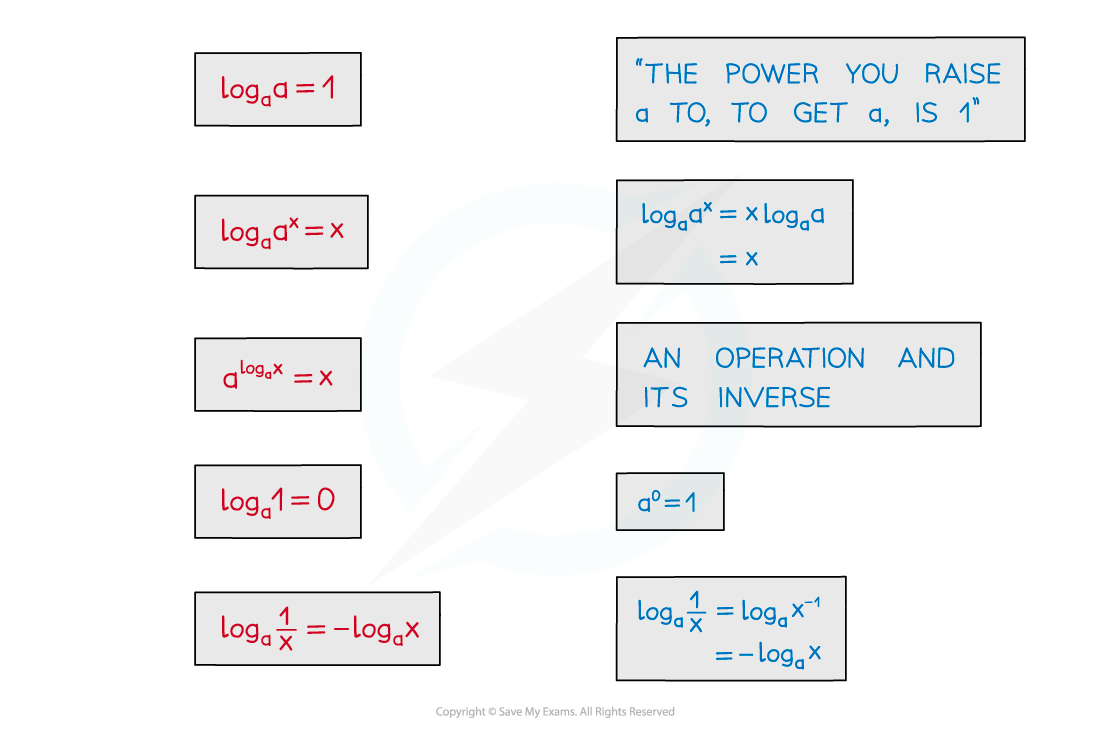
Mathematical properties of logarithms and exponents with examples, including inverse relationships and expressions for logs and powers.

Examiner Tips and Tricks

Beware: loga(x+y)logax+logay

  • The useful results can be applied to ln x (logex) too

    • Two particularly useful results are

      • ln ex = x

      • elnx = x

When are logarithms undefined?

  • You cannot take the log of zero or the log of a negative number

    • logax is defined for x>0

    • logax is undefined for x0

  • Similarly

    • loga(x5) is defined for x>5

    • loga(x5) is undefined for x5

    • etc

Examiner Tips and Tricks

When solving an equation involving logs, remove any solutions that make the original equation undefined.

Worked Example

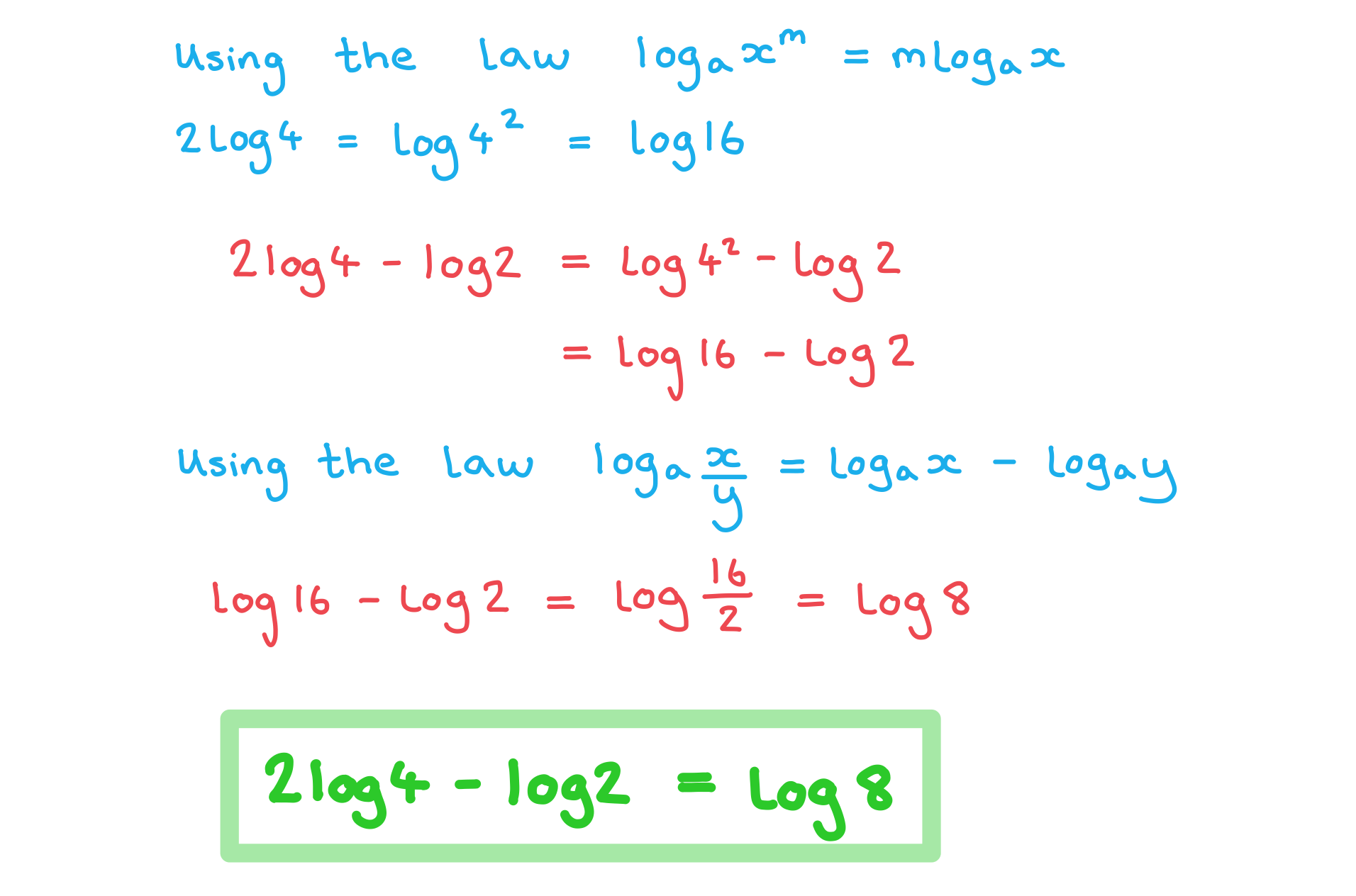
a) Write the expression 2 log 4  log 2 in the form log k, where k  .

Answer:


aa-sl-1-2-2-laws-of-logs-we-solution-part-a

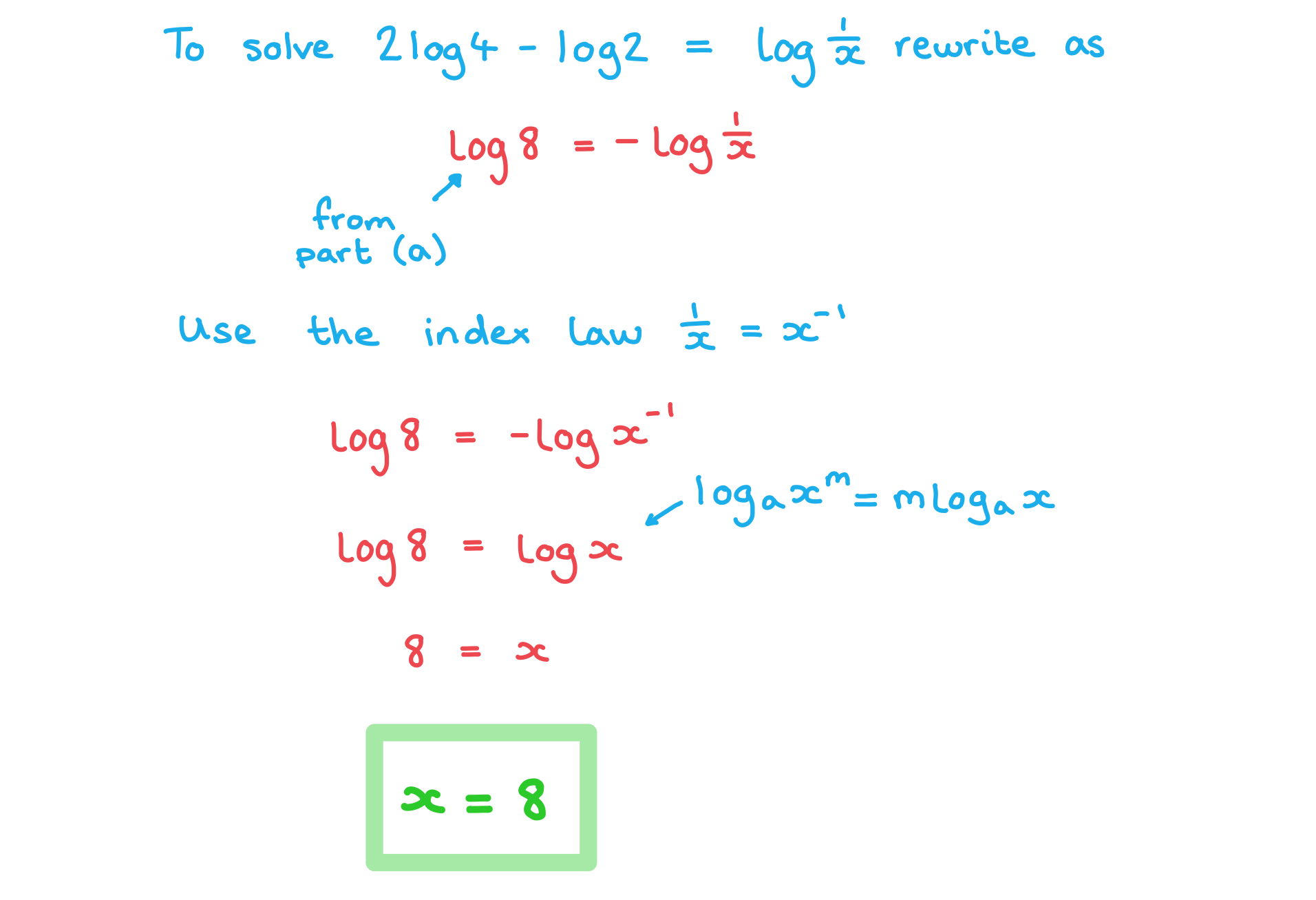
b)   Hence, or otherwise, solve 2 log 4log 2=log 1x.

Answer:

aa-sl-1-2-2-laws-of-logs-we-solution-part-b

Unlock more, it's free!

Join the 100,000+ Students that ❤️ Save My Exams

the (exam) results speak for themselves:

Build on this topic

Amber

Author: Amber

Expertise: Maths Content Creator

Amber gained a first class degree in Mathematics & Meteorology from the University of Reading before training to become a teacher. She is passionate about teaching, having spent 8 years teaching GCSE and A Level Mathematics both in the UK and internationally. Amber loves creating bright and informative resources to help students reach their potential.

Mark Curtis

Reviewer: Mark Curtis

Expertise: Maths Content Creator

Mark graduated twice from the University of Oxford: once in 2009 with a First in Mathematics, then again in 2013 with a PhD (DPhil) in Mathematics. He has had nine successful years as a secondary school teacher, specialising in A-Level Further Maths and running extension classes for Oxbridge Maths applicants. Alongside his teaching, he has written five internal textbooks, introduced new spiralling school curriculums and trained other Maths teachers through outreach programmes.