Matrices of Geometric Transformations (DP IB Applications & Interpretation (AI): HL): Revision Note

Matrices of geometric transformations
How do I find the matrix for a transformation?
You be asked to find the matrix transformation given an object and its image
You need to know three pairs of coordinates of the object and its image
You can just substitute coordinates of the object and coordinates of the image into the equation
Each pair of coordinates gives you two equations
You can solve the equations to find the unknown values
Transformations with translations
It is easiest if you know the images of , and
The image of is
The image of is
The image of is
For example, suppose (0, 0) ⇾ (2, 5), (1, 0) ⇾ (3, -1) and (0, 1) ⇾ (5, 0)
is the image of the origin so this is the translation vector
Subtract this from the image of the other two points
The matrix transformation is
Transformations with no translations
It is easier if you know there are no translations
This means that the origin does not change under the transformation
In these cases, you can quickly find the transformation matrix by seeing where and are mapped to
These coordinates are the columns of the matrices
For example, suppose (0, 0) ⇾ (0, 0), (1, 0) ⇾ (3, -1) and (0, 1) ⇾ (5, 0)
The transformation matrix is
What are the matrices for common geometric transformations?
Most of the following transformation matrices are given in the formula booklet
The translation one is not given
Transformation | Matrix |
|---|---|
Rotation anticlockwise (or counter-clockwise) through angle θ about the origin | |
Rotation clockwise through angle θ about the origin | |
Reflection in the line | |
Enlargement with scale factor k, centre of enlargement at the origin (0, 0) | |
Horizontal stretch (or stretch parallel to the x-axis) with scale factor k | |
Vertical stretch (or stretch parallel to the y-axis) with scale factor k | |
Translation by vector |
If you are given a line of reflection in the form
then solve
Examiner Tips and Tricks
It would be good practice for you to try to derive the matrices in the table above by considering what happens to the points and .
Worked Example
Triangle PQR has coordinates P(-1, 4), Q(5, 4) and R(2, -1).
The transformation T is a reflection in the line .
a) Find the matrix T that represents a reflection in the line .
Answer:

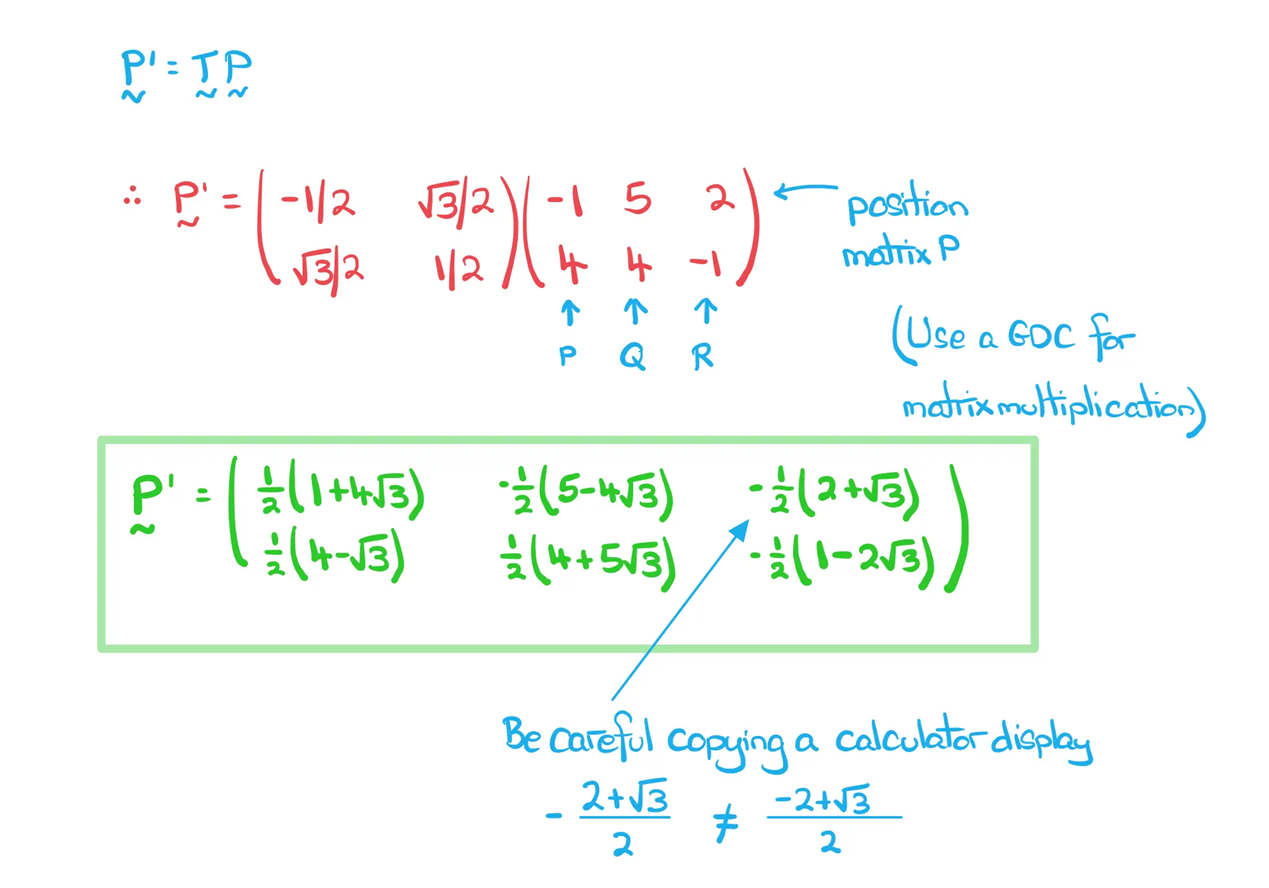
b) Find the position matrix, P’, representing the coordinates of the images of points P, Q and R under the transformation T.
Answer:

Unlock more, it's free!
Join the 100,000+ Students that ❤️ Save My Exams
the (exam) results speak for themselves:

Was this revision note helpful?
Build on this topic
