Changes of State (Edexcel IGCSE Physics): Revision Note
Exam code: 4PH1

Changes of state
When a solid is heated, it melts to form a liquid
When it reaches the melting point, further energy supplied is transferred to the potential store of the particles
This breaks the rigid bonds between the particles so they can flow over each other
When a liquid is heated, it boils to form a gas
When it reaches the boiling point, further energy supplied is transferred to the potential store of the particles
This overcomes the intermolecular bonds completely, so the particles spread far apart and move randomly
Evaporation can also turn a liquid into a gas, but it is different from boiling:
Evaporation can happen at any temperature, not just the boiling point
Only the most energetic particles at the surface of the liquid have enough kinetic energy to escape the intermolecular bonds
Bubbles of gas form in the liquid during boiling, but not during evaporation
Changing between states of matter

Changing the temperature of a solid, liquid or gas changes its state
Heat & temperature
Heating a system increases the internal energy of its particles
The internal energy is made up of two parts:
The kinetic energy of the molecules, due to their motion
The potential energy of the molecules, due to their position relative to each other (the intermolecular bonds)
The temperature of the material is related to the average kinetic energy of the molecules
The increase in internal energy from heating can:
cause the temperature to increase — the energy goes into the kinetic store of the molecules, so they move around faster
produce a change of state (e.g., solid to liquid or liquid to gas) — the energy goes into the potential store of the molecules, breaking the intermolecular bonds, while the kinetic energy stays constant, so the temperature does not rise
The higher the temperature, the higher the average kinetic energy of the molecules, and vice versa
The relationship between temperature and internal energy
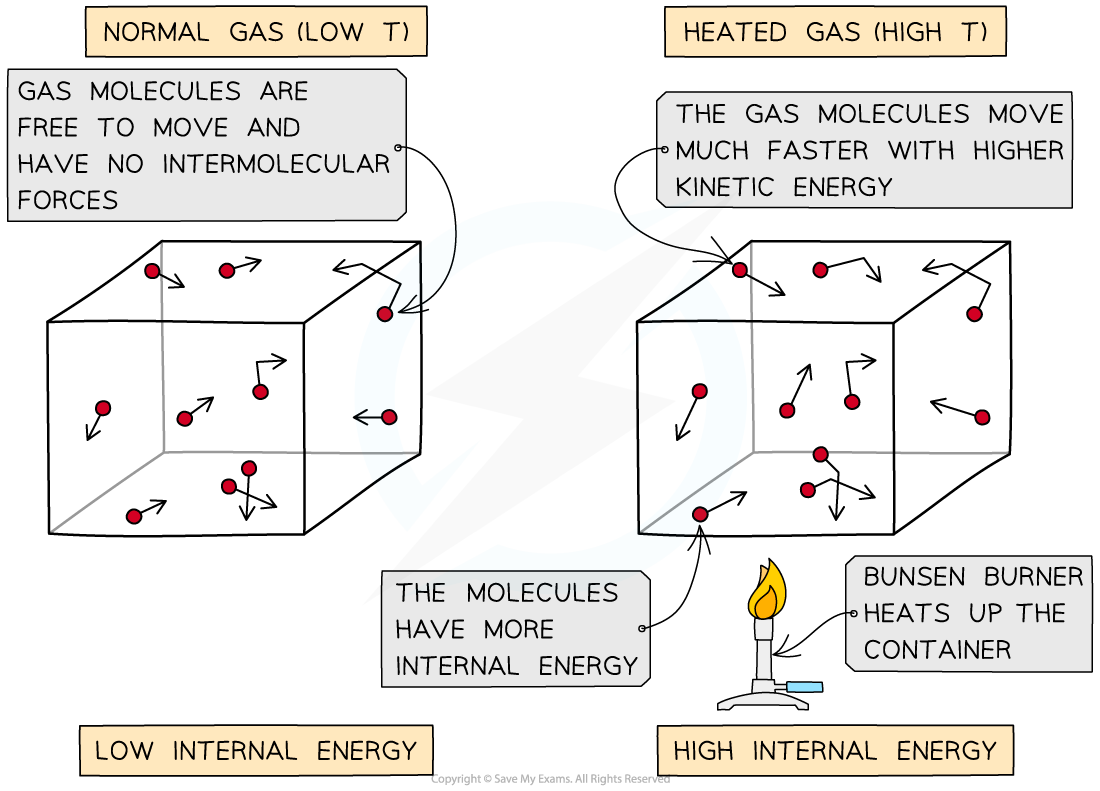
As the container is heated up, the gas molecules move faster with higher kinetic energy. The energy stored within the system - the internal energy - therefore increases
Worked Example
A student measures the mass of a beaker of water twice, leaving 24 hours between the readings. The temperature in the room remained constant between readings, however, they noticed a decrease in the mass of the beaker of water.

Which of the following is not a correct conclusion that can be drawn from the experiment?
A The difference in mass is equal to the mass of the water that evaporated
B The total energy within the beaker decreased
C The density of water in the air increased
D The total number of water molecules in the air and water decreased
Answer: D
A is true because the mass lost from the beaker is due to those water molecules evaporating
B is true because evaporation causes the most energetic particles to leave the beaker
C is true because additional water molecules were added to the air, without a significant change in the volume of the air
D is not true because no mass is lost during evaporation - it is only changed from a liquid to a gas state
Therefore, the total number of particles in the beaker decreased, but the total number of water molecules in the air and water remained constant
Examiner Tips and Tricks
Heating a system will always increase the energy stored within the system. Remember this increase in 'internal energy' can have two effects: either the temperature of the system will increase, or the system will change state (e.g., from a solid to a liquid, or a liquid to a gas).

Unlock more, it's free!
Join the 100,000+ Students that ❤️ Save My Exams
the (exam) results speak for themselves:

Was this revision note helpful?
Build on this topic