Pressure in Liquids (Edexcel IGCSE Physics): Revision Note
Exam code: 4PH1

Pressure in liquids
A fluid is either a liquid or a gas
When an object is immersed and stationary in a fluid, the fluid will exert pressure, squeezing the object
This pressure is exerted evenly across the whole surface of the fluid and in all directions
The pressure exerted on objects in fluids creates forces against surfaces
These forces act at 90 degrees (at right angles) to the surface
Pressure in a liquid
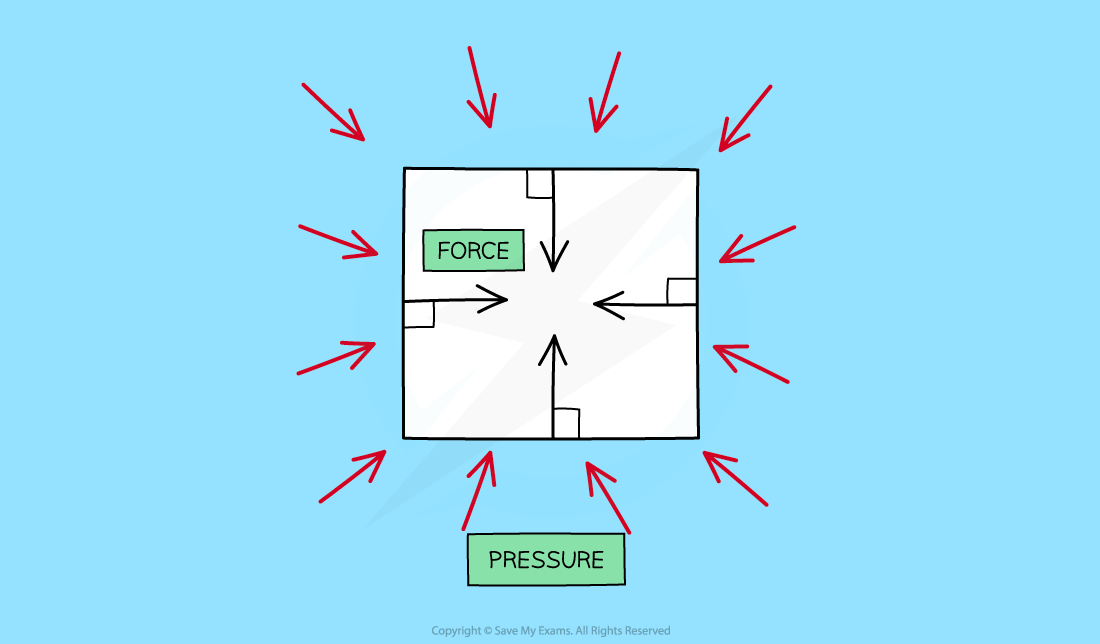
The pressure of a fluid on an object creates a force normal (at right angles) to the surface
Calculating pressure in a liquid
The pressure acting on an object in a fluid changes with depth
The deeper the object then the higher the pressure exerted upon it and vice versa
The equation for the pressure difference, at different depths, in a fluid is given by the equation:
Where:
p = pressure in pascals (Pa)
h = height or depth of the fluid column above the object in metres (m)
ρ = density of the fluid in kilograms per metre cubed (kg/m3)
g = gravitational field strength on Earth in newtons per kilogram (N/kg)
Pressure in a liquid with a density is applied at a depth
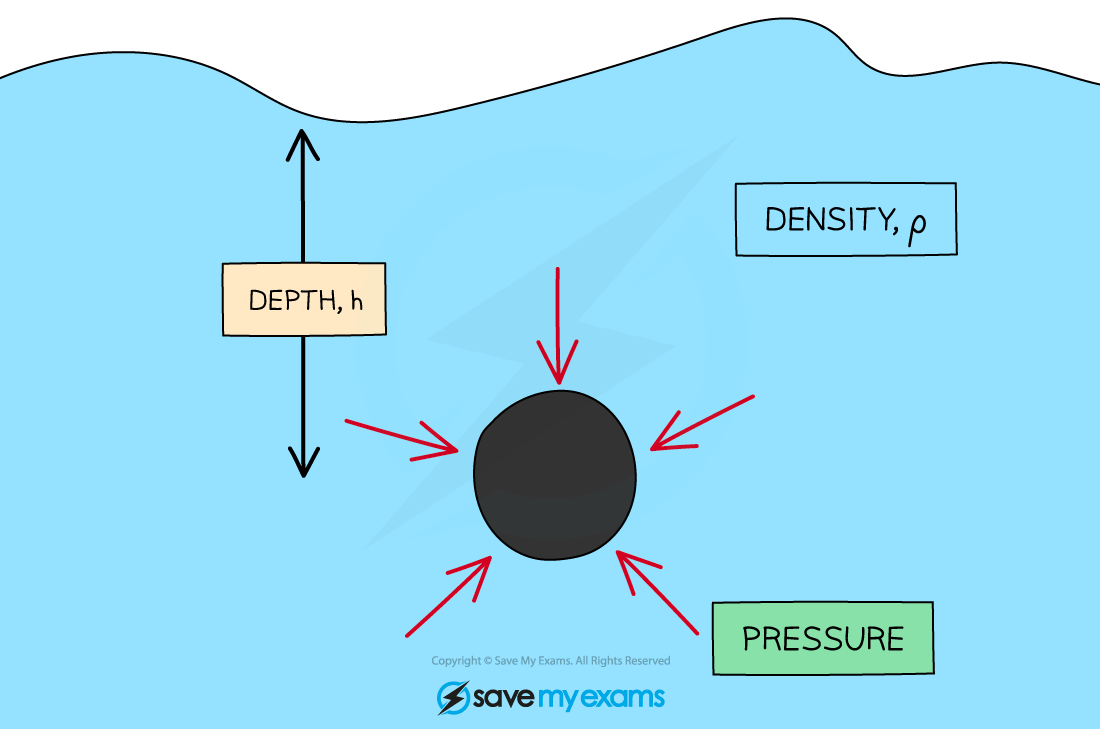
The force from the pressure of objects in a liquid is exerted evenly across its whole surface
Worked Example
Calculate the depth of water in a swimming pool where a pressure of 20 kPa is exerted. The density of water is 1000 kg/m3 and the gravitational field strength on Earth is 9.8 N/kg.
Answer:
Step 1: List the known quantities
Pressure, P = 20 kPa
Density of water, ρ = 1000 kg/m3
Gravitational field strength, g = 9.8 N/kg
Step 2: List the relevant equation
Step 3: Rearrange for height, h
Step 4: Convert any units
Step 5: Substitute in the values
Examiner Tips and Tricks
This pressure equation will be given on your formula sheet, however, make sure you are comfortable with rearranging it for the variable required in the question!

Unlock more, it's free!
Join the 100,000+ Students that ❤️ Save My Exams
the (exam) results speak for themselves:

Was this revision note helpful?
Build on this topic