Resistance, Resistivity & Potential Dividers (Edexcel International A Level (IAL) Physics): Multiple Choice Questions

Exam code: YPH11

47 mins11 questions
1
1 mark

The equation I = nqvA relates the current in a sample of a material to the movement of free charge carriers in the sample.

Which of the following is a correct definition of one of the terms in this equation?

  • n represents the number of charge carriers in the sample.

  • q represents the total charge stored in the sample.

  • v represents the drift velocity of the charge carriers in the sample.

  • A represents the surface area of the sample.

1
1 mark

A current-carrying wire AB of length x and uniform diameter is connected in a circuit as shown.

q8-wph12-02-oct-2021-edexcel-int-as-and-a-level-phy

The slider S is moved along the wire until the reading on the voltmeter is 0 V.

Which of the following equations is correct?

  • yx=R1R2

  • yx−y=R1R2

  • xy=R1R2

  • xy=R1R1+R2

2
1 mark

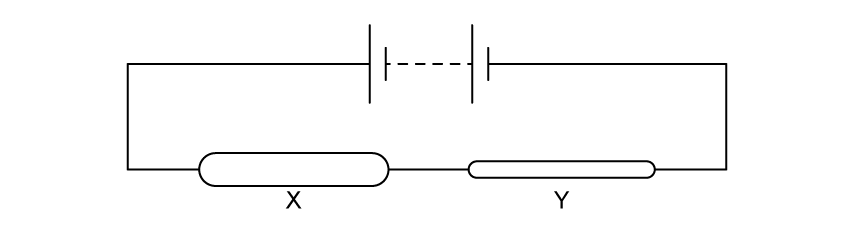
Two copper wires of the same length are connected in a circuit, as shown.

A circuit diagram with a battery and two resistors in series, drawn as oblong shapes in the lower branch and labelled X on the left and Y on the right.

The diameter of wire X is twice the diameter of wire Y.

Wire X has resistance RX. Wire Y has resistance RY.

Which of the following gives the value of RXRY?

  • 14

  • 12

  • 2

  • 4

3
1 mark

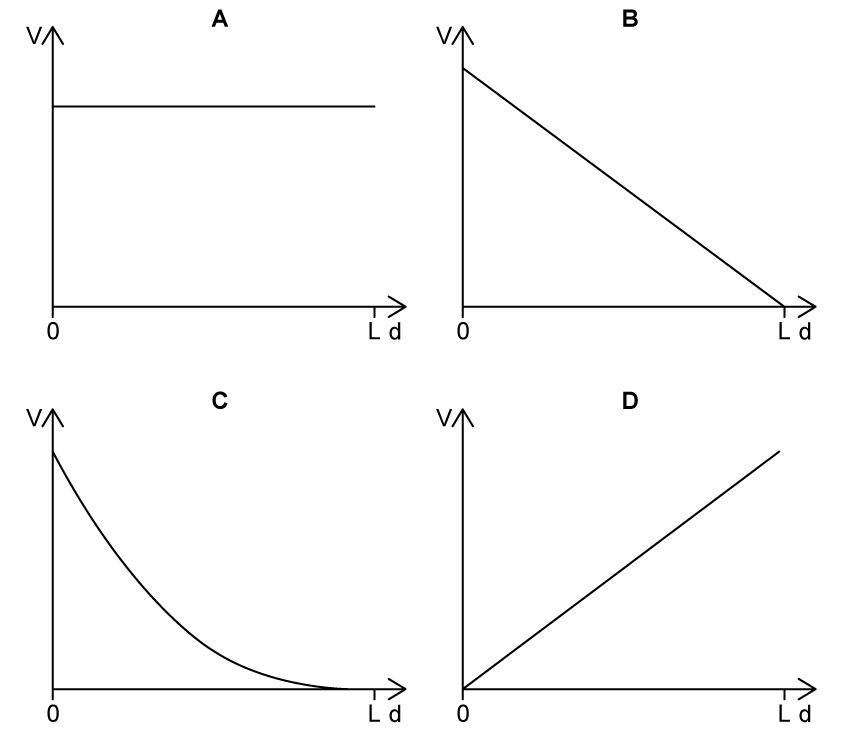
The current in a length L of uniform wire XY is constant.

The current enters the wire at X and leaves the wire at Y. The potential V at points along the wire is measured relative to Y.

Which of the following graphs shows how V varies with the distance d from X?

Four small graphs of potential V against distance d in a 2 by 2 grid, labelled A, B, C and D, each with d running from 0 to L. A shows a horizontal line at a constant positive value. B shows a straight line falling from a maximum at d equals 0 to zero at d equals L. C shows a curve falling steeply at first and then levelling off towards zero at d equals L. D shows a straight line starting from the origin and increasing linearly.