Practical Skills I: Planning (Edexcel International A Level (IAL) Physics): Exam Questions

Exam code: YPH11

1 hour6 questions
1a
1 mark

A student planned an experiment to determine the density of acetate.

She was given a pack of 50 acetate sheets and had access to standard laboratory apparatus.

q1-wph13-03-june-2021-edexcel-int-as-a-level-phy

The approximate dimensions of a single sheet of acetate are given on the pack.

Length

30 cm

Width

21 cm

Thickness

0.15 mm

 The total mass of 50 acetate sheets is approximately 670 g.

To determine the density of acetate, the student needed to take measurements.

Complete the table below.

Quantity to be measured

Measuring instrument

Resolution

Mass 

Balance

0.1 g

Length and width

Metre rule


Thickness

Vernier calipers


1b
4 marks

Describe a method to determine an accurate value for the density of acetate.

1c
2 marks

The student then followed the same method using thicker sheets of acetate.

Explain why using thicker sheets of acetate would reduce the uncertainty in her value for density.

2a
2 marks

A student investigated the acceleration of a trolley as it rolled down a ramp. The trolley was released from rest at the top of the ramp and allowed to roll onto a horizontal surface. There was a single light gate above the horizontal surface, as shown.

q1-wph13-03-jan-2022-edexcel-int-as-a-level-phy

The light gate was connected to a data logger. The data logger recorded the time taken for the card to pass through the light gate.

Describe how the student could determine the velocity v of the trolley as it passed through the light gate.

2b
6 marks

The student repeated the procedure and determined four values of v. The values are shown in the table.

v / m s–1

2.07

1.84

1.91

2.10

 i) Calculate the mean value for v and the percentage uncertainty in v.

Mean v = ............................ m s–1

Percentage uncertainty in v =........................... %

(3)

ii) The student measured the distance s that the trolley travelled on the ramp.

Determine the acceleration of the trolley on the ramp.

s = 1.50 m

Acceleration = ............................. m s–2(2)

iii) A second student carried out the same experiment and determined a similar value for the acceleration of the trolley on the ramp.

State why this does not show that the results are reproducible.

(1)

3a
4 marks

A student was asked to investigate the ultimate tensile stress of a sample of thin nylon fishing line.

Describe a method to determine the maximum force the nylon fishing line can withstand before breaking.

3b
2 marks

Identify one safety issue with this investigation and how it may be dealt with.

3c
8 marks

Before testing, the student measured the diameter at five points along the sample of nylon fishing line.

0.55mm 

0.57mm

 0.54mm

0.55mm 

 0.53mm

i) Calculate the percentage uncertainty in the mean diameter of the nylon fishing line.

Percentage uncertainty = .........................................(3)

ii) The student read an article that suggested nylon fishing line can absorb water.

The article suggested that the ultimate tensile stress of nylon decreases by 10% after absorbing water.

She repeated her experiment, using new samples of fishing line before and after they absorbed water.

Sample

Maximum force / N

Diameter / mm

Before

65.8

0.45

After

57.8

0.46

Evaluate whether her results support the suggestion in the article.

(5)

4a
6 marks

The specific latent heat of vaporisation L of water can be determined using the apparatus shown.

q2-wph16-06-june-2021-edexcel-int-as-a-level-phy

Devise a plan to determine the value of L using a graphical method.

You should include a circuit diagram and any additional apparatus required.

4b
3 marks

One significant source of error in this experiment is the uncertainty in the mass reading due to the water moving as it boils.

Explain how another significant source of error affects the value of L.

5a
2 marks

A student investigated how the current needed to melt a fuse wire depends on the diameter of the wire.

He connected each sample of fuse wire between two terminals separated by a fixed distance. The circuit contained a fixed power supply and additional components that enabled the student to vary and measure the current in the fuse wire.

Complete the diagram to show the circuit that the student should use.

Partial circuit diagram showing a fuse wire held horizontally between two terminals
5b
2 marks

Identify one safety issue with this investigation and how it may be dealt with.

5c
3 marks

The student needs to determine the current that melts the wire as precisely as possible.

Describe how the student should collect his data for one diameter of fuse wire.

5d
3 marks

For each diameter of fuse wire, the student repeated the procedure and recorded the mean melting current in a table.

Diameter of fuse wire / mm

Mean melting current / A

0.15

2.9

0.20

4.5

0.25

6

Criticise the recording of the data.

6a
3 marks

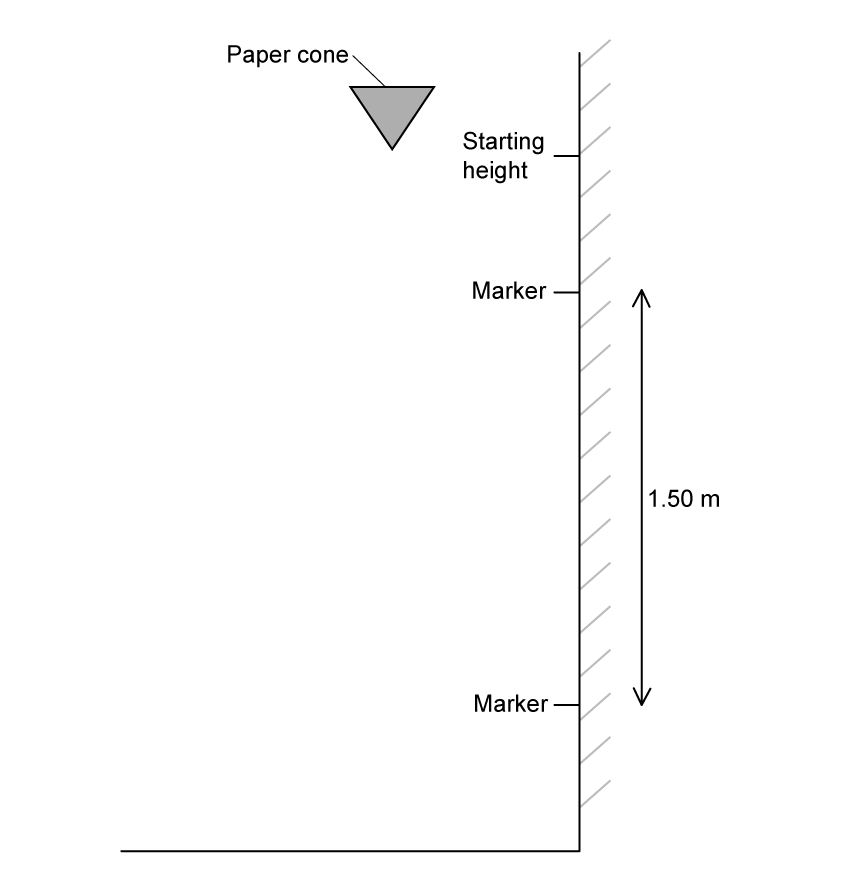
A student investigated the motion of a paper cone falling through air.

The student released the cone from the same starting height and measured the time t for the cone to fall between two markers. The markers were placed 1.50 m apart, as shown.

A paper cone above the floor at a point marked "starting height" beside a hatched wall. Two markers on the wall are separated by 1.50 metres.

Describe how the student could use a metre rule to position the two markers on the wall 1.50 m apart as accurately as possible.

You may include additional apparatus.

6b
2 marks

The student assumed the cone was travelling at terminal velocity as it passed between the two markers.

Explain how the student could check this assumption.

6c
4 marks

The student repeated the measurement of t, as shown in the table.

t / s

1.32

1.28

1.36

1.30

1.34

(i) Determine the mean value of t.

[2]

(ii) Determine the percentage uncertainty in the mean value of t.

[2]

6d
3 marks

Another student suggests that using light gates connected to a data logger would give a more accurate value of t.

Discuss whether this suggestion is correct.