Practical Skills II: Implementation & Measurements (Edexcel International A Level (IAL) Physics): Exam Questions

Exam code: YPH11

17 mins2 questions
1a
5 marks

A wire-wound resistor can become hot when there is a current in it. This heating effect can be investigated using the apparatus shown.

q1-wph16-06-oct-2021-edexcel-int-as-and-a-level-phy

A student investigated whether the temperature rise of the water ∆θ was proportional to the current I in the resistor. For each value of current, the student refilled the beaker with water at the same initial temperature.

i) Identify two other control variables for this investigation.

(2)

ii) The student recorded the following data.

I/A

1.5

2

2.5

3

∆θ

3.5

7 

9.5

15

Criticise the recording of this data.

(3)

1b
2 marks

Explain one improvement the student could make to reduce the uncertainty in the measurement of ∆θ for each value of I.

2a
4 marks

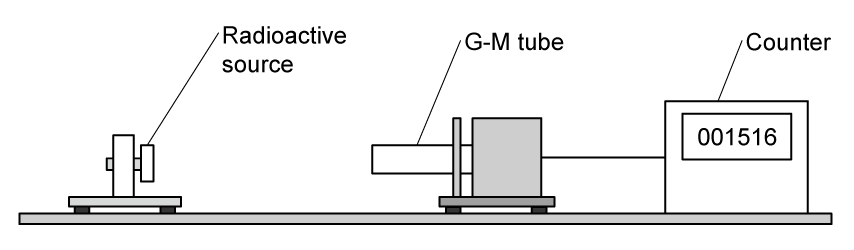
A student used a Geiger–Müller (GM) tube connected to a counter to investigate the count rate from a sealed radioactive source, as shown. The source emits beta and gamma radiation.

A sealed radioactive source in a holder on a bench, facing a GM tube held in a clamp at a fixed distance from the source. The GM tube is connected by a lead to a counter, shown as a box with a digital display. Labelled "radioactive source", "G-M tube" and "counter".

The G-M tube was placed at a fixed distance from the source.

The student recorded the count for 120 s and repeated this measurement four more times.

The data is recorded in the table below.

Count

1467

1547

1516

1533

1489

Count rate / s-1

12.2

12.9

12.63

12.8

12.4

(i) One of the values in the table has been recorded incorrectly.

Identify this value and state the value that should have been recorded.

[2]

(ii) Calculate the mean count rate recorded by the counter.

[2]

2b
2 marks

The student stated that the mean count rate is the count rate due to radiation from the source.

Explain why the student's statement is not correct and what the student should have done.

2c
4 marks

The student then wanted to determine the count rate due to gamma radiation only.

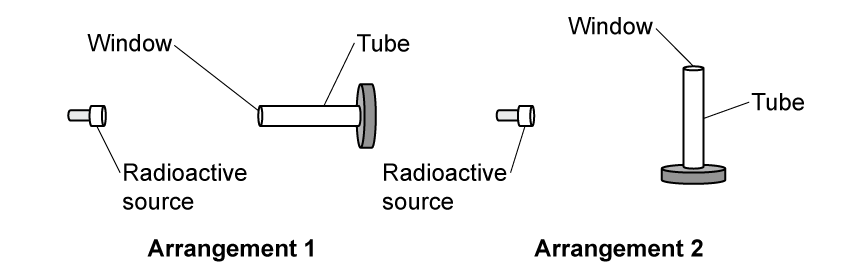
The G-M tube is made from steel that is a few millimetres thick. The tube has a thin mica window at one end that allows all types of ionising radiation to enter. Ionising radiation may be detected anywhere inside the tube.

The student could position the G-M tube in either of the two arrangements shown.

Two side-by-side arrangements. Arrangement 1 (left): the GM tube drawn horizontally with its window (the flat end) facing the source. Arrangement 2 (right): the GM tube standing vertically on its base so that the side wall faces the source and the window points upward. The source is the same distance from the tube in both arrangements.

Explain which arrangement the student should use.