Quadratic Inequalities (Edexcel International AS Maths: Pure 1): Revision Note
Exam code: XMA01

Quadratic inequalities
What are quadratic inequalities?
Similar to quadratic equations, quadratic inequalities just mean there is a range of values that satisfy the solution
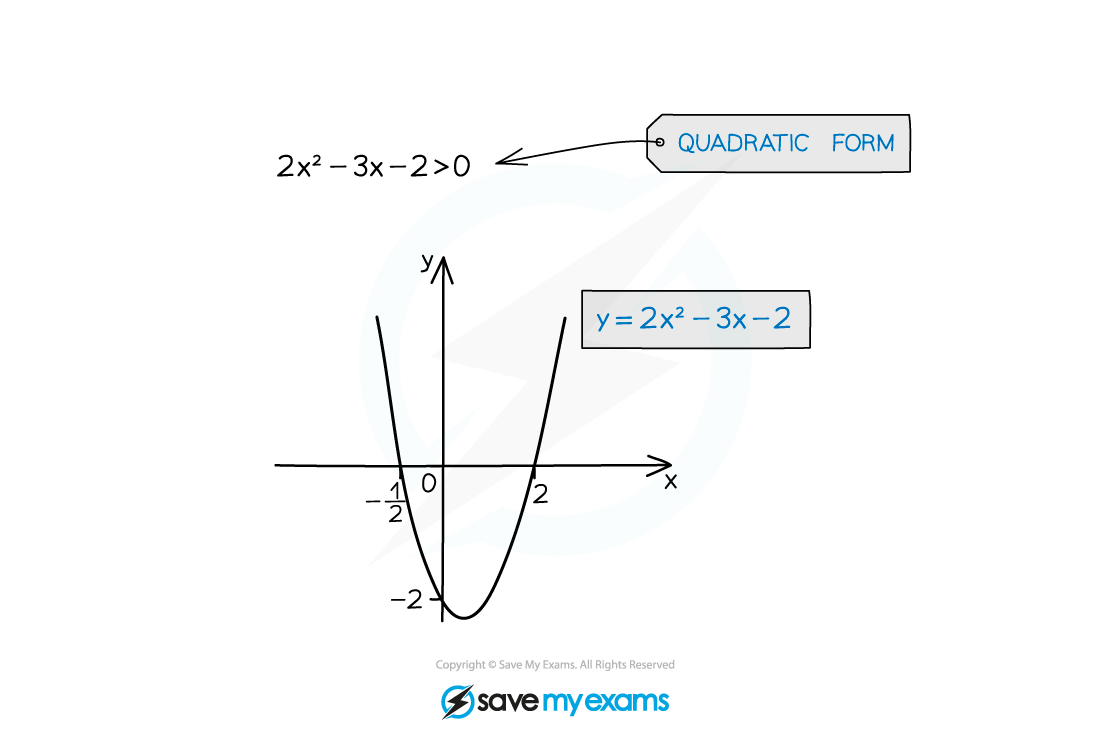
Sketching a quadratic graph is essential
Can involve the discriminant or applications in mechanics and statistics
How do I solve quadratic inequalities?
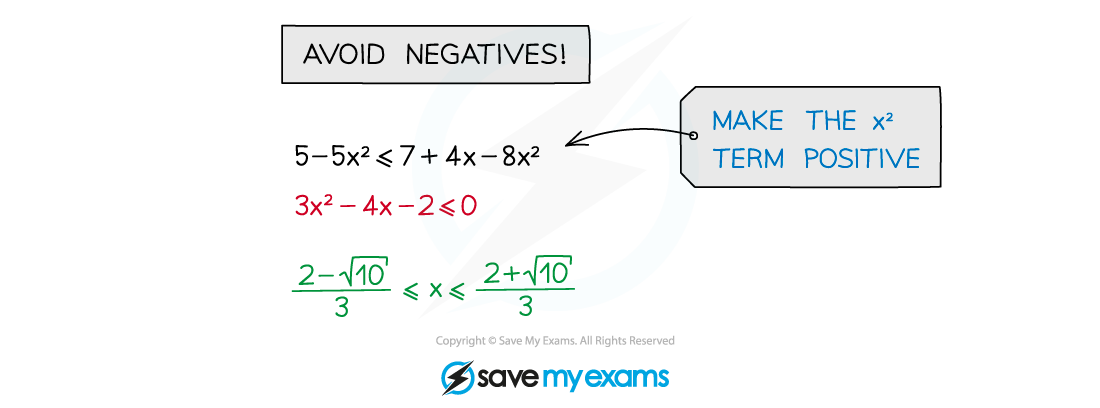
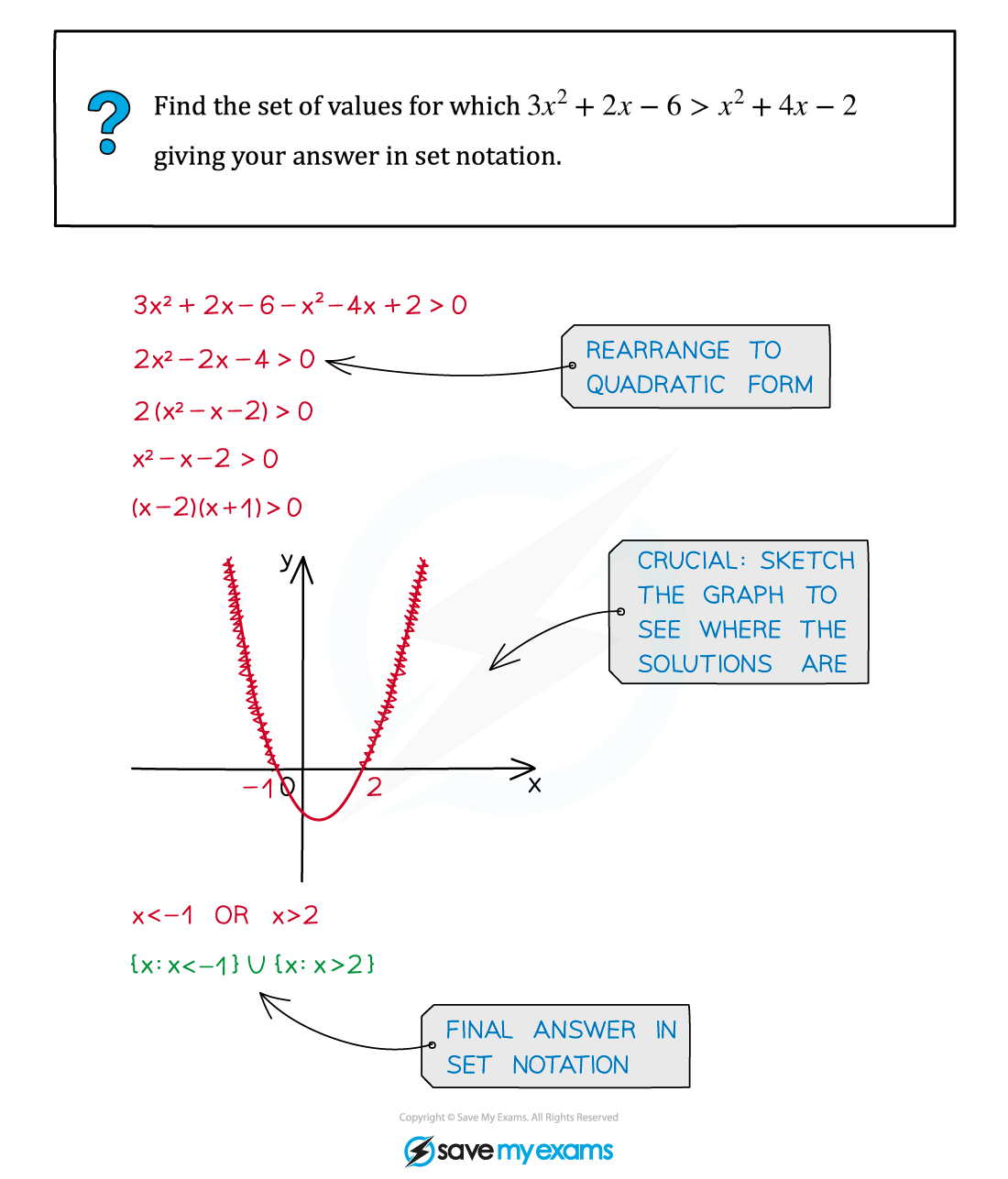
STEP 1: Rearrange the inequality into quadratic form with a positive squared term
ax2 + bx + c > 0 (>, <, ≤ or ≥)
STEP 2: Find the roots of the quadratic equation
Solve ax2 + bx + c = 0 to get x1 and x2 where x1 < x2
STEP 3: Sketch a graph of the quadratic and label the roots
As the squared term is positive it will be "U" shaped
STEP 4: Identify the region that satisfies the inequality
For ax2 + bx + c > 0 you want the region above the x-axis
The solution is x < x1 or x > x2
For ax2 + bx + c < 0 you want the region below the x-axis
The solution is x > x1 and x < x2
This is more commonly written as x1 < x < x2
avoid multiplying or dividing by a negative number
if unavoidable, “flip” the inequality sign so < → >, ≥ → ≤, etc
avoid multiplying or dividing by a variable (x) that could be negative
multiplying by x2 is safe, as it is never negative
but exclude any value of x that makes a denominator zero
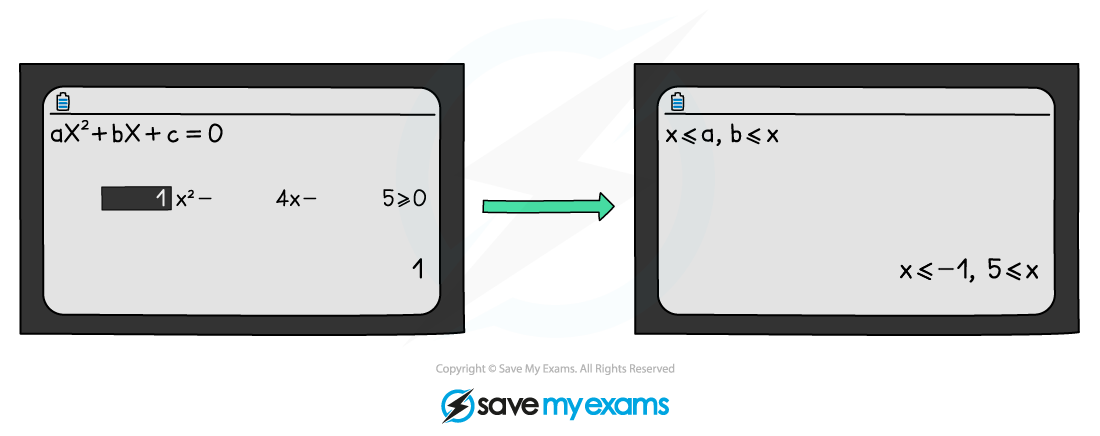
How do I solve quadratic inequalities on a calculator?
Be aware of unconventional ways calculators can display an answer
eg 8 > x > 2 rather than 2 < x < 8
Examiner Tips and Tricks
A calculator can be super-efficient but some marks are for method.
Use your judgement:
is it a “show that” or “prove” question?
how many marks?
how long is the question?
Worked Example
How do I solve inequalities with x in the denominator?
Some inequalities have in the denominator
e.g. or
Do not multiply both sides by the denominator
it could be negative for some values of , which would flip the inequality sign
Multiply both sides by the square of the denominator instead
a square is never negative, so the inequality sign does not change
STEP 1: Multiply both sides by the square of the denominator
e.g. becomes
STEP 2: Bring all the terms to one side, so that zero is on the other side
do not expand any brackets
STEP 3: Factorise and find the critical values
take out any common bracket first
STEP 4: Sketch the quadratic and identify the region that satisfies the inequality
STEP 5: Exclude any value of that makes the original denominator zero
e.g. is undefined at , so is never part of the solution, even for or
e.g. gives ,
so the solution is
You can also solve these graphically
e.g. sketch and , then find where the curve is above the line
Examiner Tips and Tricks
A very common mistake is to multiply both sides of by and give the answer . This misses that must also be positive. A quick sketch of and will show you whether your answer makes sense.
Worked Example
Use algebra to solve
Answer:
Multiply both sides by , which is never negative
Bring all the terms to one side
Factorise
Find the critical values
and
Sketch ; it is on or above the -axis outside the critical values
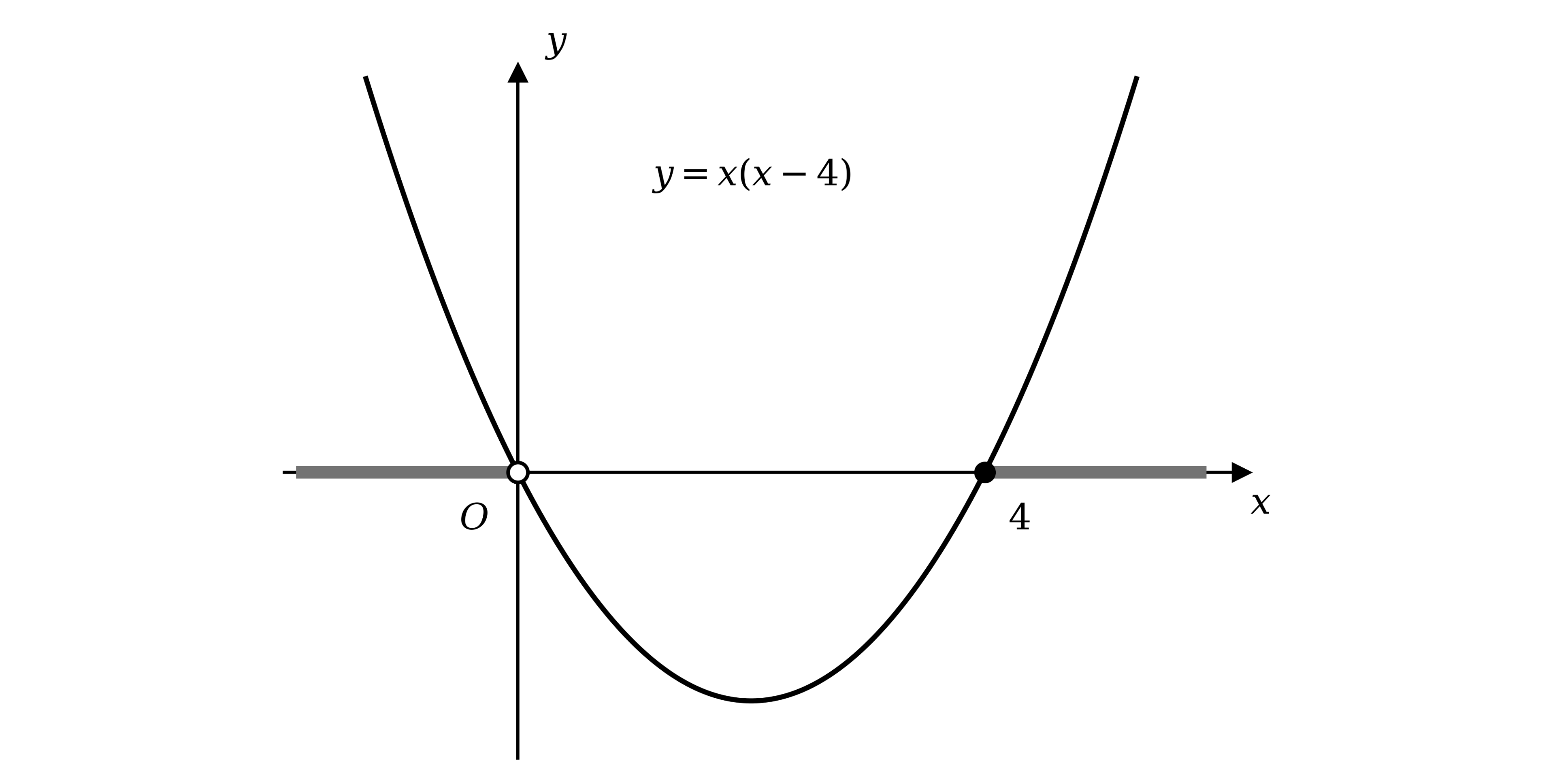
or
makes the denominator zero, so exclude it
or

Unlock more, it's free!
Join the 100,000+ Students that ❤️ Save My Exams
the (exam) results speak for themselves:

Was this revision note helpful?
Build on this topic