Answering 25-Mark Evaluate, Assess & Discuss Questions (Papers 1 & 2) (AQA A Level Economics): Revision Note
Exam code: 7136

How 25-mark questions work on Papers 1 and 2
You answer two 25-mark questions on each of Papers 1 and 2
Section A: the last question in your chosen context (Question 04 or 08)
Section B: the second part of your chosen essay
Together they are worth 50 of the 80 marks on each paper
The command word is usually Evaluate, Assess or Discuss
Occasionally: "To what extent… ? Justify your answer."
All of these are marked in the same way: they all require a balanced argument and a supported judgement
The two sections need slightly different approaches
Section A (data response) | Section B (essay) | |
|---|---|---|
How the question starts | a quotation from one of the extracts, with line numbers | a short paragraph introducing the topic |
Typical wording | "Using the data in the extracts and your knowledge of economics, evaluate…" | "Evaluate the view that…", "Assess whether…" |
Where your evidence comes from | the extracts and your own knowledge | your own knowledge: there are no extracts |
These are the only questions on Papers 1 and 2 that reward evaluation (AO4)
Aim for about 650 words, in about 35 minutes in Section A and about 37 minutes in Section B
How the marks are awarded
25-mark questions are marked using five levels
What is assessed | Level 5 (21–25 marks): Sound, focused analysis and well-supported evaluation that | Level 4 (16–20 marks): Sound, focused analysis and some supported evaluation that |
|---|---|---|
Organisation and knowledge (AO1) | is well organised, showing sound knowledge and understanding of economic terminology, concepts and principles with few, if any, errors | is well organised, showing sound knowledge and understanding of economic terminology, concepts and principles with few, if any, errors |
Application (AO2) | includes good application of relevant economic principles to the given context and, where appropriate, good use of data to support the response | includes some good application of relevant economic principles to the given context and, where appropriate, some good use of data to support the response |
Analysis (AO3) | includes well-focused analysis with clear, logical chains of reasoning | includes some well-focused analysis with clear, logical chains of reasoning |
Evaluation (AO4) | includes supported evaluation throughout the response and in a final conclusion | includes some reasonable, supported evaluation |
The biggest difference between Level 3 and Level 5 is evaluation
Level 5 needs evaluation "throughout the response and in a final conclusion"
A one-paragraph conclusion on its own is not enough
Structuring your answer
Use the following essay structure to help you reach Level 5"
[K + Ap + signpost] → ([KAA] → [Ev]) × 3 → [Ev: conclusion]: eight paragraphs
Key: K = knowledge · Ap = application · An = analysis · Ev = evaluation · KAA = knowledge, application and analysis
Paragraph | Skill | What to write | Approx. words |
|---|---|---|---|
1 | K + Ap | introduction: define the key terms, apply them to the context, and signpost the three issues, e.g. "Three issues will be considered…" | 70 |
2 | KAA | argument 1: a clear point, a chain of reasoning and a diagram if it helps, applied to the context | 100 |
3 | Ev | evaluate argument 1: how big, when, what it depends on, who is affected | 60 |
4 | KAA | argument 2: often on the other side | 100 |
5 | Ev | evaluate argument 2 | 60 |
6 | KAA | argument 3: e.g. an alternative policy or a different group affected | 100 |
7 | Ev | evaluate argument 3 | 60 |
8 | Ev | conclusion: answer the question, say which argument matters most and why, and state the conditions your judgement depends on | 100 |
Each KAA paragraph should set up the application before the analysis: see the Writing a Strong KAA Paragraph page for how to build one
Each evaluation paragraph should judge the argument before it, with supporting reasoning: see the Writing Strong Evaluation page
Worked Example
Evaluate the view that a national minimum wage is the best way to reduce poverty in the UK.
[25 marks]
Model answer
Key: K = knowledge · Ap = application · An = analysis · Ev = evaluation
[K] A national minimum wage (NMW) is a legal minimum hourly rate of pay that employers must pay. [Ap] In the UK, the National Living Wage for workers aged 21 and over rose to £11.44 in April 2024, around two-thirds of median hourly earnings. [K] Poverty is usually measured in relative terms: a household is in relative poverty if its income is below 60% of the median. [An] Three issues will be considered: how far a minimum wage raises the incomes of poor households, its possible effect on employment, and whether other policies would reduce poverty more effectively.
[K] A minimum wage sets a legal floor under hourly pay, so it directly raises the earnings of the lowest-paid workers. [Ap] The National Living Wage has risen faster than average earnings since it was introduced in 2016, so the pay of the lowest-paid has grown faster than that of typical workers. [An] As a result, low-paid households' incomes rise, lifting some of them above the poverty line. It also costs the government nothing directly, as employers pay for it, and higher pay may raise workers' motivation and reduce staff turnover, helping firms absorb some of the cost.
[Ev] However, a minimum wage only helps people in work. Many households in poverty contain no one in paid work, such as pensioners, the long-term sick and the unemployed, so it cannot reach them. Its effect also depends on hours worked: a part-time worker on the minimum wage may still have a low weekly income, while some minimum-wage earners are second earners in households that are not poor.
[K] In a competitive labour market, a minimum wage set above the equilibrium wage creates an excess supply of labour. [Ap] With the National Living Wage now at around two-thirds of median pay, this affects more firms than when it was first introduced. [An] As the diagram shows, the quantity of labour demanded falls from Q1 to Q2, while the quantity supplied rises to Q3, creating unemployment of Q3 − Q2. Workers who lose their jobs may fall into poverty, so the policy could make some of the poorest households worse off.
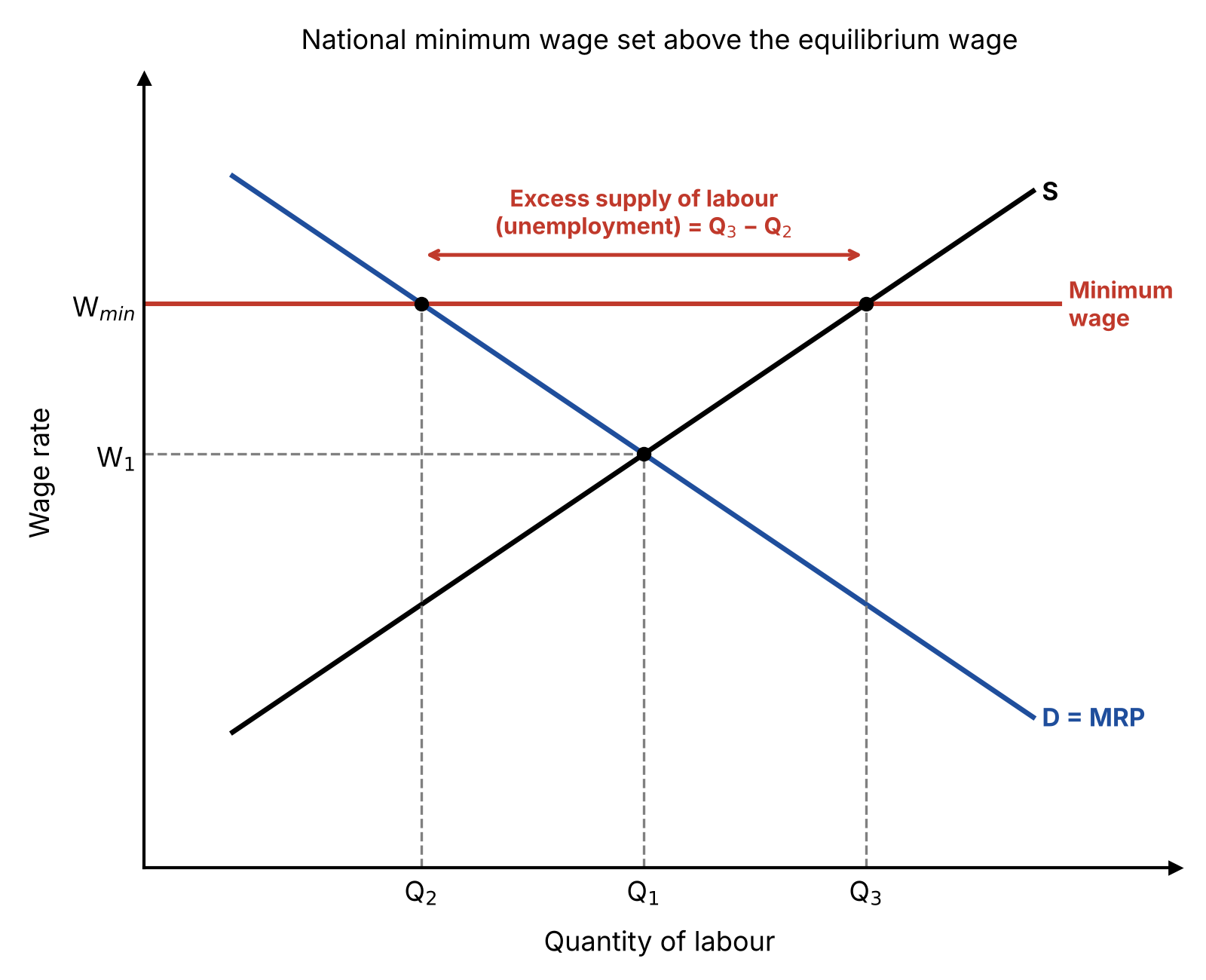
[Ev] The size of this effect depends on the wage elasticity of demand for labour. If demand is inelastic, for example where labour cannot easily be replaced by machines, few jobs are lost. In a monopsony labour market, such as a town dominated by one large employer, a minimum wage can raise both wages and employment. [Ap] Evidence reviewed by the Low Pay Commission has generally found that UK minimum wage rises have had little negative effect on employment, [Ev] although the risk is likely to grow as the minimum wage rises closer to median pay.
[K] Other policies may target poverty more precisely, such as means-tested benefits or a higher income tax personal allowance. [Ap] In the UK, Universal Credit is paid to low-income households whether or not anyone works, and is adjusted for family size and housing costs. [An] Because it is based on household income, not hourly pay, it reaches the jobless households that a minimum wage misses. A higher personal allowance also raises low earners' take-home pay.
[Ev] However, benefits are funded by taxpayers and, because they are withdrawn as income rises, can reduce the incentive to work more hours, creating a poverty trap. On the other hand, benefits can be changed quickly in a crisis, as when Universal Credit was temporarily raised by £20 a week during the pandemic. Raising the personal allowance gives nothing to those who earn too little to pay income tax, and gives the same gain to higher earners, so it is poorly targeted.
[Ev] Overall, a national minimum wage is an effective way to reduce in-work poverty, especially where the demand for labour is inelastic or employers have monopsony power, and it costs the government little. However, it is not the best single way to reduce poverty, because it cannot help households where no one works, and very large rises risk job losses that could increase poverty. The best policy depends on the cause of poverty, so the most effective approach is a combination: a minimum wage set at around two-thirds of median earnings, alongside targeted benefits for those who cannot work.
Why this answer would reach Level 5
The introduction defines both key terms, applies them to the UK and sets out three issues
It follows the eight-paragraph structure: each KAA paragraph is followed by a paragraph that evaluates it
A labour market diagram is used to analyse the risk of unemployment
Evaluation uses several techniques: who is affected, what the effect depends on, monopsony as an exception, and alternative policies
The conclusion answers the question directly and states the conditions behind the judgement

Unlock more, it's free!
Join the 100,000+ Students that ❤️ Save My Exams
the (exam) results speak for themselves:

Was this revision note helpful?
