Modelling with Volumes of Revolution (Cambridge (CIE) A Level Maths: Pure 1): Revision Note
Exam code: 9709

Modelling with Volumes of Revolution
What is meant by modelling with volumes of revolution?
Many every day objects such as buckets, beakers, vases and lamp shades can be modelled as a solid of revolution
This can then be used to find the volume of the solid (volume of revolution) and/or other information about the solid that could be useful before an object is manufactured
Modelling with volumes of revolution could involve rotation around the x-axis or y-axis so ensure you are familiar with both
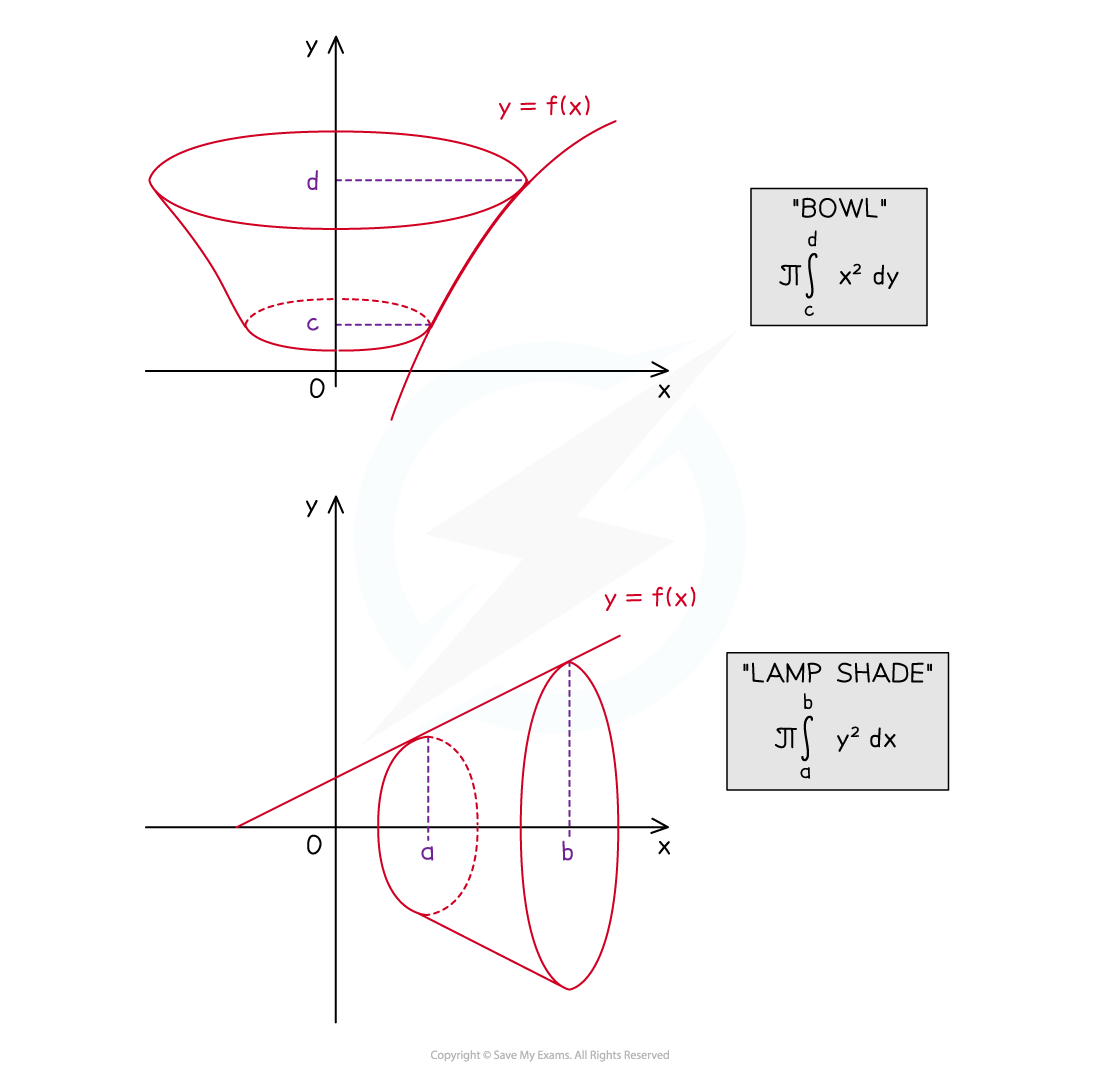
What modelling assumptions are there with volumes of revolution?
The solids formed are usually the main shape of the body of the object
For example, the handles on a vase would not be included
The lip on the top edge of a bucket would not be considered
A common question or assumption concerns the thickness of a container
The thickness is generally ignored as it is relatively small compared to the size of the object
thickness will depend on the purpose of the object and the material it is made from
Some questions may refer to the solid formed being the ‘inside’ of an object or refer to the ‘internal’ dimensions
If the thickness of the material is significant it would involve two related solids of revolution (Adding & Subtracting Volumes)
How do I solve modelling problems with volumes of revolution?
Visualising and sketching the solid formed can help with starting problems
Familiarity with applying the volume of revolution formulae for rotations around both the x and y axes
x-axis
y-axis
The volume of a solid may involve adding or subtracting different volumes of revolution
Subtraction would need to be used for solids formed from areas that do not have a boundary with the axis of rotation
Questions may go on to ask related questions in context so do take notice of the context
A question about a bucket being formed may ask about its capacity
This would be measured in litres so there may also be a mix of units that will need conversion (e.g. 1000cm3 = 1 litre)
Worked Example


Examiner Tips and Tricks
Consider the context of the question to gauge whether your final answer is realistic
a vase holding just 0.126 litres of water will not hold many flowers, but the question did state it was a miniature vase
For rotation around the y -axis remember to rearrange into the form

Unlock more, it's free!
Join the 100,000+ Students that ❤️ Save My Exams
the (exam) results speak for themselves:

Was this revision note helpful?
Build on this topic