Neural & Hormonal Mechanisms (AQA A Level Psychology): Revision Note
Syllabus Edition
First teaching 2025
First exams 2027
Exam code: 7182

The role of the hypothalamus & the dual-centre model of eating
The hypothalamus is the part of the brain responsible for the control of hormones, linking the nervous system (neural) to the endocrine system (hormonal)
The hypothalamus also regulates homeostasis , receiving information about the body to make compensatory changes
Hetherington & Ranson (1942) used lesion studies on rats to identify the hypothalamus as playing a key role in controlling food intake
They found that lesioning the ventromedial hypothalamus (VMH) caused the animals to become hyperphagic (to overeat) and gain weight
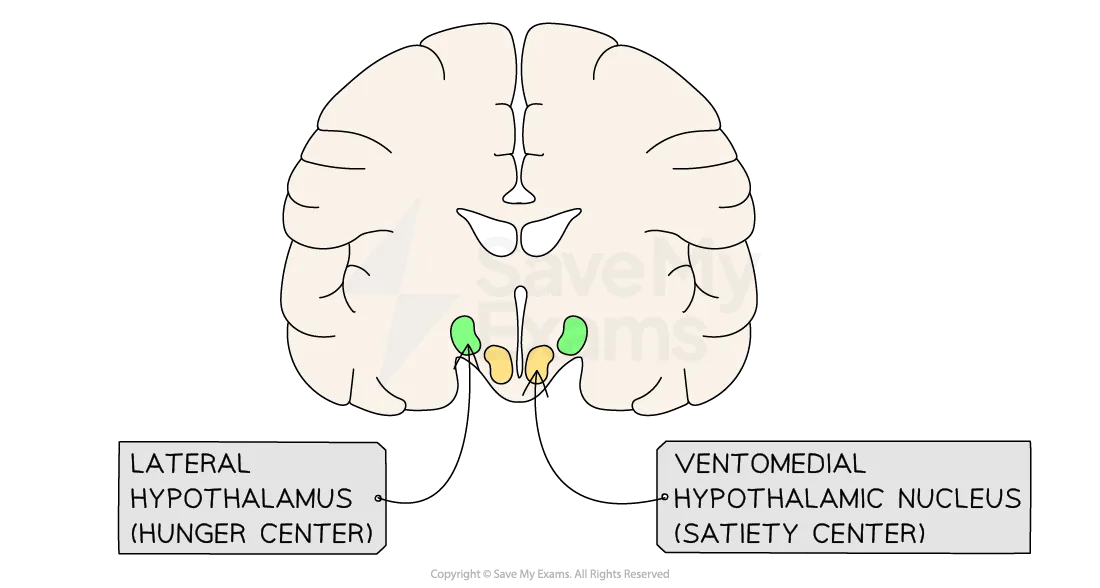
In a dual-centre model (also known as dual-control theory):
the lateral hypothalamus (LH) was identified as the the lateral hypothalamus (LH) was identified as the 'feeding centre' or 'on switch', initiating eating behaviour
the ventromedial hypothalamus (VMH) was identified, as the 'satiety centre' or 'off switch', producing a feeling of fullness that stops eating
When glucose levels fall below a set point, this is detected by glucose-sensing cells in the LH, triggering the motivation to eat and the behaviours accompanying it, such as searching for and preparing food
The LH detects glucose directly via glucose-sensing neurons
After eating, the liver provides the body with glucose, and rising glucose levels in the bloodstream are detected by cells in the VMH
Activity in the VMH triggers the increase past a set point, at which the individual feels satiated and stops eating
Therefore both the LH and the VMH work together in the dual-centre model to balance hunger and eating
The role of ghrelin & the role of leptin in eating behaviour
Ghrelin
Ghrelin is a hormone secreted from the lining of the stomach, whose concentration in the blood falls after each meal and rises progressively until the next meal
Thus, the amount of ghrelin in the bloodstream is a marker of how long it has been since the individual last ate and as it rises, so does appetite
The emptier the stomach, the more ghrelin is released, which is then detected by receptors in a part of the hypothalamus called the arcuate nucleus
The arcuate nucleus then sends signals to the lateral hypothalamus to secrete the appetite stimulant neuropeptide Y (NPY), a powerful hunger stimulant
Rats injected with NPY directly into the hypothalamus eat excessively and continue eating even when sated
At the same time, ghrelin signals the pituitary gland to release growth hormones
Ghrelin is known to be an appetite stimulant in humans, and research has found that when given intravenously, it causes a short-term increase in the amount of food eaten (Wren et al., 2001)
Circulating ghrelin roughly doubles before a meal, decreases sharply afterwards, and correlates closely with subjective feelings of hunger
Leptin
Leptin is a hormone produced by adipose (fat) cells and released into the blood, where it is detected in the brain by the VMH, signalling that fat stores are high
The hypothalamus receives the message from leptin that calorie storage is high, and therefore, appetite decreases
However, when people are dieting or do not have enough to eat, fat is used up, and fat cells stop producing leptin, causing leptin levels in the blood to fall
The hypothalamus detects the drop in leptin and generates the sensation of hunger, stimulating an individual to eat more
Leptin inhibits ghrelin in two ways, which prevents the appetite-stimulant effect of ghrelin and neuropeptide Y:
It reduces ghrelin secretion in the stomach
It suppresses ghrelin receptors' expression in the neuropeptide Y system
Research which investigates the role of neural and hormonal mechanisms in eating behaviour
Nakazato et al. (2001) found that ghrelin injections stimulated feeding and increased weight gain in normal rats and rats genetically deficient in growth hormone, demonstrating the important role of ghrelin in promoting eating and releasing growth hormone
Shiiya et al. (2002) found that ghrelin levels were lower in obese people and higher in those with anorexia than in normal weight participants, supporting the theory of ghrelin as an appetite stimulant
Licinio et al. (2004) studied an extremely rare genetic condition in which individuals are unable to produce leptin naturally, a condition associated with severe obesity. Over an 18-month period of leptin-replacement therapy, participants showed an average weight loss of more than 40% and an initial reduction in food intake of 49%
Evaluation of the role of neural and hormonal mechanisms in eating behaviour
Strengths
Understanding the neural and hormonal mechanisms controlling eating behaviour has real-world applications in offering treatment possibilities for obesity, as we better understand the complex interactions between the nervous system and the hormones regulating eating
Research using injections of ghrelin has shown that it stimulates appetite and research using leptin-replacement therapy shows that leptin suppresses appetite, supporting the theory of the role of these hormones in eating behaviour
Limitations
Neural and hormonal mechanisms are only part of the complex systems regulating eating, as other factors such as biological rhythms also affect eating behaviour, shown by the fact that rats become most active and start to eat after dark, regardless of when they last ate (Kraly et al., 1980)
Leptin injections have not been a universally effective treatment for obesity, so this means that research needs to investigate leptin further and identify if it is really useful for weight loss or might be better in preventing weight gain, suggesting there is more to understand about how leptin works
Issues & Debates
The theory assumes our eating behaviour is biologically determined by automatic hormonal signals (e.g., ghrelin increases = must eat)
This challenges the idea of free will, as it downplays conscious decision-making or self-control in modern eating contexts
Research into hormones like ghrelin and leptin is nomothetic, as it uses large samples aiming to find general laws about how biological mechanisms regulate eating
This scientific, generalisable approach helps identify universal patterns in appetite and weight control, but it may overlook individual differences that also influence eating behaviour

Unlock more, it's free!
Join the 100,000+ Students that ❤️ Save My Exams
the (exam) results speak for themselves:

Was this revision note helpful?
Build on this topic
