Psychological Explanations for Obesity (AQA A Level Psychology): Revision Note
Syllabus Edition
First teaching 2025
First exams 2027
Exam code: 7182

Restraint theory
Herman & Polivy (1975) developed restraint theory, a cognitive theory of obesity arguing that restrained eating is counterproductive and ultimately self-defeating, as a significant proportion of restrained eaters overeat to the extent that they become obese
Limiting food intake leads to psychological stress, lowered mood and cravings
Restraint theory combines two factors:
Cognitive control – restrained eaters categorise foods as 'good' or 'bad' and create rules and beliefs about which foods are allowed and which are forbidden, replacing physiological control with conscious control
Paradoxical outcome – the restrained eater becomes more preoccupied with food, actively ignoring physiological signals of hunger and satiety, which leads to disinhibition of eating behaviour
Disinhibition
After a period of restraint, individuals become tired of restricting themselves and start eating as much as they want, often taking an 'all or nothing' approach
Restrained eaters are vulnerable to internal cues (such as lowered mood) and external food-related cues (such as media images), known as disinhibitors, which lead to a loss of control over restrained eating
Once disinhibited, the individual may reason that as they have already broken their rules there is no point in stopping, which Herman & Polivy call the 'what the hell effect', marked by passivity and resignation
This disinhibition sometimes leads to binge eating
After a period of disinhibition, some individuals will go back to restraint in what becomes a cycle of dieting and bingeing (also known as ‘yo-yo dieting’), while others continue to overeat, leading to obesity
The boundary model
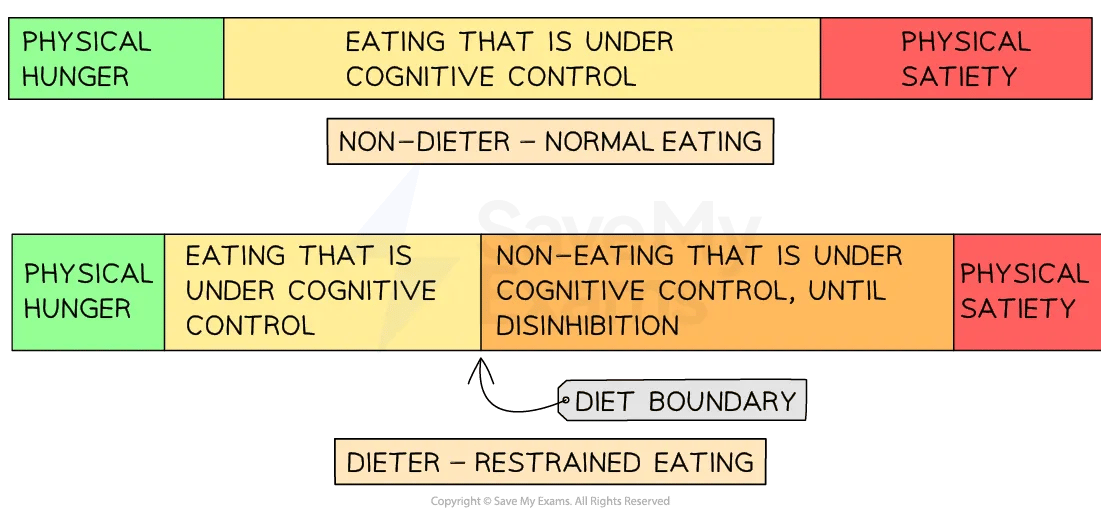
Herman & Polivy (1984) developed the boundary model, in which food intake lies on a continuum from an aversive state of hunger at one end to an aversive state of satiety at the other
Different physiological processes determine how much and when we eat on each end of this continuum, with low energy leading to hunger and a feeling of fullness leading to satiety
Between these boundaries lies a zone of biological indifference, where eating is under cognitive and social control rather than physiological control
The unrestrained eater will eat until they reach satiety, while the restrained eater will eat until they reach their cognitive boundary, which is determined by the limit they have set for themselves
Restrained eaters have a lower hunger boundary, so are less responsive to feelings of hunger, and a higher satiety boundary, so they need more food before they consider themselves full, meaning their zone of biological indifference is wider and they are more vulnerable to disinhibition
The boundary model demonstrates how, once restraint is replaced by disinhibition, previous dieters eat more than those who are not controlling their food intake psychologically and obesity is the result
Research which investigates psychological explanations for obesity
Herman & Mack (1975) used a questionnaire to identify participants’ level of restrained eating and then gave them ice cream in a mock ‘taste test’
They found that restrained eaters ate significantly more ice cream than a control group of unrestrained eaters if they had been given a milkshake to drink before the study
This suggests they had already exceeded their cognitive boundary in drinking the milkshake, supporting restraint theory and the boundary model
Adriaanse et al. (2011) found that when female students who were trying to cut down on their intake of unhealthy snacks were presented with diet intentions expressed in a negative form (e.g., ‘When I am sad, I will not eat chocolate’), they ate unhealthy snacks more often in the following week, consuming more calories than a control group, which supports the restraint theory
Evaluation of psychological explanations for obesity
Strengths
Wardle & Beales (1988) randomly allocated 27 women to a restrained-eating diet group, an exercise group or a control group, and found that after seven weeks the restrained eaters consumed the most calories overall, experiencing occasional disinhibition of their eating when they would binge beyond feeling full
This supports the argument that restraint is a causal factor in overeating, rather than simply co-occurring with it
Psychological explanations for obesity have been used to successfully develop cognitive behavioural therapy for binge-eating and obesity (Mesarič et al, 2023)
Limitations
Savage et al. (2009) measured dietary restraint and disinhibition in 163 women at the start of a study and every two years afterwards over a six-year period, and found that increases in restrained eating were linked to decreases in weight
This suggests that restrained eating leads to weight loss rather than weight gain, at least in the short term, the opposite of what restraint theory predicts
Much of the data comes from self-report questionnaires and daily eating diaries, which are subject to a social desirability bias, which would lower the validity of the findings
Issues & Debates
The theory reduces obesity to cognitive processes like restraint and disinhibition, overlooking complex interactions with biological and social factors (e.g., genetics, economic access to food, cultural eating norms)
This oversimplifies the causes of obesity, limiting the theory’s explanatory power
Psychological explanations of obesity are nomothetic because they aim to establish general laws of behaviour by identifying patterns and mechanisms that apply across individuals
This allows for large-scale treatments like CBT to be developed but may overlook individual differences in experiences of food restriction and emotional triggers
Examiner Tips and Tricks
There is some overlap between the biological and psychological explanations for obesity, as physiological feelings of hunger and satiety are relevant to both. Be sure to shape your answer carefully to keep focused on the question and use research relevant to each explanation.

Unlock more, it's free!
Join the 100,000+ Students that ❤️ Save My Exams
the (exam) results speak for themselves:

Was this revision note helpful?
Build on this topic