Biological Explanations for Obesity (AQA A Level Psychology): Revision Note
Syllabus Edition
First teaching 2025
First exams 2027
Exam code: 7182

Genetic explanations
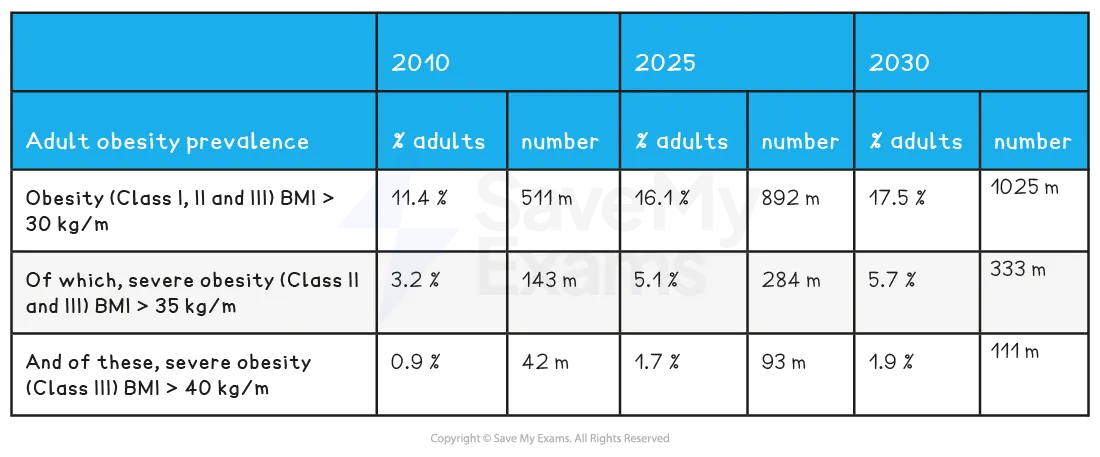
Obesity is defined as a body mass index (BMI) of 30 kg/m² or above
Research seems to suggest an inherited genetic basis for obesity, as some individuals appear more genetically predisposed to become obese than others
Genetic explanations suggest obesity is polygenic, with many genes involved that interact with each other and have relatively small effects
E.g., Locke et al. (2015) studied the genomes of more than 300,000 people and identified 97 genes associated with variations in BMI, which together accounted for only 2.7% of BMI variation
Genetic explanations are generally tested by looking at the incidence of obesity among related individuals, using twin and family studies, as well as gene-profiling studies that search for common genes among obese people
Family studies show clear family-related patterns in BMI, with concordance rates for first-degree relatives living apart in the region of 20% to 50%, indicating a moderate degree of heritability (Chaput et al., 2014)
Obesity has also been blamed on the inherited genes from human ancestors that predispose individuals to favour fatty, sweet and salty foods, all of which are now cheap and easily accessible through fast food outlets
Because the human gene pool has not substantially altered since our ancestral past, genes that once favoured survival by promoting fat storage now contribute to obesity in an environment of abundant food
This is known as the thrifty gene model, in which genes that were adaptive in conditions of food scarcity have become maladaptive in modern environments
Neural explanations
The hypothalamus is the brain structure identified as playing a central role in the regulation of eating
Therefore, neural explanations focus on the idea that a malfunction within the hypothalamus is associated with the development of obesity
The lateral hypothalamus (LH) is the 'feeding centre' that initiates eating behaviour, and the ventromedial hypothalamus (VMH) is the 'satiety centre'
Neural explanations for obesity go back to the ob gene (above), which codes for leptin, arguing that obese individuals lack the hormone leptin because of a mutation in the ob gene and therefore do not receive the message in the VMH to stop eating when full
The neurotransmitters serotonin and dopamine are also related to obesity, with low levels of both associated with increased appetite
Serotonin normally regulates feeding behaviour by inhibiting the activity of various sites in the hypothalamus, including the VMH, signalling that the individual has eaten to satiety
Dysfunctions of the serotonin system may be genetically inherited, or may occur due to stress or co-morbid disorders such as depression
When levels of serotonin are abnormally low, this creates inaccurate satiety signals to the hypothalamus, disinhibiting eating behaviour
Low levels of serotonin have also been linked with cravings for energy-rich foods, such as cake and chocolate, that are high in fats and sugars, which cause weight gain through consuming too many calories (Wurtman, 1995)
Dopamine stimulates brain areas including the hypothalamus, hippocampus and amygdala, providing rewarding feelings of pleasure and well-being associated with eating and with cues associated with eating, such as the smell of food
Wang et al. (2001) found that obese individuals had significantly fewer dopamine D2 receptors in the striatum than normal-weight controls
Low levels of dopamine reduce pleasure in eating, and overeating is an attempt to activate reward centres in the brain by increasing dopamine levels
The explanation that focuses on low levels of dopamine proposes that obesity is caused by food addiction that operates neurochemically in the same ways as other addictions
Research which investigates biological explanations for obesity
Ritchie & Noble (2003) conducted a PET scan study and found that people who inherited one version of the DRD2 gene had 30–40% fewer D2 receptors than those with other versions
This suggests that people with low dopamine levels experience less pleasurable reward from eating, making them more likely to overeat
Nan et al. (2012) conducted a meta-analysis of 12 twin studies involving over 8,000 MZ and nearly 10,000 DZ twins, and found concordance rates ranging from 61% to 80%
This demonstrates a substantial genetic component to obesity that remained influential from late childhood through adolescence into adulthood
Evaluation of biological explanations for obesity
Strengths
The discovery of genes related to obesity has practical application, as it has led to the search for effective gene therapies for the treatment of the condition
Ohia et al. (2013) highlight the importance of one serotonin receptor in particular, the 2C receptor, with 'knockout' mice genetically engineered to have no functioning 2C receptors showing late-onset obesity
This provides further evidence of a link between obesity and a dysfunctional serotonin system
Limitations
Neural explanations for obesity that examine serotonin and dopamine levels are correlational, and so it is not clear whether low neurotransmitter levels are a cause or an effect of being obese
Many findings from biological research into obesity are based on genetically modified mice, and so may not generalise to humans, whose eating behaviour is also shaped by social and cultural factors
Issues & Debates
Biological explanations are heavily nativist, emphasising genetic and neurochemical causes of obesity
This underplays the role of nurture, such as lifestyle, diet, and cultural factors, that also contribute to obesity
Biological theories of obesity may be culturally biased, as much of the research is based on Western populations, particularly from the US and Europe
These explanations may not fully apply to non-Western cultures where dietary norms and lifestyle patterns differ significantly
This limits the universality of biological theories and could lead to misdiagnosis or inappropriate treatment in diverse cultural settings

Unlock more, it's free!
Join the 100,000+ Students that ❤️ Save My Exams
the (exam) results speak for themselves:

Was this revision note helpful?
Build on this topic
