Genetics & Neural Explanations of Offending Behaviour (AQA A Level Psychology): Revision Note
Syllabus Edition
First teaching 2025
First exams 2027
Exam code: 7182

Genetic explanations of offending behaviour
Genetic explanations of offending behaviour revolve around the idea that criminality is inherited and that there may be specific genes which predispose individuals to criminal behaviour
A genetic explanation of criminality assumes that mutations within specific genes or combinations of genes may be a key contributory factor in determining criminal behaviour in an individual
One way of investigating a genetic explanation of offending behaviour is to use twin studies in which concordance rates are measured to look for agreement between MZ (identical) and DZ (non-identical) twins in relation to criminality, i.e., if one twin has committed a crime, how likely is it that the other twin has also committed a crime?
The main assumption underpinning twin studies is that if criminality is genetic, then there will be a higher concordance rate between MZ twins than between DZ twins, as MZ twins share 100% of their DNA
Lange (1930) conducted the first criminal twin study, investigating 13 MZ and 17 DZ twins where one of the twins in each pair had served time in prison
Lange found that 10 of the MZ twins but only 2 of the DZ twins had a co-twin who was also in prison
Tiihonen et al. (2014) conducted a genetic analysis of almost 900 offenders and found abnormalities in two genes associated with violent crime:
The MAOA gene, which controls dopamine and serotonin in the brain
The CDH13 gene, which has been linked to substance abuse and ADHD
Within the Finnish sample, individuals with this high-risk combination were around 13 times more likely to have a history of violent behaviour, although this research is in its infancy and has not so far been replicated
Examiner Tips and Tricks
Make sure that you don’t confuse MZ twins with DZ twins, as doing so will mean that you are unlikely to gain full marks in a question on genetics.
Neural explanations of offending behaviour
Neural explanations of offending behaviour assume that brain structure and/or neurochemistry increase an individual’s propensity to criminal behaviour
A neural explanation of criminality assumes that specific neurotransmitters may be a key contributory factor in determining criminal behaviour in an individual
E.g., heightened levels of dopamine leading to reward-seeking behaviour
Evidence suggests there may be neural differences in the brains of criminals and non-criminals, with much of this evidence focusing on individuals diagnosed with antisocial personality disorder (APD), formerly referred to as psychopathy
APD is associated with reduced emotional responses, a lack of empathy for the feelings of others, and is a condition that characterises many convicted criminals
Structural differences in the brain may also play a role in offending behaviour, particularly concerning the limbic system
The limbic system is the area of the brain that helps to regulate emotional responses, particularly the amygdala, which processes emotional information
Recent research suggests that criminals with APD can experience empathy, but do so more sporadically than the rest of us
Keysers et al. (2011) found that only when participants were asked to empathise with a person depicted on film experiencing pain did their empathy reaction, controlled by mirror neurons in the brain, activate
This suggests that APD individuals are not totally without empathy, but may have a neural 'switch' that can be turned on and off, unlike the 'normal' brain which has the empathy switch permanently on
Raine has conducted many studies of the APD brain, reporting that there are several dozen brain-imaging studies demonstrating that individuals with antisocial personality disorder have reduced activity in the prefrontal cortex, the part of the brain that regulates emotional behaviour
Raine et al. (2000) also found an 11% reduction in the volume of grey matter in the prefrontal cortex of people with APD compared with controls
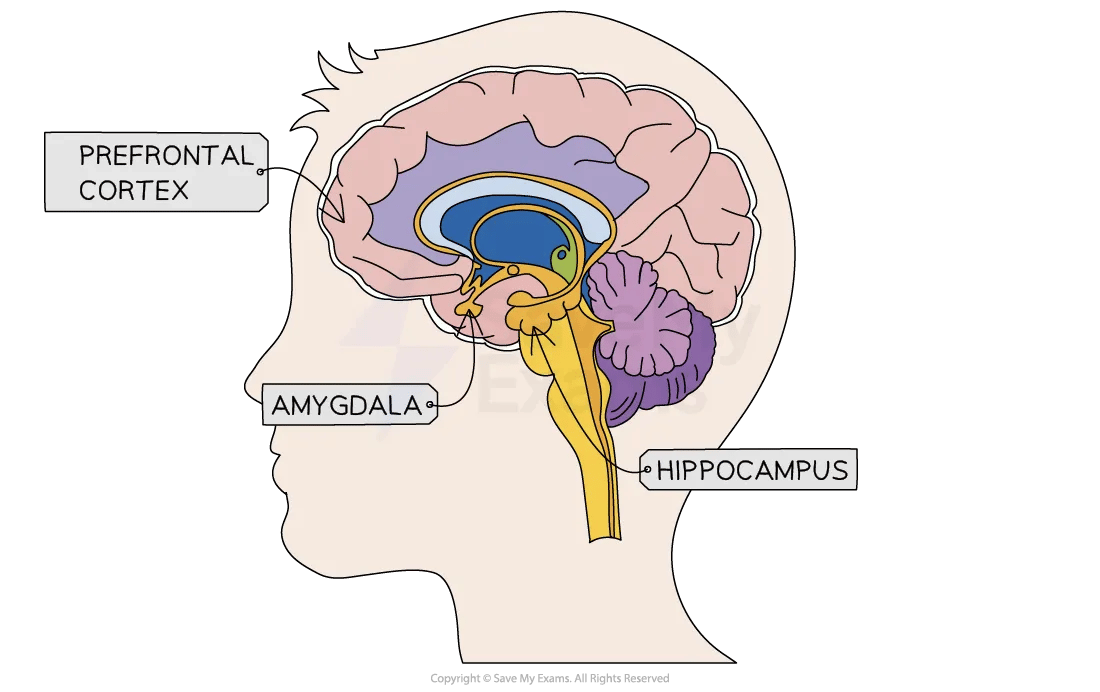
Research which investigates genetic & neural explanations of offending behaviour
Crowe (1972) found that adopted children who had a biological parent with a criminal record had a 50% risk of having a criminal record by the age of 18, whereas adopted children whose mother did not have a criminal record had only a 5% risk
Brunner (1993) identified a mutation in the MAOA gene, which disturbed the levels of key neurotransmitters such as serotonin, which he linked to the anti-social behaviour and low IQ of a group of males from one family in the Netherlands
Evaluation of genetic & neural explanations of offending behaviour
Strengths
Mednick et al. (1984) studied over 13,000 Danish adoptees, checking court convictions against police records for each adoptee and their biological and adoptive parents
Conviction rates rose from 13.5% when neither set of parents had convictions, to 20% when a biological parent did, to 24.5% when both biological and adoptive parents did, suggesting genetic inheritance matters but environmental influence cannot be disregarded, supporting a diathesis-stress model
The use of brain imaging techniques such as PET and fMRI provides objective evidence of structural and functional differences, which increases the validity of neural explanations compared with self-report methods
Limitations
Twin studies typically use small samples, and twins are an unusual sample in themselves so may not represent the rest of the population, e.g., Lange's research was poorly controlled and judgements about zygosity were based on appearance rather than DNA testing
Twins also share the same environment, which is a major confounding variable, as concordance rates may be due to shared learning experiences rather than genetics
Adoption studies are complicated by late adoption, as many children spend much of their infancy with their biological parents and often maintain contact with them afterwards
This makes the environmental impact of the biological parents difficult to assess, and Mednick's figures applied to petty offences such as burglary rather than violent crime, so may not generalise to more serious crimes
Issues & Debates
These explanations focus heavily on biological (nature) factors such as genes (e.g. MAOA, CDH13) and brain structures (e.g. prefrontal cortex, amygdala)
This may underestimate the role of environmental influences like upbringing, trauma, or peer pressure, which also contribute to offending behaviour
These theories are reductionist, as they reduce complex behaviours like crime to simplistic biological causes
They ignore the holistic interaction of social, cognitive, and psychological factors in offending behaviour
While helpful in identifying risk factors, this approach lacks a full explanation for why crime occurs in specific contexts or why many people with similar biology don't offend
Worked Example
Here is an example of an AO2 question you might be asked on this topic.
AO2: You need to apply your knowledge and understanding, usually referring to the ‘stem’ in order to do so
Dr Monno investigated genetic explanations of criminal behaviour using concordance rates. She compared the number of criminal acts committed by one twin (the proband) and their sibling across 98 MZ twins, 98 DZ twins, and 98 non-twin siblings.
Q. Using the table, explain what each correlation shows and what the findings suggest about the genetic basis of criminal behaviour.
[4 marks]
| MZ twins | DZ twins | Non-twins |
Correlation coefficient for criminal acts | 0.7 | 0.3 | 0.1 |
Model answer:
Present your points using the data in the table:
The MZ twins showed the highest correlation (0.7), suggesting a strong genetic influence on criminal behaviour since they share 100% of their genes [1 mark]
DZ twins had a weak correlation (0.3), supporting the idea that sharing fewer genes (50%) results in less similarity in criminal acts [1 mark]
Non-twin siblings showed a very weak correlation (0.1) despite sharing the same proportion of genes as DZ twins, suggesting that shared environment and age also matter, not genetics alone [1 mark]
Overall, the pattern suggests that the more genetically similar individuals are, the more likely they are to share criminal behaviour, supporting a genetic explanation [1 mark]
[4 marks]

Unlock more, it's free!
Join the 100,000+ Students that ❤️ Save My Exams
the (exam) results speak for themselves:

Was this revision note helpful?
Build on this topic
