Resistors in Parallel (Cambridge (CIE) AS Physics): Revision Note

Exam code: 9702

Ashika

Written by: Ashika

Reviewed by: Caroline Carroll

Updated on

Deriving the equation for resistors in parallel

  • In a parallel circuit, the reciprocal of the combined resistance of two or more resistors is the sum of the reciprocal of the individual resistances

  • In a parallel circuit:

    • The current is split at the junction (and therefore between resistors)

    • The potential difference is the same through all resistors

  • The equation for combined resistors in parallel is derived using Kirchhoff’s laws:

10-1-2-5-derivation-of-resistors-in-parallel-1
Derivation of resistors in parallel (2), downloadable AS & A Level Physics revision notes

Resistors in parallel

  • When two or components are connected in parallel:

    The reciprocal of the combined resistance is the sum of the reciprocals of the individual resistances

Resistors in parallel

Resistors in parallel diagram, downloadable AS & A Level Physics revision notes

Resistors connected in parallel have the same voltage


  • The equation for the combined resistance, R  of resistors in parallel is:

1 over R space equals space 1 over R subscript 1 space plus thin space 1 over R subscript 2 space plus thin space 1 over R subscript 3...

  • This means the combined resistance decreases and is less than the resistance of any of the individual components

  • For example, If two resistors of equal resistance are connected in parallel, then the combined resistance will halve

Maths tip

  • The reciprocal of a value is fraction numerator 1 over denominator v a l u e end fraction

  • For example, the reciprocal of a whole number such as 2 equals 1 half

    • The reciprocal of 1 half is 2

  • If the number is already a fraction, the numerator and denominator are ‘flipped’ round

Reciprocals
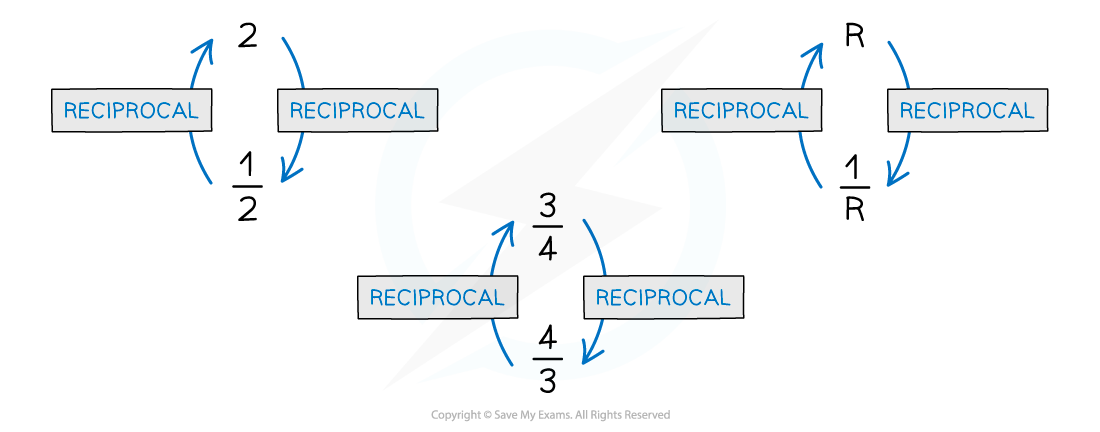
Reciprocals, downloadable AS & A Level Physics revision notes

The reciprocal of a number is 1 ÷ number


  • In the case for the resistance R, this becomes 1 over R. To get the value of R from 1 over R, you must calculate fraction numerator 1 over denominator y o u r space a n s w e r end fraction

  • You can also use the reciprocal button on your calculator (labelled either x-1 or 1 over x, depending on your calculator


Worked Example

The circuit below shows 3 resistors connected in parallel. 

Which value gives the combined resistance of all the resistors in this circuit?

A. fraction numerator 5 R over denominator 2 end fraction     

B. fraction numerator 2 over denominator 5 R end fraction     

C. fraction numerator 5 over denominator 2 R end fraction      

D. fraction numerator 2 R over denominator 5 end fraction

10-2-4-we-resistors-in-parallel--cie-new

Answer: D

Step 1: Resistors in parallel equation

1 over R space equals fraction numerator space 1 over denominator R subscript 1 end fraction space plus thin space 1 over R subscript 2 space plus thin space.... space equals space 1 over R subscript 1 space plus thin space 1 over R subscript 2 space plus thin space 1 over R subscript 3

Step 2: Substitute in the values given from the equation

1 over R subscript T space equals fraction numerator space 1 over denominator R end fraction space plus thin space fraction numerator 1 over denominator 2 R end fraction space plus fraction numerator space 1 over denominator R end fraction space equals space open parentheses 1 space plus thin space 1 half space plus thin space 1 close parentheses space 1 over R space equals space fraction numerator 5 over denominator 2 R end fraction

Step 3: Calculate the total resistance

1 over R subscript T space equals fraction numerator space 5 over denominator 2 R end fraction

R subscript T space equals fraction numerator space 2 R over denominator 5 end fraction

Examiner Tips and Tricks

The most common mistake is to leave the answer as 1/RT. Remember to calculate fraction numerator 1 over denominator a n s w e r end fraction to get the value of RT.

Unlock more, it's free!

Join the 100,000+ Students that ❤️ Save My Exams

the (exam) results speak for themselves:

Build on this topic

Ashika

Author: Ashika

Expertise: Physics Content Creator

Ashika graduated with a first-class Physics degree from Manchester University and, having worked as a software engineer, focused on Physics education, creating engaging content to help students across all levels. Now an experienced GCSE and A Level Physics and Maths tutor, Ashika helps to grow and improve our Physics resources.

Caroline Carroll

Reviewer: Caroline Carroll

Expertise: Head of Content Delivery

Caroline graduated from the University of Nottingham with a degree in Chemistry and Molecular Physics. She spent several years working as an Industrial Chemist in the automotive industry before retraining to teach. Caroline has over 12 years of experience teaching GCSE and A-level chemistry and physics. She is passionate about delivering high-quality resources to help students achieve their full potential.
