Calculating Uncertainties (Cambridge (CIE) AS Physics): Revision Note

Exam code: 9702

Ashika

Written by: Ashika

Reviewed by: Caroline Carroll

Updated on

Guided study available on this topic

Understand this topic with deeper explanations and understanding checks.

Calculating uncertainty

What is uncertainty?

  • When measurements are taken, there is always a degree of uncertainty in those measurements due to errors in the experimental technique

  • Uncertainties are not the same as errors

    • Errors can be thought of as the difference between the actual reading taken and the true value

    • The uncertainty is a range of values around a measurement within which the true value is expected to lie, and is an estimate

  • For example, if the length of a box is measured multiple times as 12.55 cm, 12.45 cm and 12.51 cm, we can say the length is 12.50 cm with an uncertainty of 0.05 cm

    • This is often written as 12.50 ± 0.05 cm

Calculating uncertainty

  • Uncertainties can be represented in a number of ways:

    • Absolute uncertainty: where uncertainty is given as a fixed quantity (as above)

    • Fractional uncertainty: where uncertainty is given as a fraction of the measurement

    • Percentage uncertainty: where uncertainty is given as a percentage of the measurement

percentage uncertainty=absolute uncertainty measured value×100

  • To find uncertainties in different situations:

    • The uncertainty in a reading (e.g. from a voltmeter): ± half the smallest division

    • The uncertainty in a measurement (e.g. from a ruler): at least ±1 smallest division

    • The uncertainty in repeated data: half the range i.e. ± ½ (largest - smallest value)

    • The uncertainty in digital readings: ± the last significant digit unless otherwise quoted

Diagram showing a reading from an ammeter
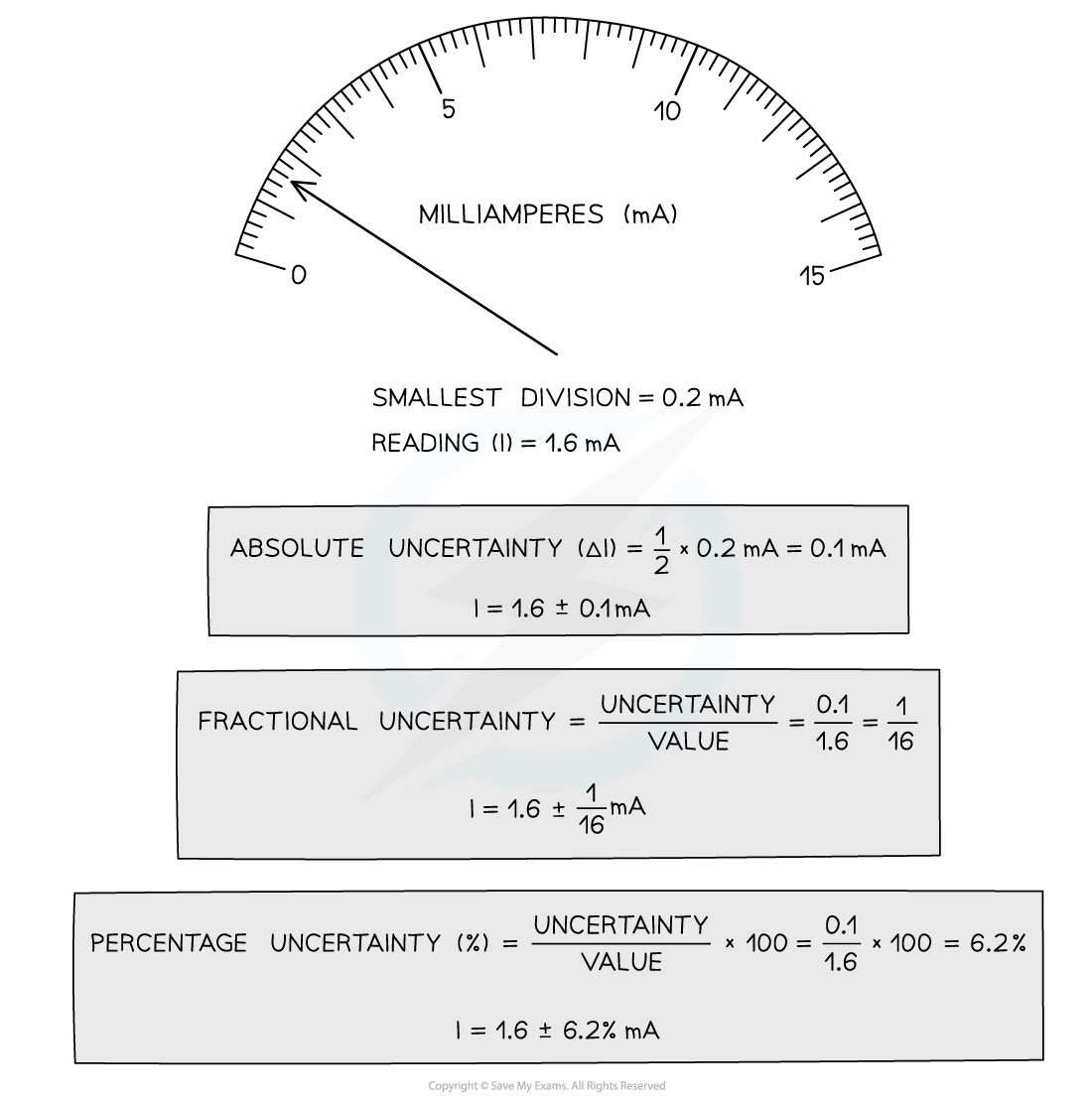
An ammeter scale from 0 to 15 mA with a smallest division of 0.2 mA, reading 1.6 mA, followed by worked calculations: absolute uncertainty = ½ × 0.2 mA = 0.1 mA, so I = 1.6 ± 0.1 mA; fractional uncertainty = 0.1 / 1.6 = 1/16; percentage uncertainty = 0.1 / 1.6 × 100 = 6.2%

Combining uncertainties

  • When combining two measurements that both have uncertainties, the uncertainties have to be combined too

Adding or subtracting data

  • When adding or subtracting two values with uncertainties, just add the absolute uncertainties

Adding or subtracting data example
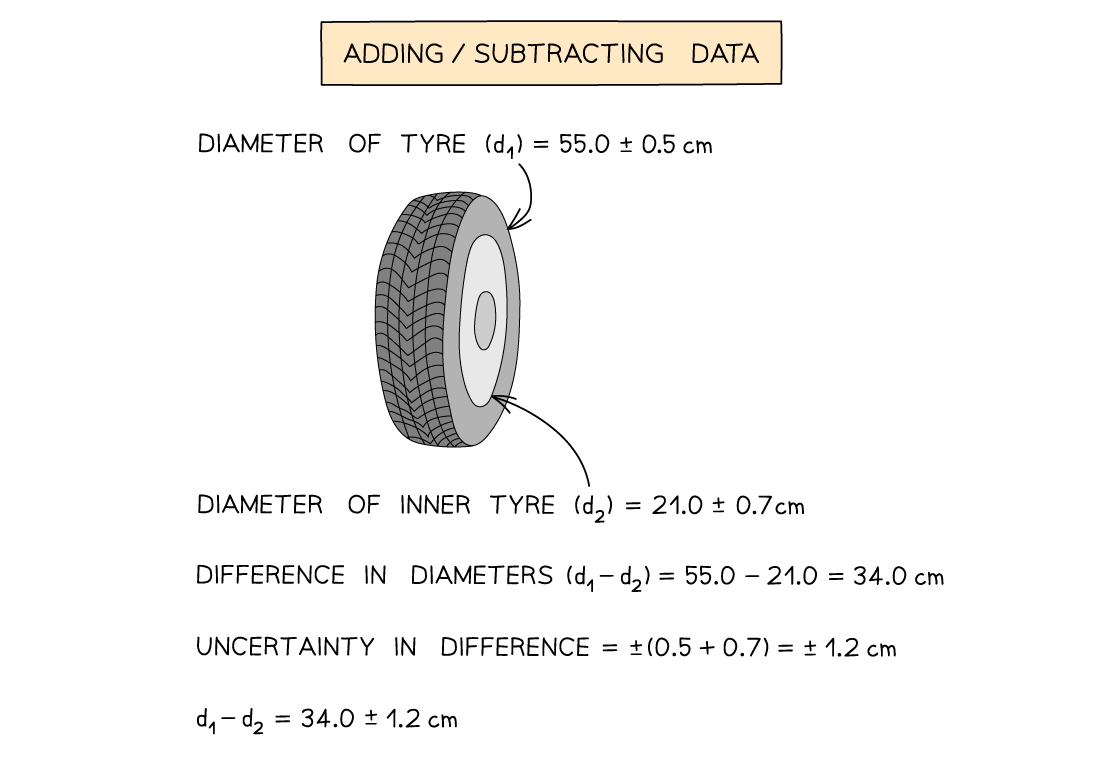
Adding or subtracting data: the outer diameter of a tyre is 55.0 ± 0.5 cm and the inner diameter is 21.0 ± 0.7 cm; the difference is 55.0 − 21.0 = 34.0 cm and the uncertainty is 0.5 + 0.7 = ±1.2 cm, giving 34.0 ± 1.2 cm

Multiplying or dividing data

  • When multiplying or dividing measurements with uncertainties, add their percentage uncertainties

Multiplying or dividing data example
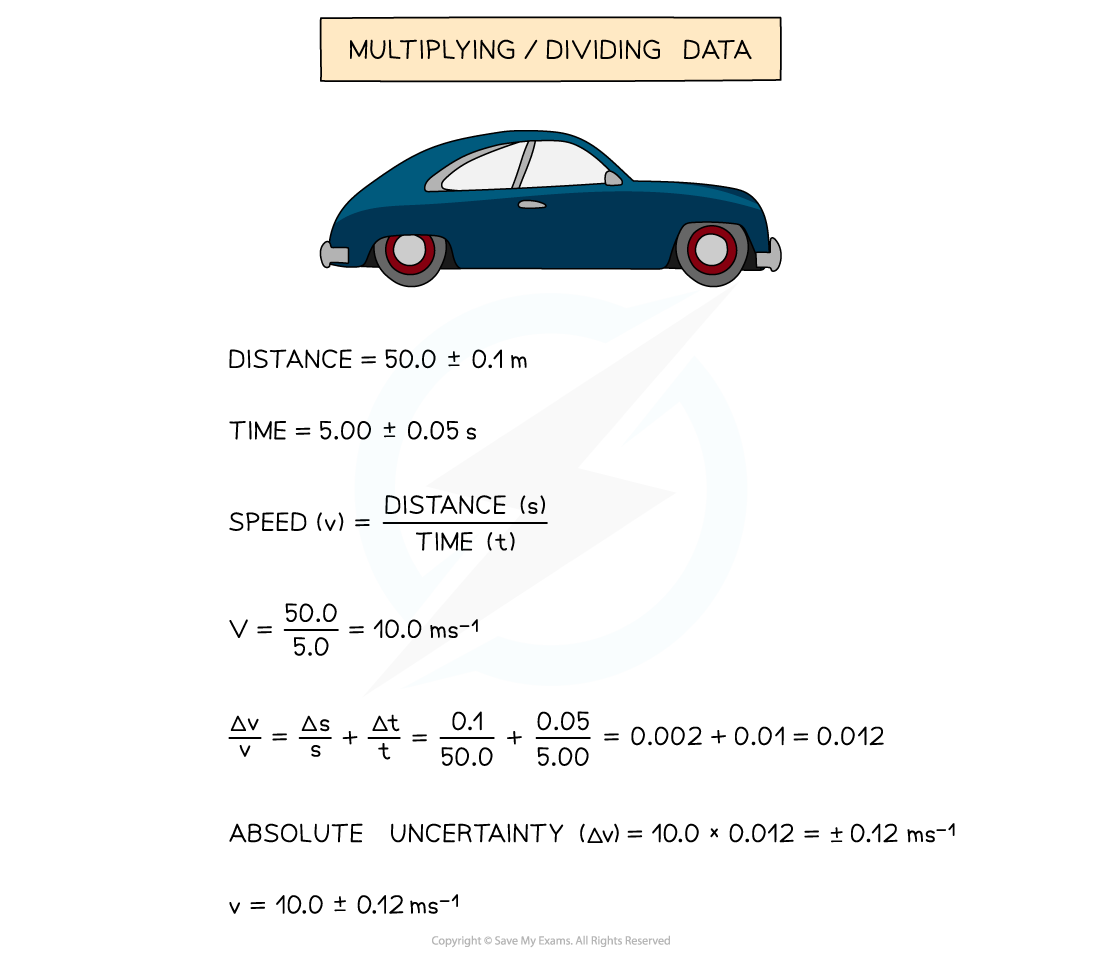
Multiplying or dividing data: a car travels a distance of 50.0 ± 0.1 m in a time of 5.00 ± 0.05 s, so its speed is 50.0 / 5.00 = 10.0 m s⁻¹; the fractional uncertainty is 0.1/50.0 + 0.05/5.00 = 0.012, so the absolute uncertainty is 10.0 × 0.012 = 0.12 m s⁻¹, giving 10.0 ± 0.12 m s⁻¹
  • When the measurement is raised to a power, multiply the fractional or percentage uncertainty by the power

Raising to a power example

Raising to a power: a sphere of radius 2.50 ± 0.02 cm is measured with vernier callipers; its volume is (4/3)π(2.50)³ = 65.5 cm³; the fractional uncertainty is 3 × 0.02/2.50 = 0.024, so the absolute uncertainty is 65.5 × 0.024 = 1.57 cm³ and the percentage uncertainty is 2.4%

Unlock more, it's free!

Join the 100,000+ Students that ❤️ Save My Exams

the (exam) results speak for themselves:

Build on this topic

Ashika

Author: Ashika

Expertise: Physics Content Creator

Ashika graduated with a first-class Physics degree from Manchester University and, having worked as a software engineer, focused on Physics education, creating engaging content to help students across all levels. Now an experienced GCSE and A Level Physics and Maths tutor, Ashika helps to grow and improve our Physics resources.

Caroline Carroll

Reviewer: Caroline Carroll

Expertise: Head of Content Delivery

Caroline graduated from the University of Nottingham with a degree in Chemistry and Molecular Physics. She spent several years working as an Industrial Chemist in the automotive industry before retraining to teach. Caroline has over 12 years of experience teaching GCSE and A-level chemistry and physics. She is passionate about delivering high-quality resources to help students achieve their full potential.
