Esters (Edexcel IGCSE Chemistry): Revision Note
Exam code: 4CH1

Esters
Making esters
Alcohols and carboxylic acids react to make esters in esterification reactions
Esters are compounds with the functional group R-COO-R

Esters are sweet-smelling oily liquids used in food flavourings and perfumes
Ethanoic acid will react with ethanol in the presence of concentrated sulfuric acid (catalyst) to form the ester, ethyl ethanoate:
CH3COOH + C2H5OH → CH3COOC2H5 + H2O
Diagram showing the formation of ethyl ethanoate

During this esterification reaction, a molecule of water is also produced
Naming Esters
An ester is made from an alcohol and carboxylic acid
The first part of the name indicates the length of the carbon chain in the alcohol, and it ends with the letters ‘- yl’
The second part of the name indicates the length of the carbon chain in the carboxylic acid, and it ends with the letters ‘- oate’
E.g. The ester formed from pentanol and butanoic acid is called pentyl butanoate

Diagram showing the origin of each carbon chain in ester
Some examples of common esters:
Examples of Esters Table

Worked Example
Propanol reacts with ethanoic acid to form an ester
Name the ester formed and write its structural formula and displayed formulae.
Answer:
Step 1: Identify the two parts of the ester name
Propanol provides the first part of the ester name
propanol - propyl
Ethanoic acid provides the second part
ethanoic acid - ethanoate
Therefore, the ester is propyl ethanoate
Step 2: Write the part that comes from the carboxylic acid
Ethanoic acid has the structural formula CH3COOH
In the ester, the -OH of the carboxylic acid is used to form water
Therefore, the first part of the structural formula is CH3CO
Step 3: Write the part that comes from the alcohol
Propanol contains a chain of 3 carbon atoms CH3CH2CH2OH
The hydrogen atom bonded to the oxygen atom in the alcohol of is used to form water
Therefore, the second part of the structural formula is CH3CH2CH2O
Step 4: Join the two parts forming the ester link -COO-
CH3COOCH2CH2CH3
This is the structural formula of propyl ethanoate
Step 5: Turn the structural formula into a displayed formula
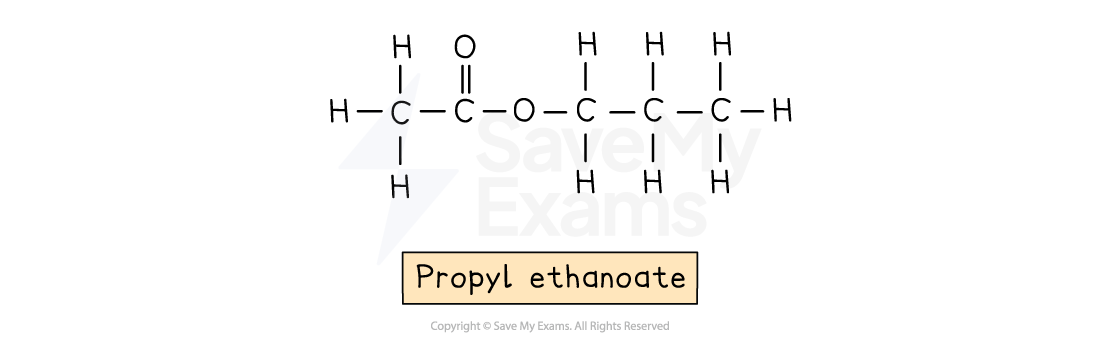
Examiner Tips and Tricks
You must be able to write the structure and displayed formula for an ester, given the name or formula of the alcohol and carboxylic acid from which it is formed and vice versa.
Worked Example
The structural formula of an ester is:
CH3CH3COOCH3
Identify the alcohol and carboxylic acid used to make this ester.
Answer:
Step 1 : Identify the ester link
Esters contain the –COO– group
Use this group to separate the two parts of the ester:
CH3CH2COO | CH3
Step 2: Identify the part from the alcohol
The carbon chain attached to the oxygen is:
–CH3
This is the alcohol part of the ester
Alcohol: methanol
Structural formula: CH3OH
Step 3: Identify the part from the carboxylic acid
The part containing the C=O group contains a chain of 3 carbon atoms
This is the carboxylic acid part of the ester
Carboxylic acid: propanoic acid
Structural formula: CH3CH2COOH
Step 4: Write the ester name
The alcohol part is the first part of the ester name
Methanol turns into methyl
The carboxylic acid part is the second part of the ester name
Propanoic acid turns into propanoate
Therefore, the ester name is: methyl propanoate

Unlock more, it's free!
Join the 100,000+ Students that ❤️ Save My Exams
the (exam) results speak for themselves:

Was this revision note helpful?
Build on this topic