1
1 mark
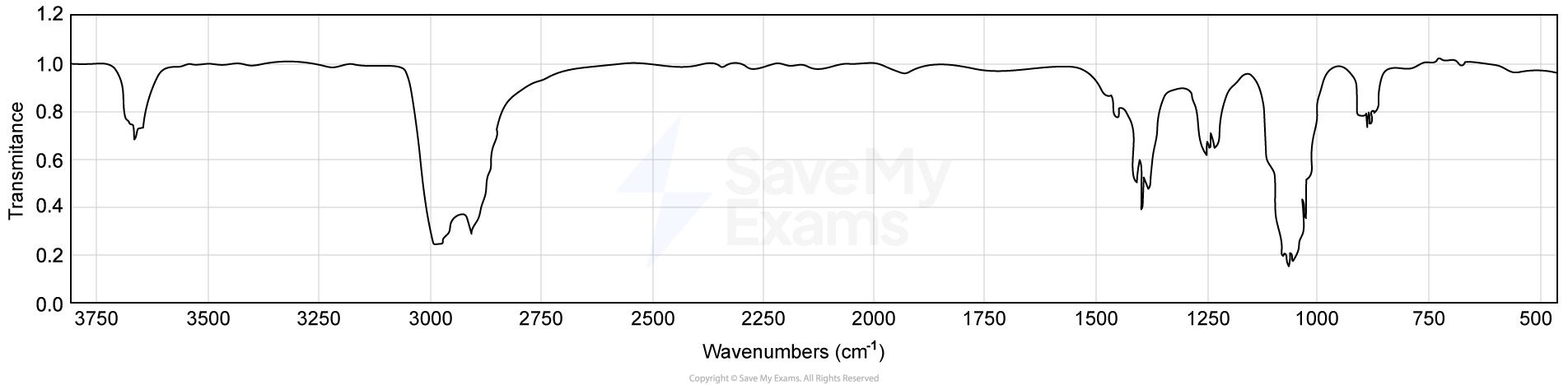
The infrared spectrum of an organic compound is shown.

Which of these compounds would give this infrared spectrum?
hexanal
hexane
hexanoic acid
hexan-1-ol
Was this exam question helpful?
Exam code: YCH11
The infrared spectrum of an organic compound is shown.
Which of these compounds would give this infrared spectrum?
hexanal
hexane
hexanoic acid
hexan-1-ol
Was this exam question helpful?
In a mass spectrum, the molecular ion is the ion which always has the
greatest abundance
greatest stability
highest charge
highest mass/charge ratio
Was this exam question helpful?

Butan-1-ol and butan-2-ol are isomers.
Which m / z value would be expected to have a significant peak in the mass spectrum of butan-1-ol but not that of butan-2-ol?
15
29
43
57
Was this exam question helpful?
Which could be the infrared spectrum of CH2=CHCH2OH?


Was this exam question helpful?
An aliphatic organic compound has the infrared spectrum shown.

What are the bond stretches responsible for the peaks P and Q in the spectrum?
|
| P | Q |
□ | A | O—H carboxylic acid | CO carboxylic acid |
□ | B | O—H carboxylic acid | CO aldehyde |
□ | C | C—H aldehyde | CO carboxylic acid |
□ | D | C—H aldehyde | CO aldehyde |
Was this exam question helpful?
The infrared spectrum of a compound X is shown.

Which could be compound X?

Was this exam question helpful?
The mass spectrum of propanone is shown.

Which fragment is most likely to produce the peak at m / z = 43?
CH3CH2C
CH3CO+
CH2CHO+
CHCH2O+
Was this exam question helpful?
Which reagent produces a silver mirror when warmed with propanal but not when warmed with propanone?
2,4-dinitrophenylhydrazine (Brady's reagent)
Acidified potassium dichromate(VI)
Fehling's solution
Tollens' reagent
Was this exam question helpful?
A colourless liquid, Z, is known to be either ethanol (CH3CH2OH) or methoxymethane (CH3OCH3).
The mass spectrum and infrared spectrum of Z are shown.

What is the relative molecular mass, Mr, of compound Z?
30
44
46
60
The broad IR absorption in the range 3230–3550 cm–1 is characteristic of which bond?
C=C
C=O
C–H
O–H (alcohol)
What is the identity of compound Z?
Ethanol, because the IR shows a broad peak at 3200–3550 cm–1
Ethanol, because the IR shows no peak near 1715 cm–1
Methoxymethane, because both compounds have Mr = 46
Methoxymethane, because methoxymethane contains an O–H bond
Was this exam question helpful?