This question is about the reactions of halogenoalkanes and alcohols.
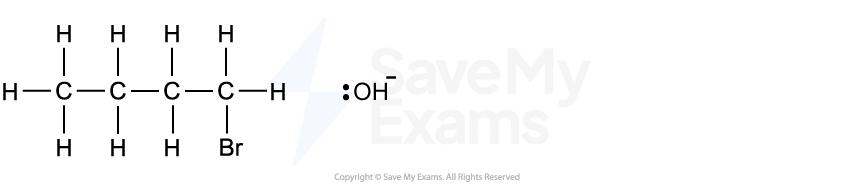
1-Bromobutane (CH3CH2CH2CH2Br) reacts with aqueous sodium hydroxide solution under reflux to form butan-1-ol.
Draw the mechanism for this reaction. Your diagram must clearly show:
the partial charges (δ+ and δ–) on the C–Br bond
the lone pair on the hydroxide ion
all curly arrows (each representing the movement of a pair of electrons)
the final organic product.
When 1-iodobutane and 1-bromobutane are separately heated under reflux with aqueous sodium hydroxide, 1-iodobutane reacts more quickly than 1-bromobutane.
Explain this observation.
Butan-2-ol (CH3CH(OH)CH2CH3) is heated under reflux with acidified potassium dichromate(VI) solution.
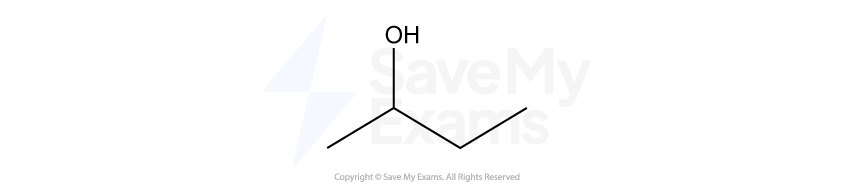
i) State the colour change observed.
[1]
ii) Write a balanced equation for the reaction, using [O] to represent the oxidising agent.
[2]
2-Methylpropan-2-ol is a tertiary alcohol.
Explain why tertiary alcohols are NOT oxidised by acidified potassium dichromate(VI).
Was this exam question helpful?