11 mark
Which type of compound cannot be a monomer in the formation of polyamides?
amides
amino acids
diacyl chlorides
diamines
Was this exam question helpful?
Exam code: YCH11
Which type of compound cannot be a monomer in the formation of polyamides?
amides
amino acids
diacyl chlorides
diamines
Was this exam question helpful?
What is the name of the compound shown?

1-methylpropanamide
3-methylpropanamide
2-methylbutanamide
3-methylbutanamide
Was this exam question helpful?
Which sequence shows these compounds in order of decreasing basicity?
C6H5NH2 > CH3CH2CH2NH2 > NH3
NH3 > CH3CH2CH2NH2 > C6H5NH2
CH3CH2CH2NH2 > NH3 > C6H5NH2
C6H5NH2 > NH3 > CH3CH2CH2NH2
Was this exam question helpful?
Alanine is an amino acid.
Which structure best represents alanine at high pH?

Alanine is a crystalline solid at room temperature.
What are the main forces broken when alanine melts?
London forces
hydrogen bonds
covalent bonds
ionic bonds
Was this exam question helpful?
Separate 0.1 mol dm−3 aqueous solutions of ammonia, butylamine and phenylamine were prepared.
Which of the following sequences shows the solutions in order of increasing pH?
butylamine, phenylamine, ammonia
ammonia, butylamine, phenylamine
phenylamine, ammonia, butylamine
ammonia, phenylamine, butylamine
Was this exam question helpful?
Which amine could not be prepared by the reduction of a nitrile?

Was this exam question helpful?
The repeat unit of a polymer is shown.

What is the structure of the monomer?

Was this exam question helpful?
How many different amino acids form the repeat unit of the polymer shown?

3
4
5
6
Was this exam question helpful?
The repeat unit of a polymer is shown.

This polymer could be
both a polypeptide and a polyamide
neither a polypeptide nor a polyamide
a polypeptide but not a polyamide
a polyamide but not a polypeptide
Was this exam question helpful?
Which of these correctly lists ammonia, butylamine and phenylamine in order of increasing base strength?
Ammonia < butylamine < phenylamine
Ammonia < phenylamine < butylamine
Phenylamine < ammonia < butylamine
Phenylamine < butylamine < ammonia
Was this exam question helpful?
Which of these correctly shows the reagents and conditions for the diazotisation of phenylamine (C6H5NH2)?
Reagents | Temperature | |
|---|---|---|
A | NaNO2, dilute HCl | Below 10°C |
B | NaNO3, dilute HCl | Below 10°C |
C | NaNO2, dilute HCl | Above 10°C |
D | NaNO2, dilute NaOH | Below 10°C |
Was this exam question helpful?
The structure of the amino acid glycine is shown.
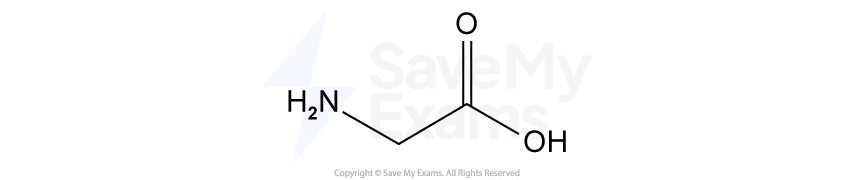
Glycine has an isoelectric point of 6.0. Which species is the predominant form of glycine at pH 6?
H2NCH2COOH
H3N+CH2COO-
H3N+CH2COOH
H2NCH2COO-
Was this exam question helpful?
Ethanamide, CH3CONH2, is heated under reflux with excess dilute hydrochloric acid. Which products are formed?
CH3COOH and NH4Cl
CH3COOH and NH3
CH3COO- and NH4Cl
CH3COO- and NH3
Was this exam question helpful?
A section of a polyamide is shown.
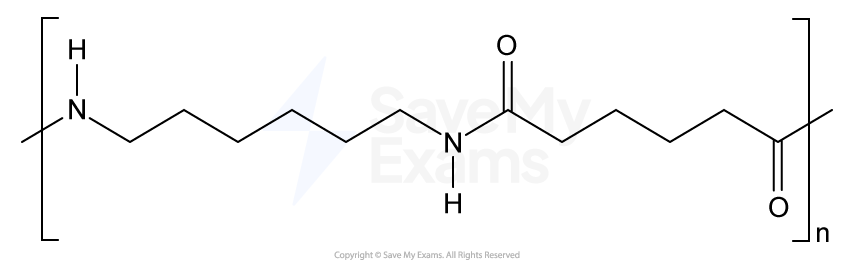
Which monomers were used to produce this polymer?
H2N(CH2)6NH2 and HOOC(CH2)4COOH
H2N(CH2)6NH2 and HOOC(CH2)6COOH
H2N(CH2)6COOH and H2N(CH2)4COOH
HOOC(CH2)6COOH and H2N(CH2)4NH2
Was this exam question helpful?
The structure of threonine is shown.
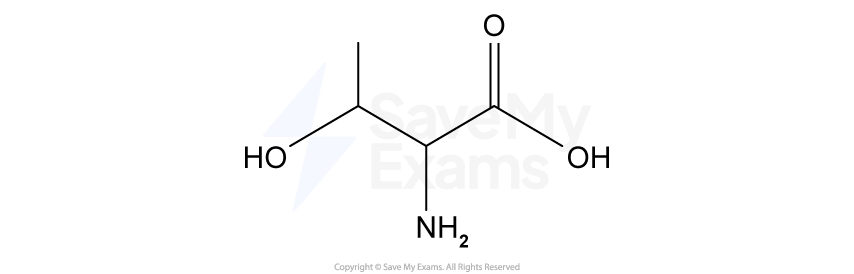
How many chiral centres does threonine contain?
0
1
2
4
Was this exam question helpful?
Which reagent reacts at room temperature with methylamine, CH3NH2, to form the compound N-methylethanamide?
CH3COCH3
CH3COOH
CH3COOCH3
CH3COCl
Was this exam question helpful?
Which reaction produces a secondary amine as the major organic product?
CH3Br + excess NH3(aq) →
CH3CH2CN + LiAlH4, then H3O+ →
CH3CONH2 + LiAlH4, then H3O+ →
Excess CH3NH2 + CH3CH2Br →
Was this exam question helpful?