Kinetics (Edexcel International A Level (IAL) Chemistry): Exam Questions

Exam code: YCH11

1 hour15 questions
1a
4 marks

A student investigated the kinetics of the reaction between bromate(V) ions and bromide ions in acidic conditions.

BrO3(aq) + 5Br (aq) + 6H+ (aq) → 3Br2(aq) + 3H2O(l)

In the first experiment, the student measured the initial rate of the reaction at five different concentrations of bromate(V) ions, BrO3 . In each case, the initial concentrations of bromide ions and hydrogen ions were constant and in large excess. The results obtained are shown.

Initial concentration of bromate(V) ions / mol dm–3

Initial rate of reaction / mol dm–3 s–1

0.030

4.17 × 10⁻⁷

0.060

8.34 × 10⁻⁷

0.090

1.25 × 10⁻⁶

0.120

1.67 × 10⁻⁶

0.150

2.09 × 10⁻⁶

i) Use the results to plot a suitable graph that can be used to show that the reaction is first order with respect to bromate(V) ions.

(3)


q16a-i-paper-4-2021-june-edexcel-ial-chemistry


ii) State how your graph shows that the reaction is first order with respect to bromate(V) ions.

(1)

1b
Sme Calculator
6 marks

In the second experiment, the student determined the initial rates of the same reaction starting with different concentrations of the reactants.

Run

[BrO3] / mol dm–3

[Br] / mol dm–3

[H+] / mol dm–3

Initial rate of reaction / mol dm–3 s–1

1

0.062

0.21

0.40

1.52 × 10⁻⁵

2

0.31

0.21

0.20

1.90 × 10⁻⁵

3

0.062

0.63

0.40

4.56 × 10⁻⁵

i) Use these results and your answer to (a) to deduce the orders with respect to Brions and H+ ions.

(2)

Br-  ions.................................................................................................................
H+   ions.................................................................................................................

ii) Write the rate equation for the reaction.

(1)

iii) Use the results for Run 1 and your rate equation from (b)(ii) to calculate the value for the rate constant, k. Include units in your answer.

(3)

1c
3 marks

The presence of bromate(V) ions in drinking water is harmful to humans. Bromate(V) ions can be converted to less harmful bromide ions by passing the water through palladium with a reducing agent.

Describe how a heterogeneous catalyst, such as palladium, increases the rate of a reaction.

2a
Sme Calculator
6 marks

The decomposition of benzenediazonium chloride is a first order reaction.

C6H5N2Cl + H2O → C6H5OH + N2 + HCl

The activation energy of this reaction was determined by measuring the rate constant
at various temperatures.

In an experiment at 333 K, the concentration of a sample of benzenediazonium chloride was measured at various times during its decomposition. The results of this experiment are shown.

Time / s

[C6H5N2Cl] / mol dm−3

0.0

0.500

40.0

0.410

100

0.285

200

0.165

280

0.100

350

0.070

400

0.050

i) Plot a graph of concentration of benzenediazonium chloride against time.

(3)

q17a-i-paper-4-oct-2021-edexcel-ial-chemistry

ii) Determine a value for the half-life, t1⁄2 , of this reaction.

You must show your working on the graph.

(1)

iii) Calculate the rate constant, k, for the reaction at 333 K.
Include units in your answer.

Use the expression ln2 = kt1⁄2

(2)

2b
Sme Calculator
9 marks

The experiment described in (a) was repeated for five temperatures and the data used to plot a graph for the Arrhenius equation in the form

lnk  =  −EaR×1T +  constant

q17b-paper-4-oct-2021-edexcel-ial-chemistry

i) Use the rate constant that you have calculated in (a)(iii) to obtain data for a point on the graph for 333K.

(2)

ii) Plot your data from (b)(i) on the graph.

(1)

iii) Determine the gradient of the graph by drawing a best-fit line.
Include a sign and units in your answer.

(3)

iv) Use the gradient determined in (b)(iii) to calculate the activation energy for the decomposition of benzenediazonium chloride.
Include a sign and units with your answer.

(3)

3
Sme Calculator
6 marks

The hydrolysis of halogenoalkanes by alkali is a nucleophilic substitution reaction.

RX + OH → ROH + X

The mechanism of this reaction for primary halogenoalkanes is different from the mechanism for tertiary halogenoalkanes.

Describe how knowledge of the rate equations for the hydrolysis of halogenoalkanes provides evidence for the mechanisms of these reactions.

Curly arrow mechanisms are not required.

1a
Sme Calculator
7 marks

Bromate(V) ions, BrO3, oxidise bromide ions, Br, in dilute acid.

BrO3(aq) + 5Br(aq) + 6H+ (aq) → 3Br2 (aq) + 3H2O(l)

Experiments to determine initial reaction rates were carried out using different initial concentrations of the three reactants.

The results are shown in the table.

Experiment number

[BrO3(aq)] /mol dm–3

[Br(aq)] /mol dm–3

[H+ (aq)] /mol dm–3

Initial rate of reaction / mol dm–3 s−1

1

0.10

0.25

0.30

3.36×10⁻⁵

2

0.10

0.25

0.60

1.34×10⁻⁴

3

0.15

0.50

0.30

1.01×10⁻⁴

4

0.15

0.25

0.60

2.01×10⁻⁴

The reaction is first order with respect to bromate(V) ions.

i) Deduce the rate equation for the reaction. Justify your answer using the data.

(4)

ii) Use the data from Experiment 4 and your answer to (a)(i) to calculate the rate constant for the reaction. Include units in your answer.

(3)

1b
1 mark

Give one possible reason why the rate equation shows that the reaction cannot proceed in one step.

2a
Sme Calculator
5 marks

This question is about some compounds of bromine.

Potassium bromate(V) decomposes to form potassium bromide and oxygen.

2KBrO3 (s)  2KBr (s) + 3O2 (g)          r H= 67.2 kJ mol1


The standard molar entropies of these substances are given in the table.

Substance

KBrO3 (s)

KBr (s)

O2 (g)

S / J K1 mol1

149.2

95.9

205.0

Calculate the total entropy change,  ΔStotal, for this reaction at 298 K.

2b
Sme Calculator
8 marks

Bromide ions react with bromate(V) ions in acidic solution.

5Br (aq) + BrO3 (aq) + 6H+  (aq)  3Br2(aq) + 3H2O(l)

Two experiments are carried out.

i) Experiment 1

The concentration of Brions is determined at different times.

The concentrations of BrO3 ions and H+ ions are in large excess and effectively constant.

The graph of concentration of Brions against time is shown.

q20b-paper-4-jan-2021-edexcel-ial-chemistry

Determine the order of the reaction with respect to bromide ions.

Show your working on the graph.

(3)

ii) Experiment 2

The initial concentrations of BrO3 ions and H+ ions are changed and the initial rate of reaction is determined.

The initial concentration of Brions is constant and in large excess.

Run

[BrO3(aq)] / mol dm−3

[H+(aq)] / mol dm−3

Initial rate / mol dm−3 s−1

1

0.1

0.1

3.6 × 10⁻³

2

0.2

0.1

7.2 × 10⁻³

3

0.3

0.2

4.3 × 10⁻²

Determine the order of reaction with respect to BrO3 ions and to H+ ions.

You must explain your working.

(3)

iii) Give the overall rate equation for this reaction.
Include the units for the rate constant.

(2)

2c
7 marks

The rate constant for the reaction between bromoalkane and cyanide ions is determined at five different temperatures.

The results are given in the table.

Temperature (T )
/ K

1/Temperature (1/T )
/ K−1

Rate constant (k)
/ s−1

ln k

300

3.33 × 10⁻³

3.72 × 10⁻⁵

−10.20

310

3.23 × 10⁻³

1.34 × 10⁻⁴

−8.92

320

3.13 × 10⁻³

5.48 × 10⁻⁴

−7.51

330

3.03 × 10⁻³

2.01 × 10⁻³

−6.21

340

2.93 × 10⁻³

7.23 × 10⁻³

−4.93

Plot a graph of ln k against 1/T and use it to determine the activation energy, Ea.

Include the sign and units of the gradient and the activation energy.

The Arrhenius equation can be expressed as

ln k = EaR ×1T+ constant

[R = 8.31 J mol1 K1]

q20c-paper-4-jan-2021-edexcel-ial-chemistry
3a
3 marks

The reaction between bromate(V) ions and bromide ions in acidic solution is given by the equation:

BrO3- (aq) + 5Br- (aq) + 6H+ (aq) → 3Br2 (aq) + 3H2O (l)

A student investigated the rate of this reaction. The results of four experiments carried out at 298 K are shown below.

Experiment

[BrO3] / mol dm−3

[Br] / mol dm−3

[H+] / mol dm−3

Initial rate / mol dm−3 s−1

1

0.10

0.10

0.10

1.20 × 10⁻³

2

0.20

0.10

0.10

2.40 × 10⁻³

3

0.20

0.20

0.10

4.80 × 10⁻³

4

0.20

0.20

0.20

1.92 × 10⁻²

Use the data in the table to deduce the order of reaction with respect to BrO3, Br and H+. Show your reasoning.

3b
3 marks

Write the overall rate equation for this reaction. Use the data from experiment 1 to calculate a value for the rate constant, k, and state its units.

3c
2 marks

A student proposes two possible mechanisms for this reaction.

Mechanism 1

Step 1 (slow): BrO3 + 5Br + 6H+ → 3Br2 + 3H2O

Mechanism 2

Step 1 (slow): BrO3 + Br + 2H+ → HBrO + HBrO2

Step 2 (fast): HBrO + Br + H+ → Br2 + H2O

Step 3 (fast): HBrO2 + 3Br + 3H+ → 2Br2 + 2H2O

Deduce which mechanism is consistent with the rate equation from part (b). Explain your answer.

3d
5 marks

In a separate investigation, the student measures the rate constant k for this reaction at five different temperatures. The data collected is shown below.

T / °C

T / K

1/T / 10−3 K−1

k / dm9 mol−3 s−1

ln k

15

3.43

25

12.0

35

39.8

45

119

55

338

The Arrhenius equation is:

lnk=EaR(1T)+lnA

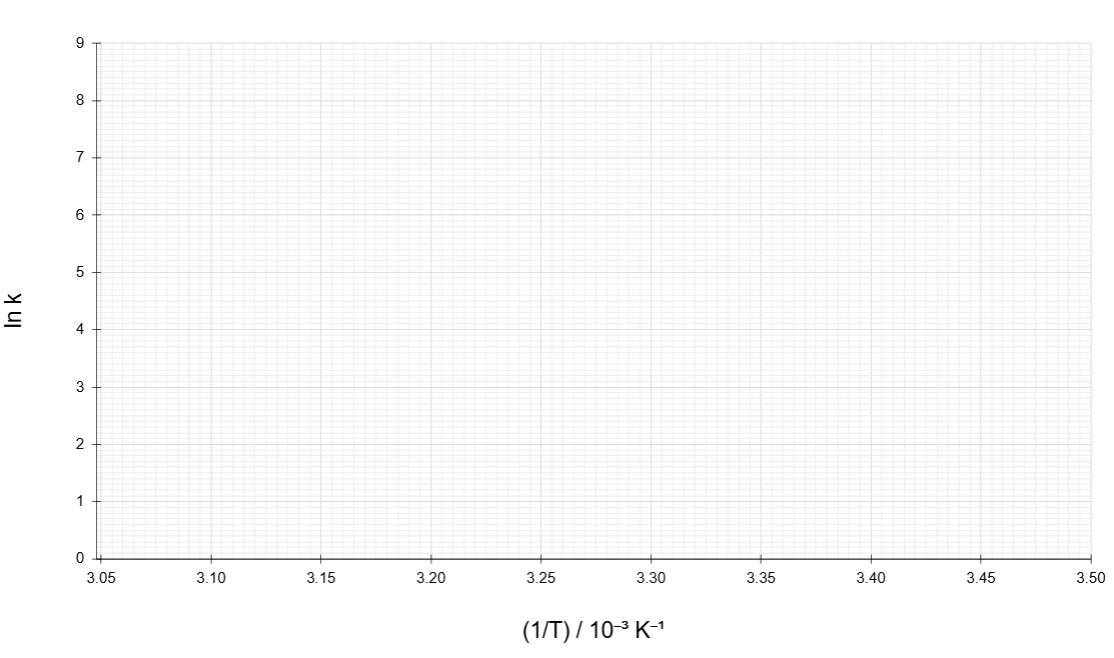
On the grid, plot a graph of ln k against 1/T .

Graph with ln k on the y-axis, ranging from 0 to 9, and (1/T) x10⁻³ K⁻¹ on the x-axis, ranging from 3.05 to 3.50, with empty gridlines.

Use the graph to determine the activation energy, Ea, for this reaction. Give your answer in kJ mol−1.

(R = 8.31 J K−1 mol−1)