Group 7 (Edexcel International A Level (IAL) Chemistry): Exam Questions

Exam code: YCH11

29 mins10 questions
1a
1 mark

This question is about the elements in Group 7.

Use your knowledge of the trends in the properties of Group 7 elements to predict the colour and physical state of astatine at room temperature.

1b
3 marks

i) State the meaning of the term electronegativity.

(1)

ii) Explain the trend in electronegativity down Group 7.

(2)

1c
6 marks

Compare and contrast the reactions of chlorine with

  • water

  • cold, dilute aqueous alkali

  • hot, concentrated aqueous alkali

Include an equation for each reaction, stating the type of reaction and the oxidation numbers of the chlorine involved. State symbols are not required.

2a
2 marks

This question is about redox chemistry, Group 2 and Group 7.

When chlorine water is added to a solution of potassium bromide, the solution turns orange.

State the changes in oxidation number of bromine and chlorine, and identify which species is the oxidising agent.

[2]

2b
3 marks

Describe and explain the trend in thermal stability of the Group 2 carbonates (MgCO3 to BaCO3).

2c
4 marks

A 1.25 g sample of impure limestone is analysed to find its percentage of calcium carbonate by a back-titration method.

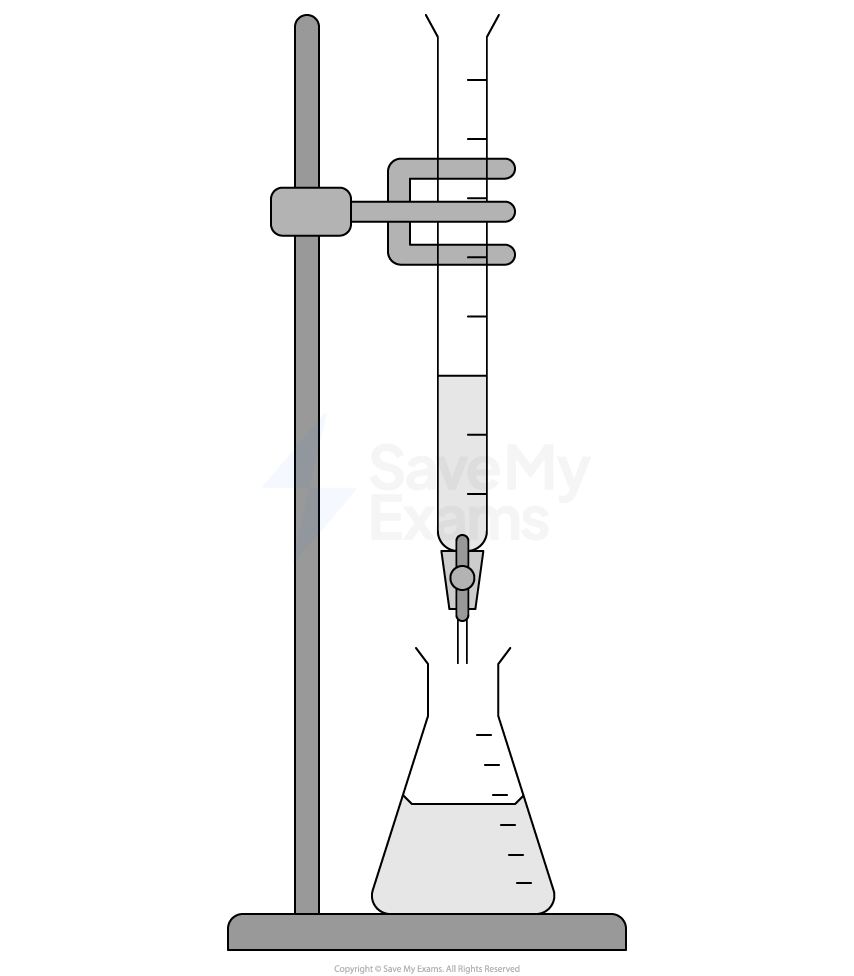
Laboratory setup showing a burette clamped to a stand above a conical flask, both partly filled with liquid, used for titration experiments

The sample is dissolved in 50.00 cm3 of 0.500 mol dm–3 hydrochloric acid (an excess).

The excess hydrochloric acid is then titrated against 0.200 mol dm–3 sodium hydroxide solution. The volume required to neutralise the excess acid is 25.00 cm3.

[Assume the impurities in the limestone do not react with the hydrochloric acid. Mr(CaCO3) = 100.0]

Calculate the percentage by mass of calcium carbonate in the limestone sample.

2d
1 mark

When chlorine is bubbled through cold, dilute sodium hydroxide solution, a disproportionation reaction occurs.

Cl2 + 2NaOH → NaCl + NaClO + H2O

Explain why it is classified as disproportionation.