Transition Metal Reactions (Edexcel International A Level (IAL) Chemistry): Exam Questions

Exam code: YCH11

1 hour13 questions
1
6 marks

Describe the reactions of separate samples of aqueous cobalt(II) sulfate with aqueous sodium hydroxide, excess aqueous ammonia and concentrated hydrochloric acid.

For each reaction, link your description to an appropriate equation.

State symbols are not required.

2
6 marks

Compare and contrast the mechanism of the action of platinum as a catalyst in the removal of pollutants from car engine exhaust fumes with that of vanadium(V) oxide as a catalyst in the Contact Process for the manufacture of sulfuric acid.

General definitions of catalysts are not required.

1a
7 marks

The diagram summarises some reactions of copper compounds.

q19-paper-5-jan-2021-edexcel-ial-chemistry

Identify, by name (including the oxidation state) or formula, the species in the sequence that contain copper.

P ......................................................
Q ......................................................
R ......................................................
S ......................................................
T ......................................................
V ......................................................
W ......................................................

1b
6 marks

T and V are the same type of chemical species.

i) Name this type of chemical species.

(1)

ii) Explain why T is coloured while V is colourless.

A detailed explanation of the fact that T is coloured is not required.

(3)

iii) Suggest an explanation for the change of V into T on shaking.

(2)

1c
Sme Calculator
3 marks

The reaction between copper(I) iodide and sulfuric acid is a disproportionation.

i) Write the ionic equation for this disproportionation reaction.

State symbols are not required.

(1)

ii) Show that the reaction in (c)(i) is thermodynamically feasible.

Use the standard electrode potentials of the relevant half-cells from the Data Booklet.

(2)

1d
Sme Calculator
6 marks

The rare mineral mitscherlichite has the chemical formula K2CuCl4⦁nH2O.

4.26 g of mitscherlichite was dissolved in distilled water and the solution made up to 250.0 cm3. Excess potassium iodide solution was added to a 25.0 cm3 portion of this solution and the iodine formed was titrated against a solution of sodium thiosulfate with a concentration of 0.0500 mol dm−3.

This procedure was repeated until concordant results were obtained. The mean accurate titre was 26.65 cm3. The equations for the reactions are

   2Cu2+ + 4I  2CuI + I2 2S2O32 + I2  S4O62+ 2I

Calculate the value of n, the number of moles of water of crystallisation per mole of mitscherlichite.

2a
Sme Calculator
1 mark

Iron(II) ions catalyse the reaction between iodide ions and peroxodisulfate ions:

S2O82- (aq) + 2I- (aq) → 2SO42- (aq) + I2 (aq)

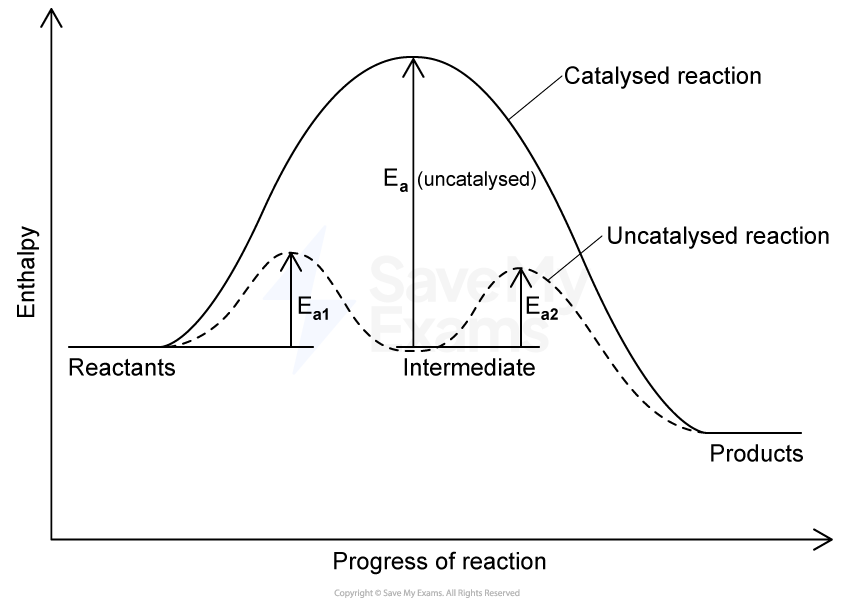
Without a catalyst, this reaction is extremely slow. The reaction profile for this reaction is shown.

A reaction energy profile showing two curves against axes labelled Energy (y) and Reaction progress (x). A solid line shows the uncatalysed reaction with a single tall peak; a dashed line shows the Fe2+ catalysed reaction with two smaller humps separated by a trough labelled Intermediate. Upward arrows indicate Ea (uncatalysed) from the reactants level to the uncatalysed peak, Ea1 from the reactants level to the first catalysed peak, and Ea2 from the intermediate trough to the second catalysed peak. The products level is lower than the reactants level.

Explain why the uncatalysed reaction between I and S2O82− ions is very slow.

2b
Sme Calculator
2 marks

Fe2+ ions catalyse this reaction in two steps. Write ionic equations for each step of the catalytic cycle.

2c
Sme Calculator
2 marks

Explain why Fe2+ ions are a particularly effective catalyst for this reaction.

2d
Sme Calculator
4 marks

The reaction between manganate(VII) ions and ethanedioate ions is also slow when the reactants are first mixed, but the rate increases significantly as the reaction proceeds:

2MnO4- (aq) + 5C2O42- (aq) + 16H+ (aq) → 2Mn2+ (aq) + 10CO2 (g) + 8H2O (l)

i) Name the type of catalysis occurring in this reaction.

[1]

ii) Identify the catalyst in this reaction.

[1]

iii) Sketch a graph of rate against time for the MnO4-/C2O42- reaction on the axes, starting from the moment the reactants are first mixed. Label the axes.

Blank graph with black horizontal and vertical axes forming an L-shape in the bottom-left. The graph has no data points or labels.

[2]

2e
Sme Calculator
6 marks

(*) Compare and contrast the homogeneous catalysis of the reaction between I- and S2O82- by Fe2+ ions with the autocatalysis of the reaction between MnO4- and C2O42- by Mn2+ ions.

In your answer, you should include:

  • similarities between the two catalytic systems

  • differences, including how the rate changes over time in each case

2f
Sme Calculator
2 marks

A student investigates the rate of the Fe2+-catalysed reaction using the iodine clock method. A small, fixed amount of sodium thiosulfate solution and starch indicator are added to the reaction mixture at the start.

Describe what the student observes and explain what this shows.

2g
Sme Calculator
1 mark

The same experiment is repeated with the concentration of I doubled but all other concentrations kept constant.

Predict the effect on the time taken for the blue-black colour to appear.