Simple Harmonic Motion (Edexcel International A Level (IAL) Physics): Multiple Choice Questions

Exam code: YPH11

45 mins16 questions
1
1 mark

A mass oscillates with simple harmonic motion about a fixed point O.

Which of the following statements about the motion of the mass is correct?

  • Its velocity is always towards O.

  • Its acceleration is always towards O.

  • Its acceleration is directly proportional to its velocity.

  • Its acceleration and its velocity are always in opposite directions.

2
1 mark

A simple pendulum oscillates with a period T.

The length of the pendulum is increased to four times its original length.

What is the new period of the pendulum?

  • T

  • 2T

  • 4T

  • It cannot be determined without knowing the amplitude of the oscillations

3
1 mark

In the Pantheon in Paris there is a pendulum that takes 8.25 s to swing from one extreme position to the other.

Which of the following expressions gives the length of the pendulum?

  • 4π2(8.25)2 ×9.81

  • 4π2(16.5)2 ×9.81

  • (8.25)2 ×9.81 4π2

  • (16.5)2 ×9.81 4π2

4
1 mark

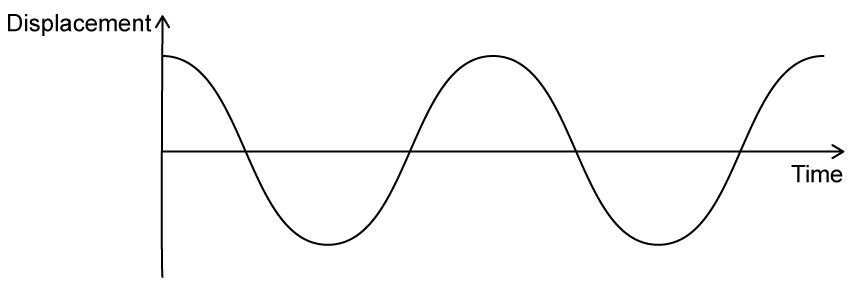
An object oscillates with simple harmonic motion. The graph shows how the displacement of the object varies with time.

A displacement–time graph for an oscillator. The curve is a cosine shape, starting at maximum positive displacement at time zero and continuing over two full cycles.

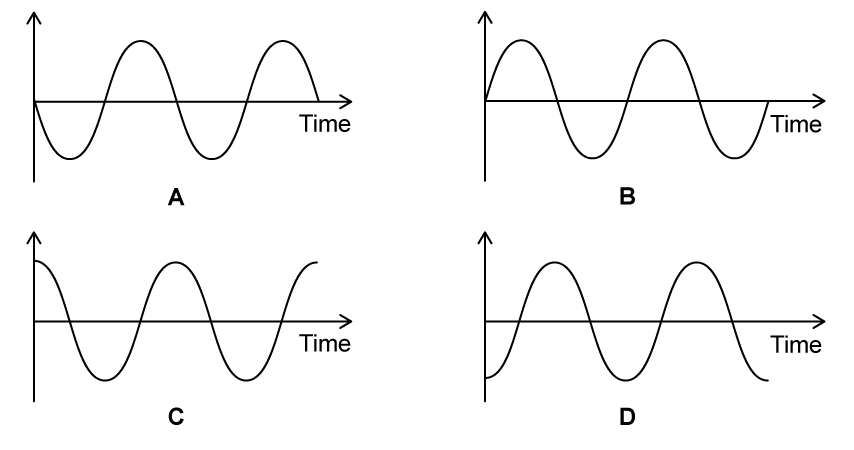
Which graph shows how the velocity of the object varies with time?

Four velocity–time graphs labelled A to D. 
Graph A is an inverted sine curve starting at zero and then peaking at a negative maximum.
Graph B is a sine curve starting at zero and then peaking at a positive maximum.
Graph C is a cosine curve starting at a positive maximum, identical to the given displacement-time curve.
Graph D is an inverted cosine curve starting at a negative maximum.
    5
    1 mark

    The gravitational field strength at the surface of the Moon is one sixth of that at the surface of the Earth. A simple pendulum has a period T at the surface of the Earth.

    What would be the time period of the same pendulum at the surface of the Moon?

    • T6

    • T6

    • T

    • T6

    6
    1 mark

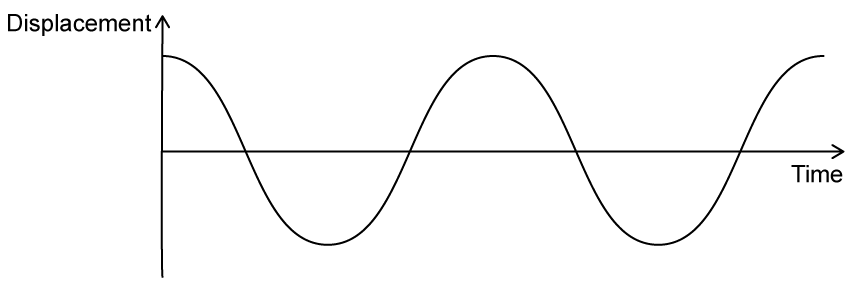
    An object oscillates with simple harmonic motion. The graph shows how the displacement of the object varies with time.

    A displacement–time graph for an oscillator. The curve is a cosine shape, starting at maximum positive displacement at time zero and continuing over two full cycles.

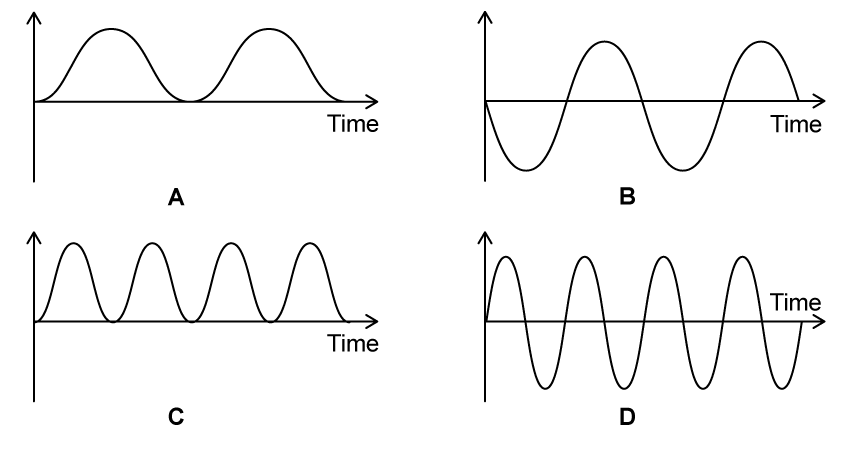
    Which graph shows how the kinetic energy of the object varies with time?

    Four kinetic energy–time graphs labelled A to D.
Graph A is a positive-only curve starting at zero and showing two peaks.
Graph B is an inverted sine curve that starts at zero, then peaks at a negative maximum, and completes two full cycles.
Graph C is a positive-only curve starting at zero and showing four peaks.
Graph D  is a sine curve that starts at zero, then peaks at a positive maximum, and completes four full cycles.
      7
      1 mark

      A mass oscillates with simple harmonic motion with a frequency of 0.5 Hz.

      The amplitude of the oscillation is 0.3 m.

      Which of the following is an expression for the maximum velocity in m s−1 of the mass?

      • (2π0.5)×0.3

      • (2π0.5)×0.15

      • 2π × 0.5 × 0.3

      • 2π × 0.5 × 0.15

      8
      1 mark

      A mass oscillates with simple harmonic motion. The graph shows how the acceleration a of the mass depends upon displacement x from the equilibrium position.

      q10-wph15-05-oct-2021-edexcel-int-as-and-a-level-phy

      Which of the following gives the period of oscillation, in seconds, of the mass?

      • 2π×(3.20.20)

      • 2π×(0.203.2)

      • 2π×(3.20.20)

      • 2π×(0.203.2)

      9
      1 mark

      An object oscillates with simple harmonic motion. The period of oscillation is 0.55 s and the amplitude is 0.25 m.

      Which of the following shows a correct calculation of the maximum velocity of the object?

      • 2π × 0.55 × 0.25

      • 2π0.55 × 0.25

      • (2π × 0.55)2 × 0.25

      • (2π0.55)2 × 0.25

      10
      1 mark

      An object undergoing simple harmonic motion has a period T and total energy E. The amplitude of oscillations is halved.

      Which row of the table gives the new period and total energy of the system?

      Period

      Total energy

      A

      T2

      E4

      B

      T2

      E2

      C

      T

      E4

      D

      T

      E2