Period of Simple Harmonic Oscillators (Edexcel International A Level (IAL) Physics): Revision Note
Exam code: YPH11

Period of a simple pendulum
A simple pendulum is:
an object moving from side to side
attached to a string which is fixed to a point above
The period of a simple pendulum can be calculated using the equation:
Where:
= the length of the pendulum
= the gravitational field strength on the planet on which the pendulum is set up
Worked Example
A child is sitting on a swing that is 200 cm long. What is the period of oscillation?
Answer:
Step 1: Convert length to meters
200 cm = 2 m
Step 2: Substitute the correct values
T = 2π= 2π=2.84 s
Step 3: Confirm the answer
The time period of 1 oscillation of the swing is 2.84 s
Period of a Mass-Spring System
A mass-spring system is:
an object moving up and down, or side to side
attached to the end of a spring
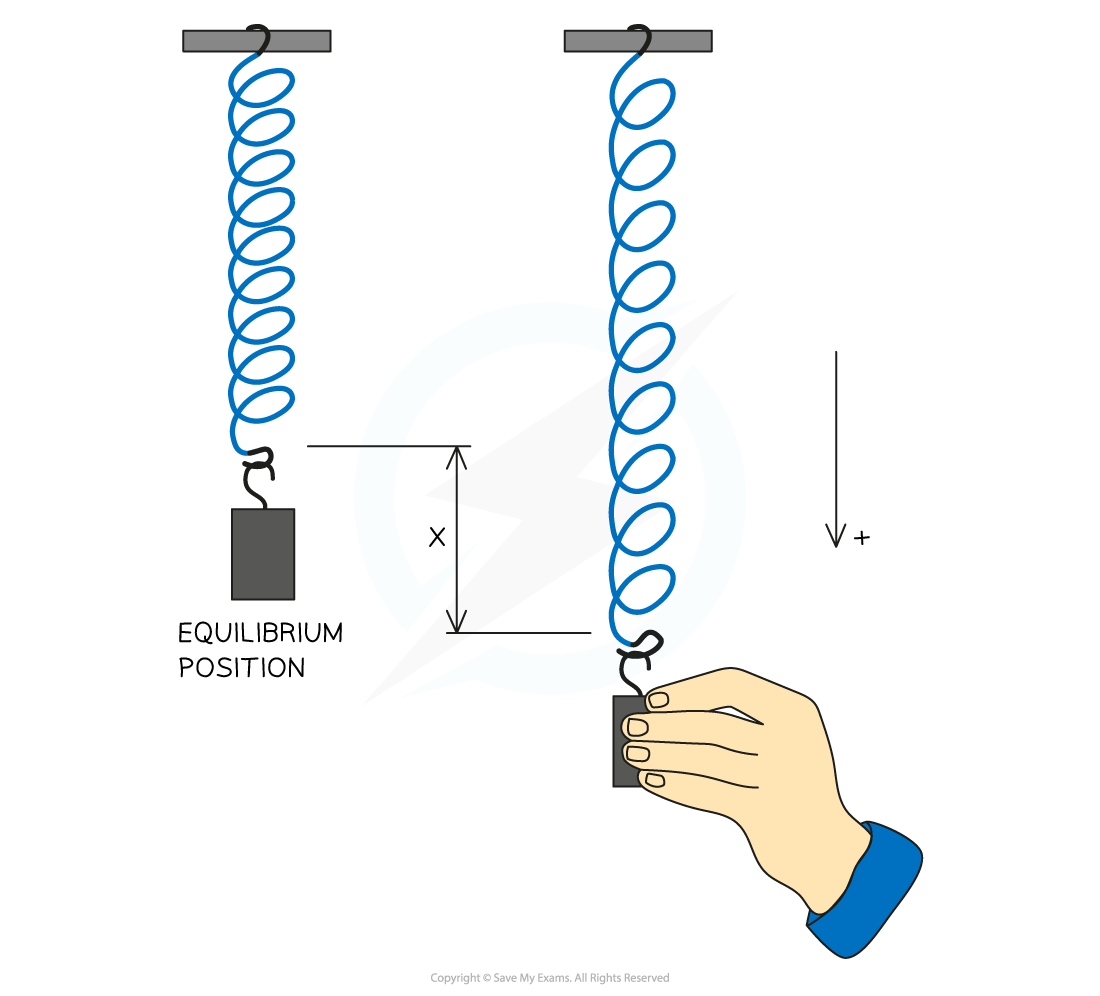
The equation for the restoring force in SHM is the same as the equation for Hooke's law
The time period T can be calculated using the equation:
Where:
= the mass of the object on the end of the spring
= the spring constant of the spring
Observing the Motion of a Mass-Spring System
An experimental and graphical method can be used to observe the motion of a simple mass-spring system
Tie a pencil together with the mass and set the mass in free oscillations by displacing it downwards slightly
The oscillations will move the pencil up and down
On a piece of graph paper, allow the pencil to trace the path of the oscillations by pulling the paper sideways as the mass-spring system oscillates up and down
The oscillations will produce a curved, periodic graph
This will decrease in amplitude as the mass-spring system slows down
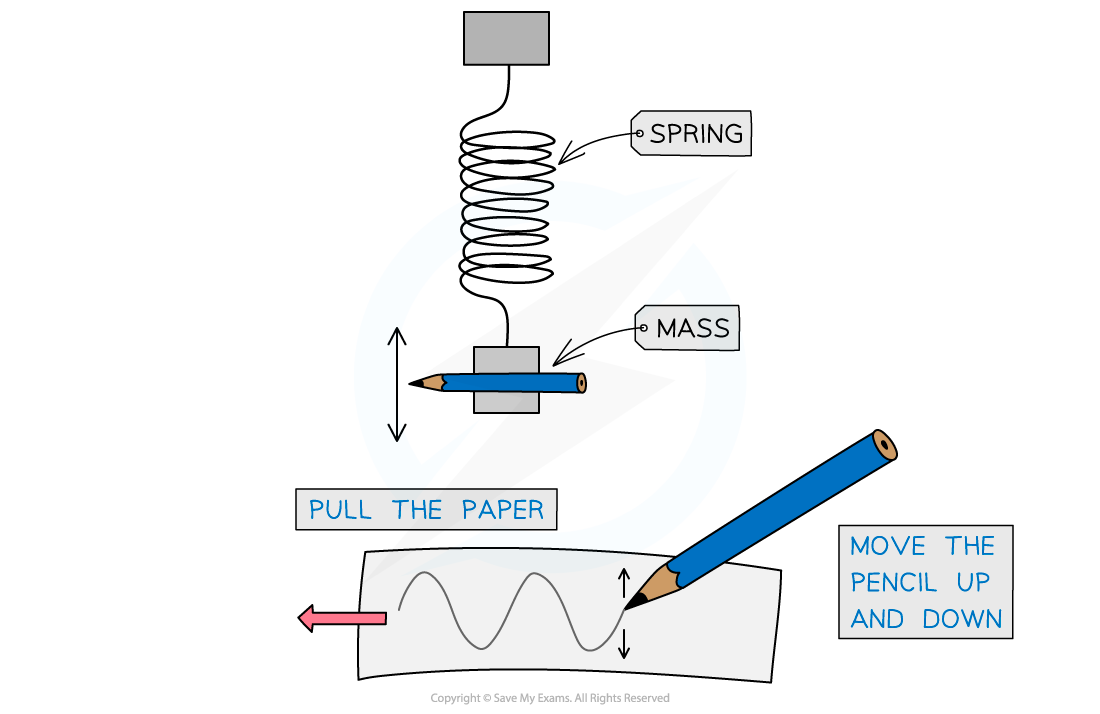
The motion of an oscillator can be observed through a simple mass-spring system

Unlock more, it's free!
Join the 100,000+ Students that ❤️ Save My Exams
the (exam) results speak for themselves:

Was this revision note helpful?
Build on this topic