Antimatter (Edexcel International A Level (IAL) Physics): Revision Note
Exam code: YPH11

Properties of Antimatter
The universe is made up of matter particles (protons, neutrons, electrons etc.)
All matter particles have antimatter counterparts
Antimatter particles are identical to their matter counterpart but with the opposite charge
This means if a particle is positive, its antimatter particle is negative and vice versa
Common matter-antimatter pairs are shown in the diagram below:
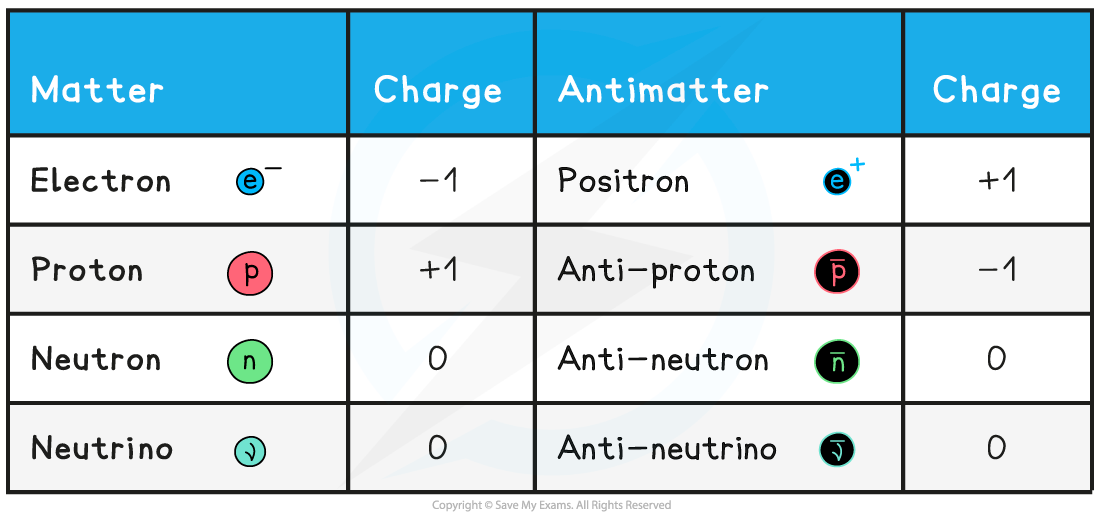
This table summarises the electric charge for typical particle-antiparticle pairs
Apart from electrons, the corresponding antiparticle pair has the same name with the prefix ‘anti-’ and a line above the corresponding matter particle symbol
Some neutral particles, such as the photon, are their own antiparticle
This is not true of all neutral particles — the antineutron and the antineutrino are distinct from the neutron and the neutrino
Mass of Matter & Antimatter Particles
Although antimatter particles have the opposite charges to their matter counterparts, they still have identical mass and rest mass-energy
The rest mass-energy of a particle is the energy equivalent to the mass of the particle at rest
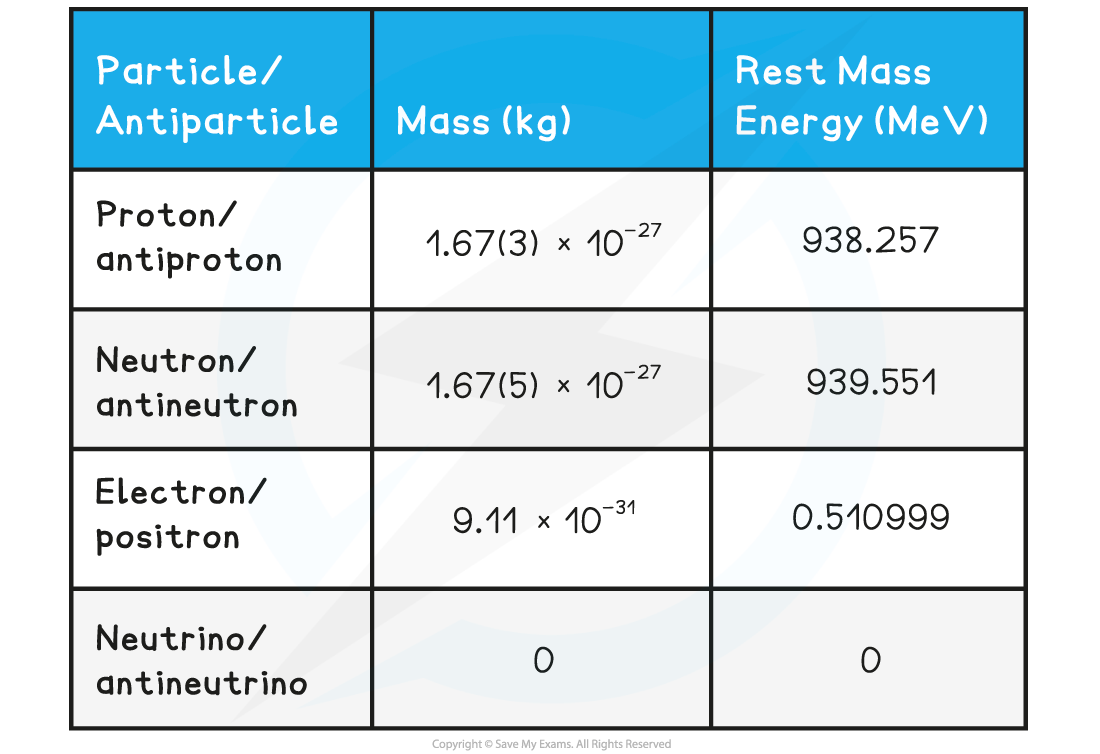
This table summarises typical particle-antiparticle pair masses and rest mass energies
Examiner Tips and Tricks
You will not be expected to memorise individual masses or rest-mass energies, but you will be expected to remember that the mass of a particle and its antiparticle counterpart are identical, and that they are oppositely charged.

Unlock more, it's free!
Join the 100,000+ Students that ❤️ Save My Exams
the (exam) results speak for themselves:

Was this revision note helpful?
Build on this topic