Core Practical 16: Investigating Resonance (Edexcel International A Level (IAL) Physics): Revision Note
Exam code: YPH11

Core Practical 16: Investigating Resonance
Aim of the Experiment
Determine the value of an unknown mass by a graphical method by using the resonant frequencies of the oscillation of known masses
Variables
Independent variable = mass (kg)
Dependent variable = time period (s)
Control variables:
The spring / oscillator
Equipment
Spring (standard 20-25 mm spring)
Slotted 100g masses and hanger
Retort stand and clamp
Digital timer
Unknown test mass
Digital scales
Method
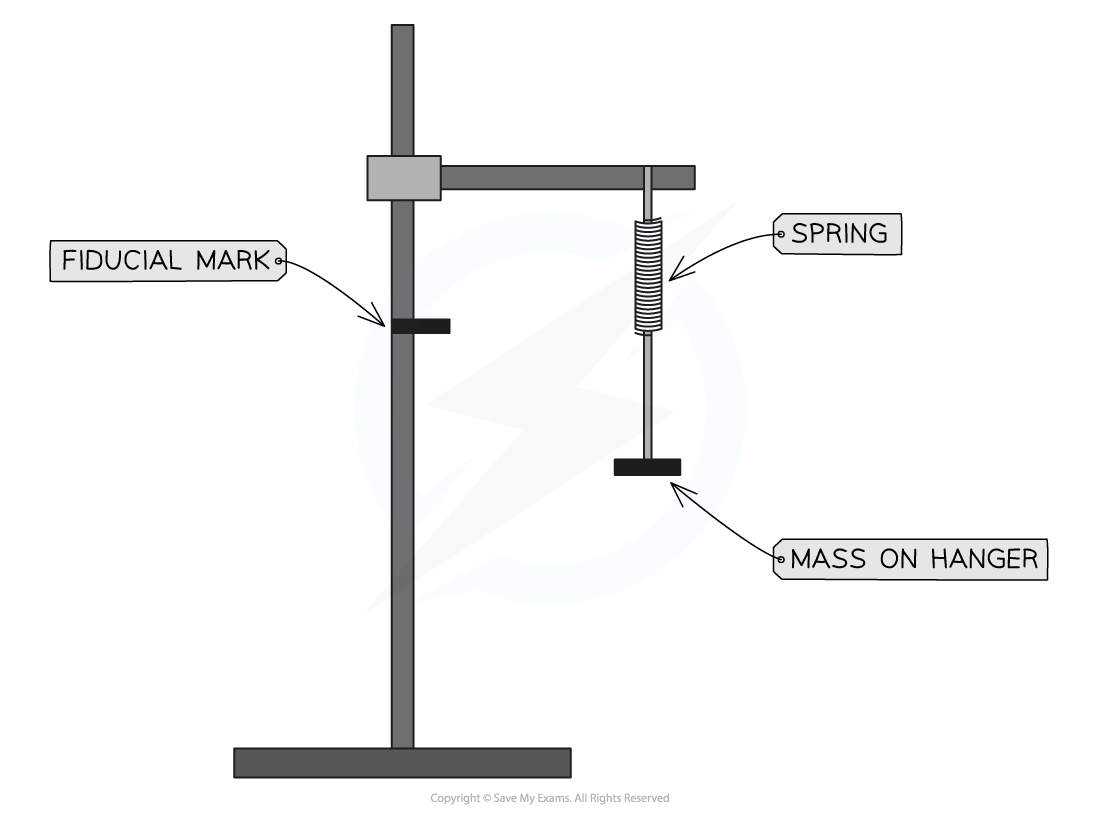
Set up the spring with 100 g mass attached
On the stand make a clear fiducial mark about 5 cm below the bottom of the spring
Extend the spring so that the bottom is level with the fiducial marker, release and start timing
Measure time for 10 oscillations
Repeat with the same mass two more times
Find the average time period of one oscillation
Add 100 g and adjust the fiducial mark downwards so that it is 5 cm below the new level of the spring
Repeat steps 3-7 until the total mass is 500 g
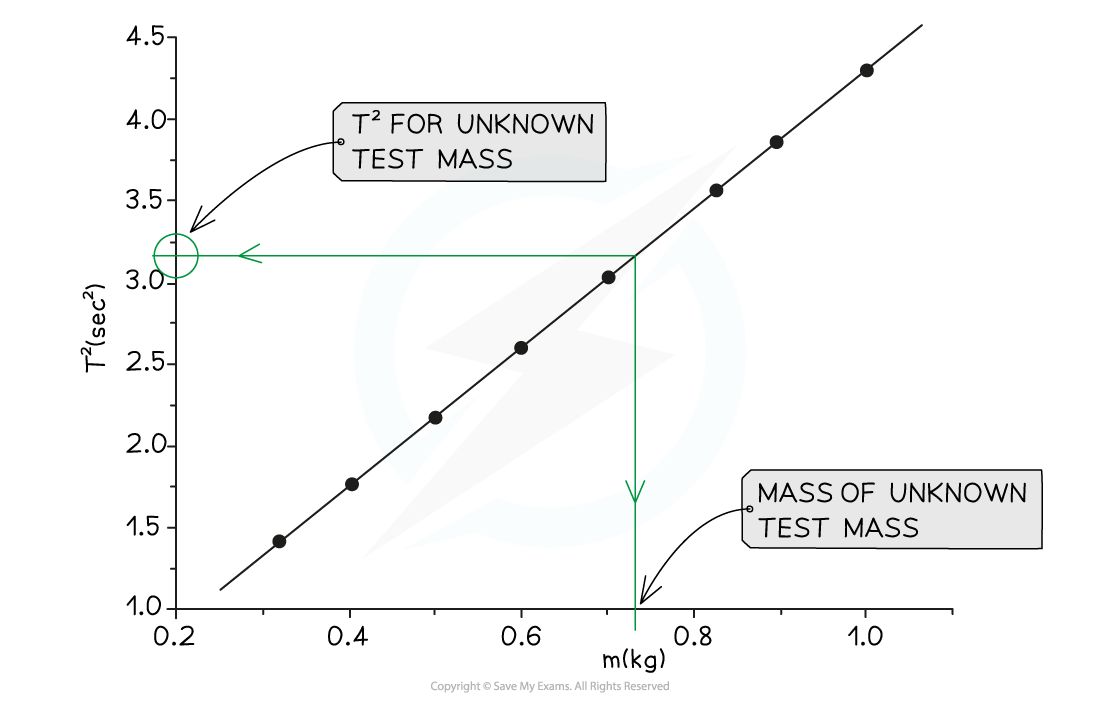
Plot a graph of T2 on the y-axis against m on the x-axis
Testing the unknown mass
Follow steps 2 - 6 for the test mass
Find the value of the time period, T and square it to find T2
On the graph mark a horizontal from T2 to the graph line and where they intersect, take the arrow vertically down to meet the x-axis
The value of m which this line coincides with is the mass of the test mass
Check the result using digital scales
Analysis
Analysis for this graph is based on three equations related to simple harmonic motion;
Angular velocity, (equation 1)
Where k = spring constant (N kg−1) and m = mass (kg)
Angular velocity, (equation 2)
Where f = frequency of oscillations (Hz)
Frequency, (equation 3)
Where T = time period for one oscillation (s)
Substitute equations 2 into equation 1;
Substitute equation 3 into equation 2
Square both sides
Make T2 the subject
Plot a graph of T2 on the y-axis against m on the x-axis to get a straight line through the origin with;
gradient =
Safety Considerations
Clamp stand to the desk for stability
Wear safety glasses in case the spring flies off or snaps
Place a cushion or catch-mat in case of falling masses

Unlock more, it's free!
Join the 100,000+ Students that ❤️ Save My Exams
the (exam) results speak for themselves:

Was this revision note helpful?
Build on this topic
