Cosmology (Edexcel International A Level (IAL) Physics): Revision Note
Exam code: YPH11

The Hubble Constant
By rearranging the equation for Hubble’s law, we can determine that the Hubble constant, H0, is:
Where:
v = recessional velocity of an object (km s–1)
d = distance between the object and the Earth (Mpc)
Ho = Hubble constant (km s–1 Mpc–1)
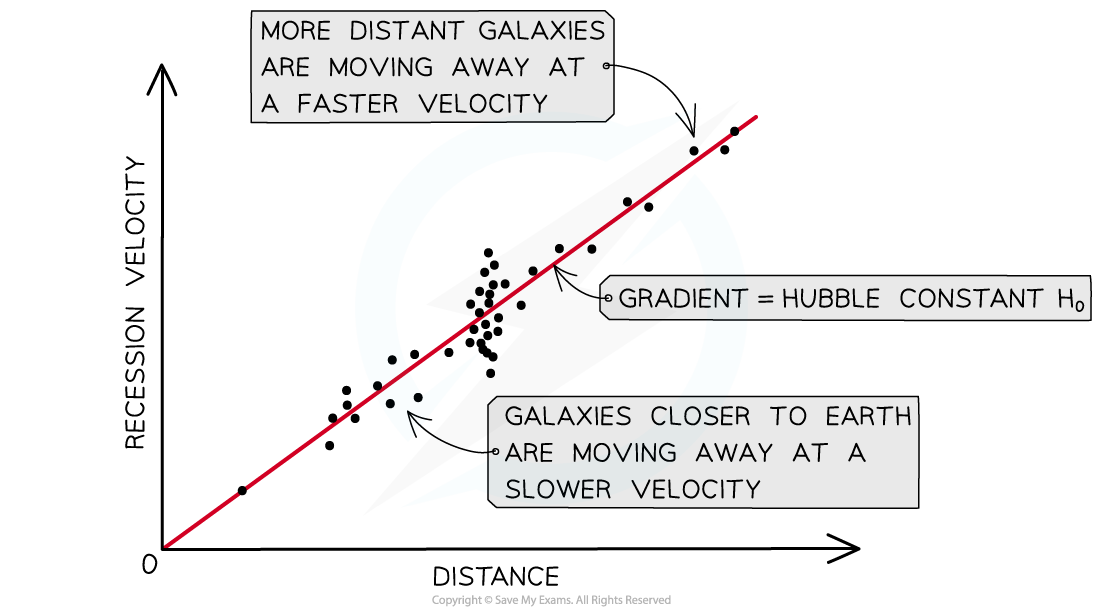
The value for the Hubble constant has been estimated using data for thousands of galaxies
The latest estimate of the Hubble constant based on CMB observations by the Planck satellite is:
H0 = 67.4 ± 0.5 km s−1 Mpc−1 (Planck Collaboration VI 2020)
It is difficult to be certain about just how accurate the values for the Hubble constant are
This is due to the random and systematic errors involved when calculating the distance to a galaxy or star
Worked Example
The graph shows how the recessional velocity, v, of galaxies varies with their distance, d, measured from the Earth.

Use the graph to determine a value for the Hubble constant and state the unit for this constant.
Answer:
Step 1: From the data booklet:
Hubble’s Law: v ≈ H0d
Step 2: Determine the Hubble constant, H0, from the graph:
y–axis = v = 20, 000
x–axis = d = 305
gradient = H0

Step 3: Calculate the gradient of the graph:
H0 = = = 66 km s–1 Mpc–1
Step 4: Confirm your answer:
The Hubble Constant = 66 km s−1 Mpc−1
Dark Matter
We would expect the velocity of an object within a galaxy to decrease as it moves away from the galaxy's centre because of weakening gravitational field strength
This is observed in smaller mass systems, like the solar system where planets orbiting furthest from the Sun have the slowest orbital velocity
This is not the case in bigger mass systems like entire galaxies

Mass is not actually concentrated in the centre of galaxies; it is spread out
All the observable mass of a galaxy is, however, concentrated in its centre, so there must be another type of matter we can't see, called Dark Matter
Dark matter is defined as:
Matter which cannot be seen and that does not emit or absorb electromagnetic radiation
Dark matter cannot be detected directly through telescopes
It should make up 27% of the mass in the universe
It is detected based on its gravitational effects relating to either the rotation of galaxies or by the gravitational lensing of starlight

Unlock more, it's free!
Join the 100,000+ Students that ❤️ Save My Exams
the (exam) results speak for themselves:

Was this revision note helpful?
Build on this topic