Trench Warfare on the Western Front, 1914-18 (Edexcel A Level History: Paper 3 Options): Revision Note
Exam code: 9HI0

Summary
Although many generals expected the First World War to be a war of speed and mobility, it soon became a stalemate
The major German advance into Belgium and France, known as the Schlieffen Plan, failed
Instead, the Germans dug defensive positions near the River Aisne
These proved impossible for British and French forces to capture
Many British and French soldiers were killed attacking them
Before long, 475 miles of continuous trenches stretched from the coast to Switzerland
Poison gas, tanks, artillery shells and new techniques were used to try to break through the trench systems that were protected by machine guns
From a war of movement to attrition: entrenchment and defensive systems
When the First World War began in August 1914, Britain sent 120,000 soldiers of the British Expeditionary Force (BEF) to France
Most British generals at this time believed that attacking was the route to success
Each battalion was equipped with just two machine guns, as these were primarily defensive weapons
The Schlieffen Plan
In August 1914, 1.5 million German troops invaded Belgium with the aim of side-stepping the French Army and sweeping down to capture Paris
On 23 August, 75,000 BEF troops engaged 300,000 German troops in battle at Mons
The BEF slowed the German advance but slowly retreated to Le Cateau, where they fought another battle
Both battles resulted in large losses for the BEF, but they delayed the Germans for long enough to enable the French armies to move north
The Battle of the Marne
The French defeated the Germans at the Battle of the Marne, halting their advance and forcing them to retreat to the River Aisne
Once there, the German forces dug trenches to protect their troops and built machine gun nests to protect against attacks
These first defensive earthworks of the Western Front proved to be extremely effective
The 'Race to the Sea'
Attacking these defensive systems was both ineffective and costly in terms of lives
As a result, both sides tried to attack around the sides of the defensive systems, or outflank each other
This led to what became known as the 'race to the sea' as each side tried to bypass the enemy's defences before they reached the coast
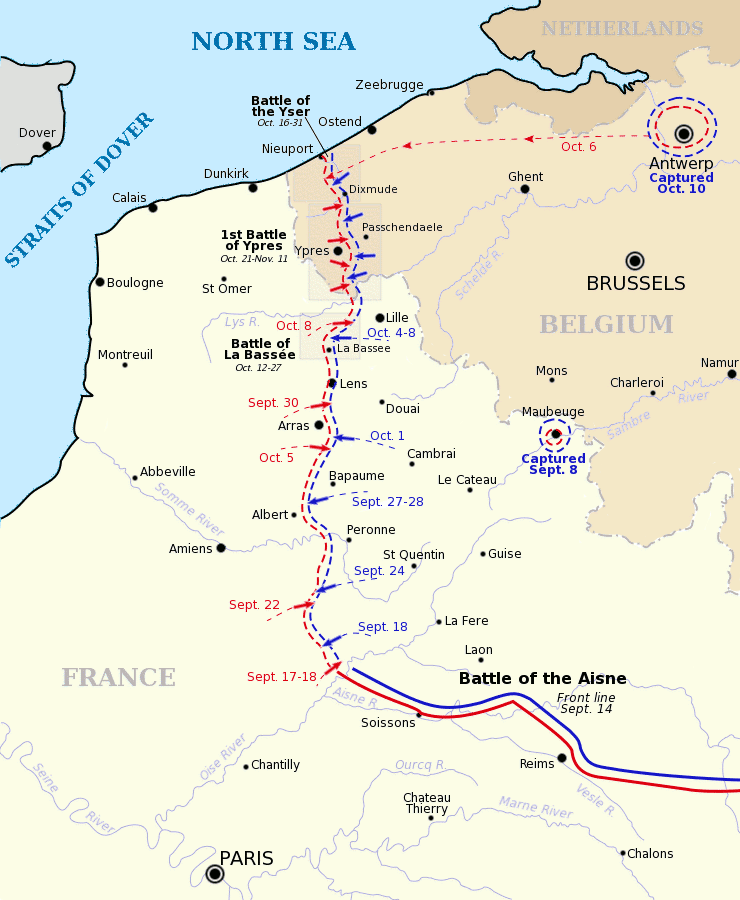
A victory for the BEF at the First Battle of Ypres between 19 October and 22 November 1914 prevented the Germans from capturing the Channel ports
This meant supplies and reinforcements could continue to flow across from Britain
The failure of either side to outflank each other meant the Western Front became bogged down in a stalemate
Over 475 miles of continuous trenches stretched from the Channel to the Swiss border
The war was not one of movement, but of stationary defensive trenches
British forces held around 35 miles of these trenches
Military adjustment and new fighting techniques
What were initially basic trenches protected by machine guns had developed by 1915 into highly complex and developed networks of defences
Thick belts of barbed wire protected their approaches and they were reinforced with sandbags and concrete
Attacks against these trench systems resulted in high numbers of casualties for both the attacking and defending sides but were rarely successful
A British offensive at Neuve Chapelle in March 1915 failed and led to 13,000 British casualties
A German offensive on 22 April 1915 became known as the Second Battle of Ypres and saw the Germans use chlorine gas
The assault failed but still resulted in 60,000 British casualties
When Britain attacked at Aubers Ridge in May 1915, it also failed to break through
Around 11,000 British troops were killed or injured
At the Battle of Loos in September 1915, Britain used chlorine gas for the first time but gained little and suffered about 60,000 casualties
Sir John French held the reserves too far back, and Haig replaced him as commander in December 1915
With traditional weapons, tactics and strategies proving unsuccessful, new solutions were sought to break the stalemate
Trench raids
Often conducted at night, these small and limited raids on German trenches became increasingly common
They were useful for capturing enemy prisoners who could be interrogated
Documents could also be captured, defensive positions destroyed and German plans disrupted
Mining and tunnelling
Specialist tunnelling companies were established in 1915 to dig tunnels beneath German positions
Explosives were then placed in these tunnels, which destroyed German fortifications without exposing troops to machine gun fire
New weapons
The Stokes 3-inch mortar was a light and portable weapon that fired explosive bombs in a high arc
It enabled British troops to fire around 20 rounds a minute on German positions without having to leave the relative safety of their own trenches
Mills bombs were fragmentation hand grenades that were introduced in 1915
Like the Stokes mortar, British troops could use them against German trenches without exposing themselves to fire
They were extremely effective weapons at clearing trenches, particularly when fighting around corners
Specialist platoons
In 1917, the BEF issued instructions for reorganising platoons into four specialist sections
These instructions were known as SS 143 and divided platoons into:
Lewis Gunners (machine gunners)
Bombers (who used hand grenades)
Riflemen (who advanced, captured and held ground)
Rifle grenadiers (who used grenades with a longer range than hand grenades)
This turned each platoon into a self-contained fighting unit, able to adjust to the circumstances it was in
'Bite and hold' tactics
Rather than attempting to achieve one enormous breakthrough, as attempted at the Somme in 1916, the BEF switched to 'bite and hold' tactics from September 1917
This involved troops attacking and capturing a specific and limited target
They would then establish defensive positions and hold the ground from counterattacks
Once the area was secure, they would use it as a base to launch another limited attack
New technology: machine guns, chlorine gas, tanks, fuze 106 and the creeping barrage
Machine guns
The BEF entered the war in 1914 with just a few hundred Vickers machine guns
The Germans, however, had around 12,000 machine guns
They proved to be very effective defensive weapons after the Germans retreated to the River Aisne
The machine gun shaped the First World War battlefields and doomed mass infantry attacks to failure
This is what led to the development of the extensive trench networks
In October 1915, the British Army established the Machine Gun Corps
It also issued the lighter and more reliable Lewis machine gun to infantry units
The Vickers was reclassified as a heavy machine gun
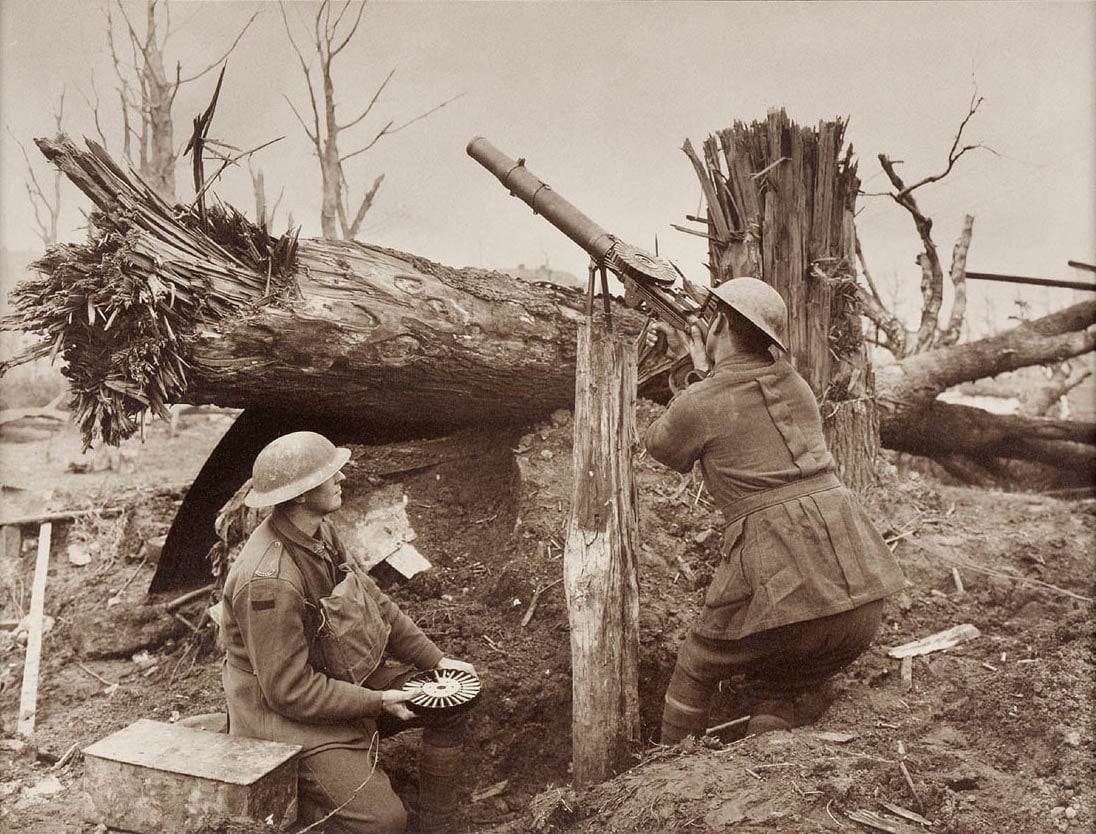
Some of the Gordon Highlanders suffered heavily in taking Mametz. They were advancing in open order with sloped arms because not a rifle shot came from the broken trenches. Suddenly a machine-gun opened fire at point-blank range and caught the Gordons full in the face. The men, at the double, dashed forward through a hail of bullets. Many of them dropped, but Mametz was taken at the point of the bayonet and held. Despite our enormous bombardment, some of the enemy's machine-gun emplacements were so strongly built of steel girders, with concrete covers, that they defied all high explosives. Inside these positions, the Germans, still defiant, worked their machine guns until they were bombed to death. They refused to surrender or escape.
An extract from The Press newspaper, published on 5 July1916
Approach
The source is valuable because it demonstrates both the destructive power of the machine gun and the strength of German defensive positions. The survival of machine-gun emplacements despite an enormous artillery bombardment helps explain why infantry attacks could suffer huge casualties without producing decisive breakthroughs, contributing to attritional warfare. However, as a newspaper report published during the battle and subject to wartime censorship, it presents British losses vaguely and emphasises courage and success, making it less reliable for judging the true scale of the casualties or the overall effectiveness of the offensive.
Chlorine gas
Poisonous chlorine gas was first used by the Germans at the Second Battle of Ypres in 1915
It was intended to clear a wide section of a trench of the soldiers and machine guns to enable an assault to take place
Britain responded with its own gas attack, but the process of opening gas canisters meant its use relied on the wind not changing direction
In 1916, Britain began to use gas shells, which could be fired deep into German trenches from a safe distance
British gas shells held tear gas at first, then the more lethal phosgene and, from 1917, mustard gas, which caused huge numbers of casualties
However, although the use of gas had an enormous psychological impact on the troops, it was not a war-winning weapon
Compared to artillery and machine guns, it killed a small fraction of those who died on the Western Front
The tank
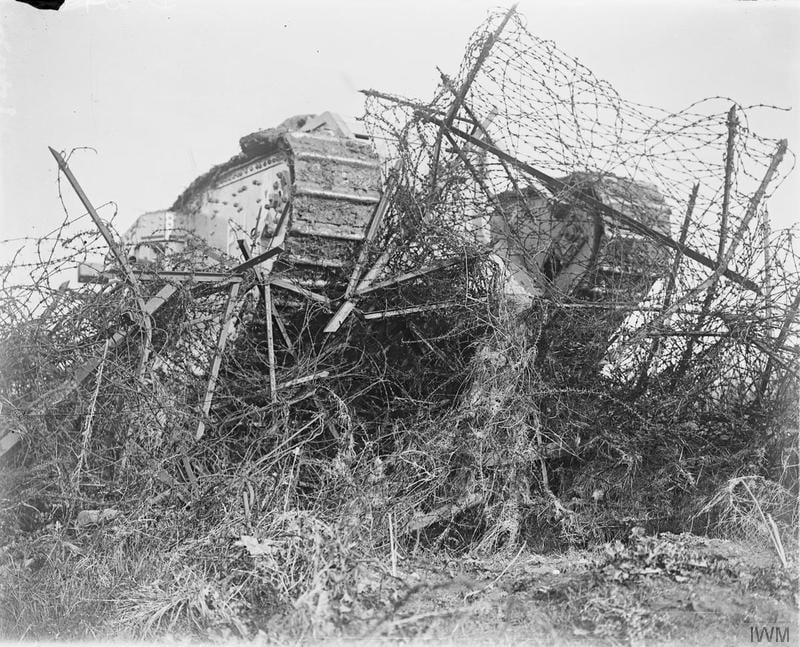
Originally named 'land ships', these vehicles were intended to cross no man's land whilst being impervious to machine gun fire
They were designed to be able to cross trenches and crush the barbed wire that slowed infantry down so much
Invented by the British, tanks were first used in attacks on German trenches at the Somme in 1916
They were mechanically unreliable and often broke down
Although they were modified and improved throughout the war, they were not a decisive weapon
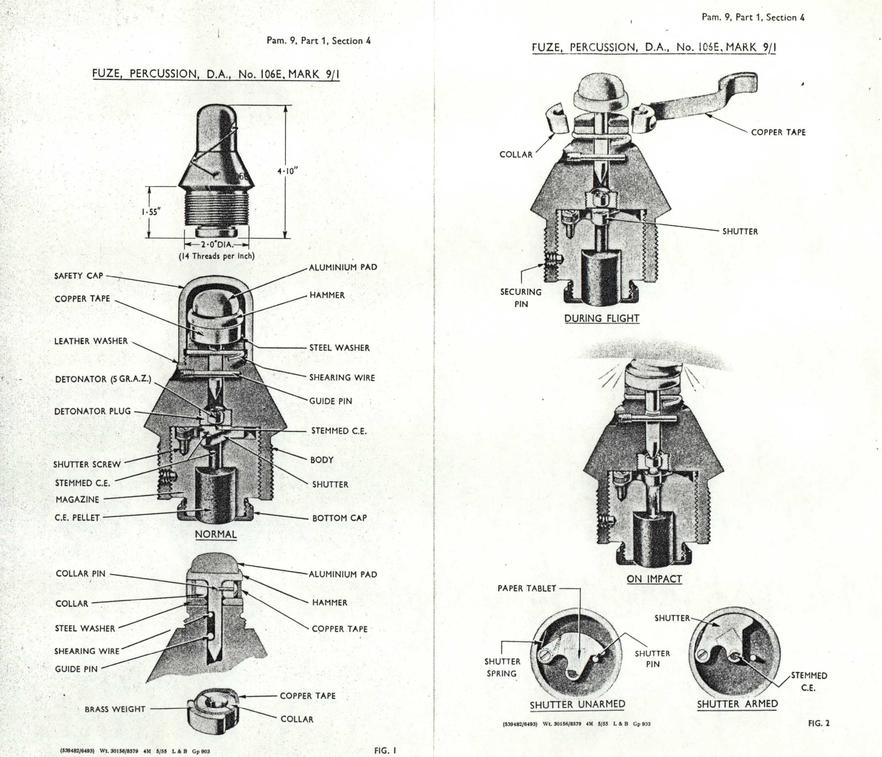
Fuse 106
At the start of the war, most artillery shells were fitted with fuses that enabled the shells to bury themselves deep into the ground before triggering the explosion
This created craters and caused damage underground, but did limited damage to objects on the surface, such as barbed wire
Fuse 106 was a highly sensitive impact fuse first used in 1917
This meant the shell would explode the instant Fuse 106 made any contact with any object
Barbed wire was a major obstacle for infantry attacks, and artillery bombardments with traditional shells left it intact before major assaults
High explosive shells fitted with Fuse 106 were very effective at cutting through barbed wire and clearing the way for assaults
The creeping barrage
Like Fuse 106, the creeping barrage was an artillery development that was intended to make infantry attacks more successful
First used on the Somme in 1916 and refined at Vimy Ridge and Arras in April 1917
It involved highly accurate shelling of ground just in front of the attacking infantry
As the infantry moved forward, so would the shells
This was intended to clear their way and prevent the defending troops from recovering after the barrage had stopped
Why did warfare on the Western Front become a war of attrition?
Attrition is the gradual wearing down of an enemy by inflicting continuous losses
This is what characterised the First World War
There were no dramatic defeats or war-winning battles like at Waterloo in 1815
Instead, both sides sapped each other's resources until, in November 1918, Germany could no longer continue fighting
Argument that technology made attrition almost inevitable
Due in large part to the machine gun, defensive firepower was stronger than the offensive capabilities of the armies for most of the First World War
Modern rifles and artillery also fired rapidly
This aided defending troops more than attacking forces
Sophisticated and reinforced trench systems greatly aided defence
Barbed wire was extremely cheap but highly effective at slowing and stopping infantry charges
Railway systems also enabled troops to remain supplied and reinforced
In previous conflicts, they would have become depleted of men and ammunition, making breakthroughs more likely
German commanders also adapted, placing machine guns in mutually supporting pillboxes to create defence in depth
Argument that strategic choices by leadership created a war of attrition
Assaults such as those at Neuve Chapelle and Aubers Ridge were failures that cost the lives of thousands of troops
Rather than risk more heavy losses and receive strong criticism, the military leaders of all sides decided to try to destroy their opponents' manpower
Even the Somme offensive of 1916, planned in December 1915, was brought forward and enlarged for the British because of the German attack at Verdun
German generals had stated they intended to 'bleed France white' at Verdun
The Somme was launched in part to relieve the pressure and divert German troops away from Verdun
Judgement
Technological developments such as the machine gun resulted in the Western Front becoming a stalemate
However, it was a deliberate decision by commanders to pursue a strategy of attrition
Victory through the slow and steady exhaustion of the enemy's resources was seen as more attractive than the high-risk strategy of trying to achieve decisive breakthroughs
Commanders only broke the stalemate in 1918, when artillery, tanks, aircraft and infantry were combined in all-arms attacks
Examiner Tips and Tricks
Section B questions on the Western Front often ask you to weigh technology against leadership. Strong answers show how the two interacted: commanders only broke the stalemate in 1918 once artillery, tanks, aircraft and infantry were combined in all-arms attacks.

Unlock more, it's free!
Join the 100,000+ Students that ❤️ Save My Exams
the (exam) results speak for themselves:

Was this revision note helpful?
