Changes in Weaponry: Science & Technology, 1790-1918 (Edexcel A Level History: Paper 3 Options): Revision Note
Exam code: 9HI0

Summary
Science and technology completely transformed weaponry and how wars were fought between 1790 and 1918
Some developments, like Congreve's rockets and Armstrong's artillery, had a limited impact in the short term
However, some developments, like the machine gun, had a much greater impact than was expected
The machine gun dominated the battlefields of the First World War
This led to the development of the tank from 1915
Carronades and the Navy in the 1790s
In 1790, the main method of attack by Royal Navy battleships, known as ships of the line, was to simultaneously fire all of the guns placed along the side of their hulls
This was known as a broadside
Most British ships of the line carried around 74 guns
The heaviest, on the lower deck, fired a 14.5 kg (32-pound) cannonball
Broadsides could be devastating, and Royal Navy seamen could fire one every minute and a half
This was much faster than enemy fleets
However, the positioning of the guns meant they were unable to attack from the front (bow) or back (stern) of the ship
The introduction of the carronade helped to change this
The carronade, first made by the Carron Company in Falkirk in the 1770s, was a short, light gun that fired heavy shot at close range
A new boring technique made them lighter than long guns of the same calibre
This meant ships could mount heavy-calibre guns on their upper decks
They were placed on mounts that enabled them to swivel
Carronades could be loaded quickly and could fire grapeshot
Positioning carronades on the forecastles and sterns of ships enabled devastating attacks on enemy sailors and marines positioned on decks
However, their short range meant an enemy ship could stay at a distance and fire on them with long guns
Carronade use continued to develop, and from 1830 the gunnery school HMS Excellent trained crews in accurate fire
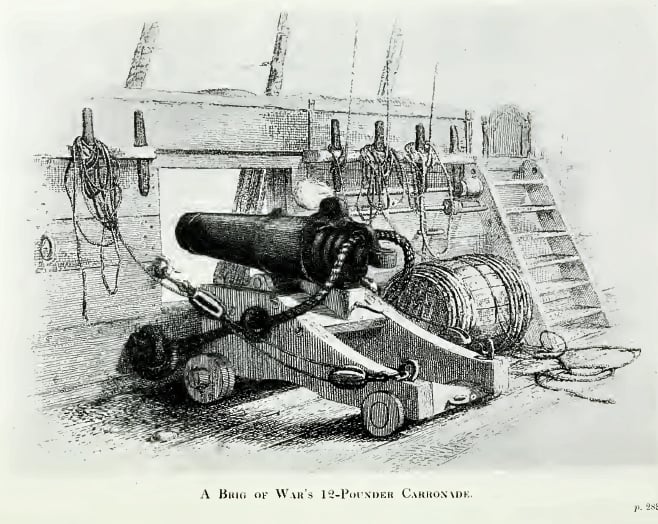
A brig of war’s 12-pounder carronade, illustration from E. Keble Chatterton, Ships and Ways of Other Days (London: Sidgwick & Jackson, 1913). Public domain, via Wikimedia Commons
Other developments in naval weaponry included:
The replacement of slowmatches with gunlocks
Slowmatches required gun captains to hold the lit piece of rope in the firing pan and hope the gunpowder it contained ignited and fired the cannon
Gunlocks involved the gun captain pulling a lanyard at the precise moment he wanted to fire
Gunlocks enabled broadsides to be fired faster and more accurately
Congreve's rockets, 1806
The army of Tipu Sultan, ruler of Mysore in southern India, had used iron-cased gunpowder rockets against British forces in the 1790s
British forces captured some of these, and William Congreve studied them at Woolwich
He adapted and improved them, increasing their range from 550 m to 2700 m
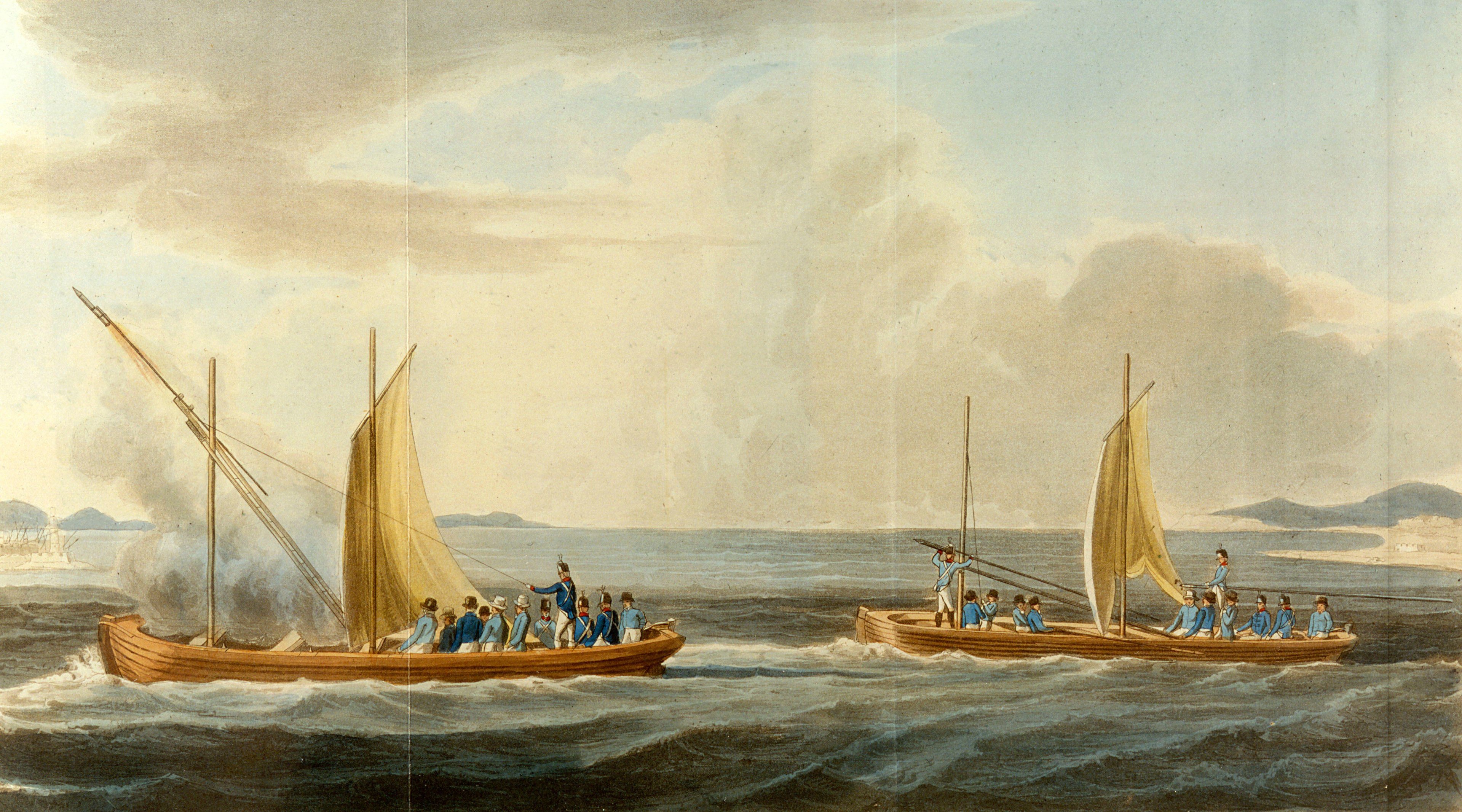
Congreve's rockets were first used in action in October 1806, when the Royal Navy attacked the French invasion fleet at Boulogne
They were cheap to produce and light in weight compared to cannon
This meant large numbers could be carried into battle easily
Merchant ships could also carry them without it affecting the amount of cargo they could carry
Congreve's rockets were very effective against certain large, flammable targets, such as when the Royal Navy attacked Copenhagen in 1807
They were later used at Leipzig (1813) and against the USA at Fort McHenry (1814)
However, they were highly inaccurate, which made them unpopular with many commanders
Examiner Tips and Tricks
Weaponry answers are stronger when they start at the beginning of the period. Congreve's rockets are named in the specification, so use them (Boulogne 1806, Copenhagen 1807) as early evidence when you judge the significance of any later development.
William Armstrong's new artillery, 1859–60
In the late 1850s, William Armstrong developed an artillery piece that had a rifled barrel and was loaded at the breech rather than the muzzle
Although he patented his design, he gave it to the British government free of charge
Armstrong's gun was much more accurate than the current smoothbore muzzle-loading guns being used
As a result, Armstrong's guns were adopted by the Army in 1859
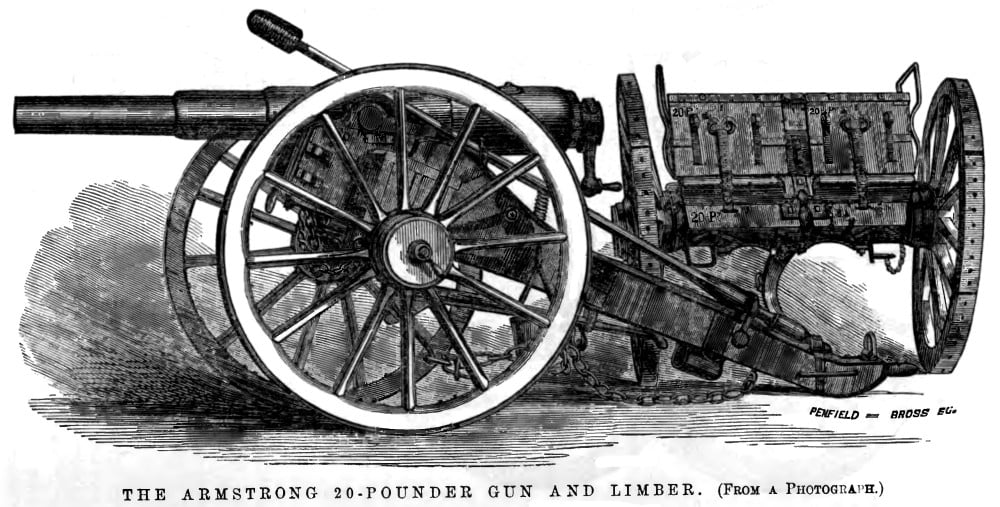
The Armstrong 20-pounder gun and limber, wood engraving from Alexander Lyman Holley, A Treatise on Ordnance and Armor (New York: D. Van Nostrand, 1865). Public domain, via Wikimedia Commons
Armstrong guns were first used in combat in China in 1860, during the Second Opium War
The Royal Navy also adopted them, but breech failures during the bombardment of Kagoshima, Japan, in 1863 damaged their reputation
The government stopped ordering Armstrong's breech-loaders in 1863
From 1865 the Army switched to rifled muzzle-loading (RML) guns
This was because they were cheaper and simpler to use, more durable and could fire the heavy charges needed to pierce armour
Britain did not return to breech-loading artillery until c. 1880
The Vickers machine gun, 1914–18
The first fully automatic machine gun was invented in 1884 by Hiram Maxim
Although the armies of every major country adopted it, most people did not realise the impact it was going to have on the battlefield
The Maxim gun was heavy and complex
It was also vulnerable to overheating and jamming
British forces used Maxim guns in colonial wars, for example at Omdurman in 1898
The British Army adopted the Vickers machine gun in 1912
The Vickers gun was a lighter, improved version of the Maxim gun, and it was seen as sturdy and reliable
It could fire 500 rounds a minute but was heavy and required a crew of six to eight men to operate it
The barrel was encased in a water jacket that stopped it overheating
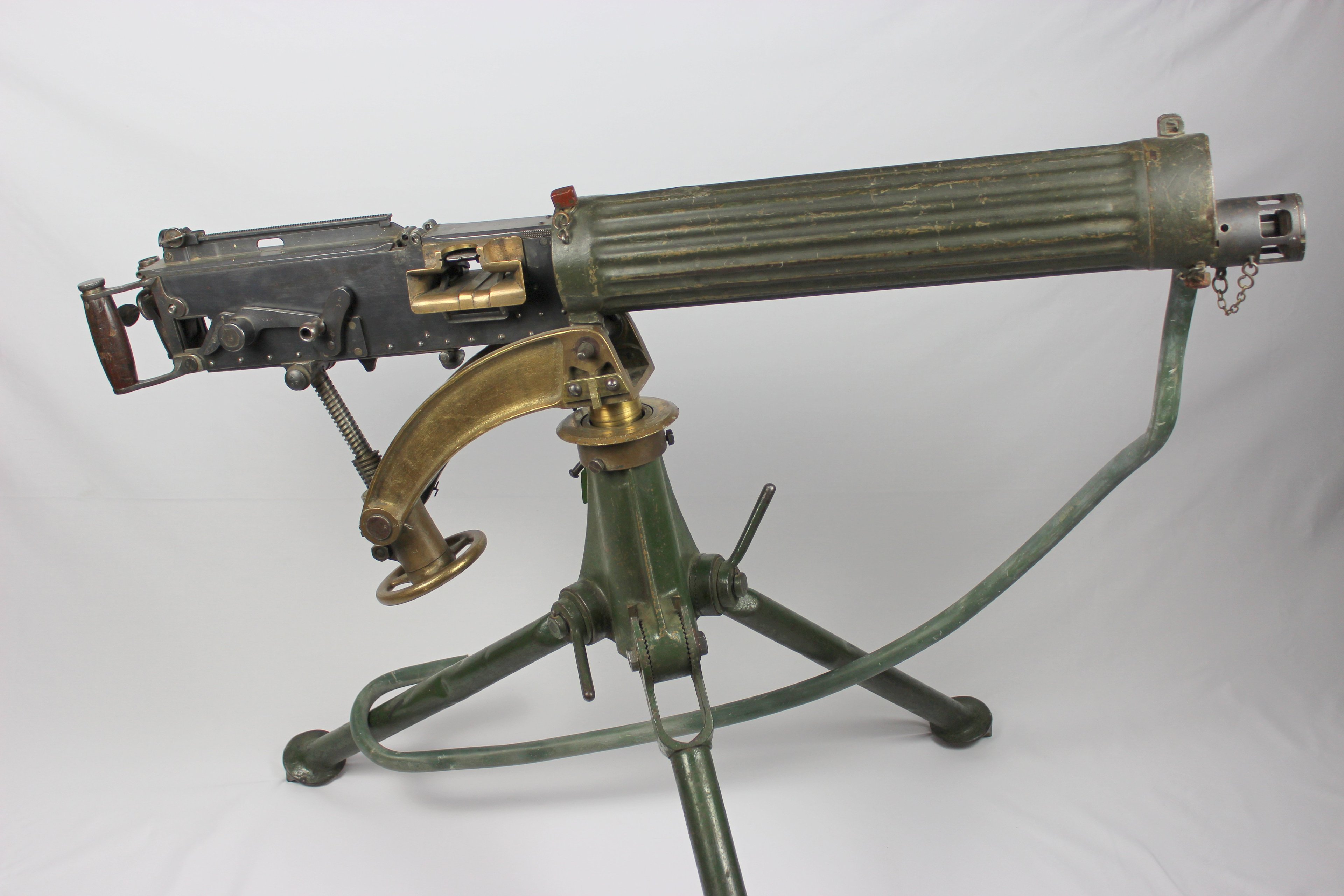
Vickers machine gun (YORCM : CA78ac), York Museums Trust, CC BY-SA 4.0, via Wikimedia Commons
In October 1915, the British Army also adopted a lighter machine gun known as the Lewis gun
The Vickers guns passed to the new Machine Gun Corps (formed October 1915) and were reclassified as 'heavy machine guns'
The Lewis gun was issued to infantry units
In 1914, each British infantry battalion had only two machine guns
By 1916, Machine Gun Corps teams were using Vickers guns to fire long-range barrages over the heads of attacking troops
The development of the tank, 1915–18
The devastating effect of the machine gun on infantry charges led to the search for alternative ways to attack
One way was the creation of armoured and armed tracked vehicles that could attack enemy lines whilst keeping their crew protected
These vehicles became known as tanks
Caterpillar tracks and a rhomboid shape let them cross trenches and barbed wire, but crews had no effective way to communicate with other tanks
In 1915, the Admiralty's Landships Committee, backed by Winston Churchill, funded the first designs, which led to the Mark I tank
Tanks were first used at Flers-Courcelette, during the Battle of the Somme, on 15 September 1916
Mechanical problems led to many of the 50 machines breaking down or getting stuck in the mud
At Cambrai in November 1917, around 400 tanks broke through the German lines, showing what massed tanks could achieve
Although they were refined and improved throughout the rest of the war, historians still debate whether they were decisive by 1918, when tanks helped the Allies break through at Amiens
They were very cumbersome things at first, with terrific caterpillar wheels, you know. What they were very good at, of course, was that they were able to get across the trench, and they’d crush the wires. They did work that the artillery couldn’t do. Very often, our men attacked the German front line and found the wire hadn’t been cut by our own artillery. But as soon as the tanks came along of course they simply crushed the wires, you see and even if there were machine-guns. Because the infantry used to follow just behind the tank, there was usually a little party of infantrymen following the tank. But I think they frightened the life out of Jerry when he first saw them!"
The recollections of British soldier Thomas Brown, who fought at the Somme and saw the first tanks in action
Approach
These recollections have value because, as a British soldier who fought on the Somme, he identifies the specific problems that tanks could overcome: trenches, uncut barbed wire and machine-gun positions. His description of infantry following tanks also demonstrates the beginnings of the combined-arms tactics that became increasingly important by 1918. His acknowledgement that early tanks were “cumbersome” is also important, since mechanical unreliability meant that tanks demonstrated greater potential than decisive effectiveness when first introduced in 1916. However, Brown was recalling the events retrospectively, and the source does not say how much time had elapsed between the event and his recollection. His view from the infantry makes the source stronger on how tanks helped attacking soldiers than on how far tanks decided the outcome of the battles.
How important was science and technology in transforming weaponry?
Science and technology had a huge impact on weaponry between 1790 and 1918
Due to science and technology, weapons became more accurate, more powerful and more destructive
However, they were not the only factors responsible for transforming weaponry and warfare
The production of the new weapons and systems relied upon industrialisation having taken place
Britain, France and Germany could produce such weapons because they had the coal, railways and industries to do so
The transformation of weaponry also relied upon government support and investment
Government funds paid for research, laboratories and factories
Without this, many of the weapons developed between 1790 and 1918 would not have made it to the battlefield
The importance of specific developments
Carronades (1790s) and Congreve's rockets (1806) improved firepower but were limited by short range and inaccuracy
Armstrong's rifled breech-loader (1859–60) showed what science could do for accuracy, but cost and reliability problems meant Britain reverted to muzzle-loaders until c. 1880
The machine gun (Maxim 1884, Vickers 1912) had the biggest impact on warfare, because it made infantry attacks so costly in lives that it forced the development of the tank
Judgement
Science and technology drove change throughout the period, but the key turning point came only when industrial production and government funding allowed new weapons to be made in huge numbers, as in 1914–18
Examiner Tips and Tricks
Section C questions name one development, such as carronades (2020), the tank (2021) or Armstrong's artillery (sample paper), and ask whether it was the key turning point. Compare it directly with at least two other developments, and cover at least three-quarters of 1790–1918 to reach Level 5.

Unlock more, it's free!
Join the 100,000+ Students that ❤️ Save My Exams
the (exam) results speak for themselves:

Was this revision note helpful?
